

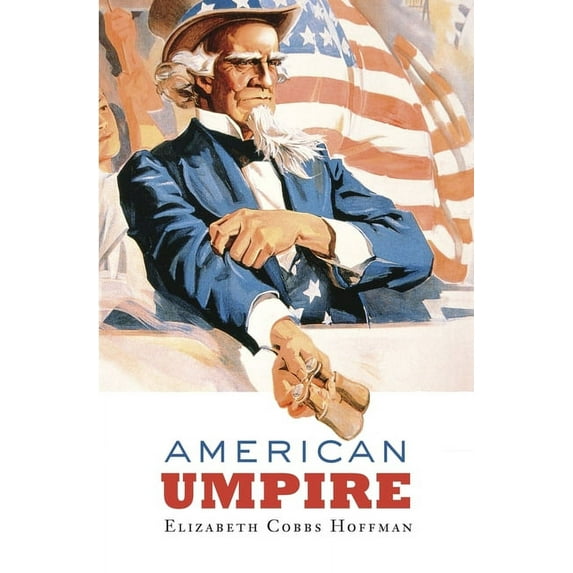
Hero image 0 of American Umpire (Hardcover), 0 of 1
American Umpire (Hardcover)
(No ratings yet)
Key item features
Publishers Weekly,In this bold revision of the history of American foreign policy, Stanford historian Hoffman upends the notion that the U.S. was ever an empire, arguing instead that democratic capitalism, in which the people are sovereign and individuals own and generate wealth, essentially sells (and is selling) itself. She begins her discussion of America as global umpire by exploring the forces that prompted a shift in the 17th and 18th centuries toward an empire-free world order, before moving chronologically through nearly 240 years of American international relations, crises, wars, and resolutions. During that time, Hoffman asserts that the benefits of democratic capitalism (e.g., "access to opportunity, arbitration of disputes, and transparency in government and business") have allowed America, and then the world, to flourish. Yet as the United States' stake in global affairs has grown greater, the country has been impelled to take on the "Burden of Preemptive Intervention," a modus operandi that has defined our global dealings since WWII. Though some might argue that such nomenclature is merely a euphemism for a modern imperialist agenda, Hoffman suggests that having an umpire is usually better than not having one at all, especially when the result is the most "functional" form of government the world has seen-so far. (Mar.) (c) Copyright PWxyz, LLC. All rights reserved.,Publishers Weekly,Publishers Weekly,In this bold revision of the history of American foreign policy, Stanford historian Hoffman upends the notion that the U.S. was ever an empire, arguing instead that democratic capitalism, in which the people are sovereign and individuals own and generate wealth, essentially sells (and is selling) itself. She begins her discussion of America as global umpire by exploring the forces that prompted a shift in the 17th and 18th centuries toward an empire-free world order, before moving chronologically through nearly 240 years of American international relations, crises, wars, and resolutions. During that time, Hoffman asserts that the benefits of democratic capitalism (e.g., "access to opportunity, arbitration of disputes, and transparency in government and business") have allowed America, and then the world, to flourish. Yet as the United States' stake in global affairs has grown greater, the country has been impelled to take on the "Burden of Preemptive Intervention," a modus operandi that has defined our global dealings since WWII. Though some might argue that such nomenclature is merely a euphemism for a modern imperialist agenda, Hoffman suggests that having an umpire is usually better than not having one at all, especially when the result is the most "functional" form of government the world has seen-so far. (Mar.) (c) Copyright PWxyz, LLC. All rights reserved.
Specs
- Book formatHardcover
- Fiction/nonfictionNon-Fiction
- Pages448
- SubgenreHistory
- EditionStandard
- PublisherHarvard University Press
Current price is USD$53.55
Price when purchased online
- Free shipping
 Free 30-day returns
How do you want your item?
Columbus, 43215
Arrives by Tue, Apr 14
|
Sold and shipped by Alibris Books
4.564402148308678 stars out of 5, based on 10613 seller reviews(4.6)10613 seller reviews

Free 30-day returns
Other sellers
$52.62
+ $6.98 shippingShipping, arrives by Tue, Apr 14 to Columbus, 43215
Sold and shipped by Best Prices & Service
Free 30-day returns
About this item
Product details
Commentators frequently call the United States an empire: occasionally a benign empire, sometimes an empire in denial, and often a destructive empire. Elizabeth Cobbs Hoffman asserts instead that, because of its unusual federal structure, America has performed the role of umpire since 1776, compelling adherence to rules that gradually earned collective approval.
This provocative reinterpretation traces America's role in the world from the days of George Washington, Abraham Lincoln, and Franklin D. Roosevelt to the present. Cobbs Hoffman argues that the United States has been the pivot of a transformation that began outside its borders and before its founding, in which nation-states replaced the empires that had dominated history. The "Western" values that America is often accused of imposing were, in fact, the result of this global shift. American Umpire explores the rise of three values--access to opportunity, arbitration of disputes, and transparency in government and business--and finds that the United States is distinctive not in its embrace of these practices but in its willingness to persuade and even coerce others to comply. But America's leadership is problematic as well as potent. The nation has both upheld and violated the rules. Taking sides in explosive disputes imposes significant financial and psychic costs. By definition, umpires cannot win. American Umpire offers a powerful new framework for reassessing the country's role over the past 250 years. Amid urgent questions about future choices, this book asks who, if not the United States, might enforce these new rules of world order?Publishers Weekly,In this bold revision of the history of American foreign policy, Stanford historian Hoffman upends the notion that the U.S. was ever an empire, arguing instead that democratic capitalism, in which the people are sovereign and individuals own and generate wealth, essentially sells (and is selling) itself. She begins her discussion of America as global umpire by exploring the forces that prompted a shift in the 17th and 18th centuries toward an empire-free world order, before moving chronologically through nearly 240 years of American international relations, crises, wars, and resolutions. During that time, Hoffman asserts that the benefits of democratic capitalism (e.g., "access to opportunity, arbitration of disputes, and transparency in government and business") have allowed America, and then the world, to flourish. Yet as the United States' stake in global affairs has grown greater, the country has been impelled to take on the "Burden of Preemptive Intervention," a modus operandi that has defined our global dealings since WWII. Though some might argue that such nomenclature is merely a euphemism for a modern imperialist agenda, Hoffman suggests that having an umpire is usually better than not having one at all, especially when the result is the most "functional" form of government the world has seen-so far. (Mar.) (c) Copyright PWxyz, LLC. All rights reserved.,Publishers Weekly,Publishers Weekly,In this bold revision of the history of American foreign policy, Stanford historian Hoffman upends the notion that the U.S. was ever an empire, arguing instead that democratic capitalism, in which the people are sovereign and individuals own and generate wealth, essentially sells (and is selling) itself. She begins her discussion of America as global umpire by exploring the forces that prompted a shift in the 17th and 18th centuries toward an empire-free world order, before moving chronologically through nearly 240 years of American international relations, crises, wars, and resolutions. During that time, Hoffman asserts that the benefits of democratic capitalism (e.g., "access to opportunity, arbitration of disputes, and transparency in government and business") have allowed America, and then the world, to flourish. Yet as the United States' stake in global affairs has grown greater, the country has been impelled to take on the "Burden of Preemptive Intervention," a modus operandi that has defined our global dealings since WWII. Though some might argue that such nomenclature is merely a euphemism for a modern imperialist agenda, Hoffman suggests that having an umpire is usually better than not having one at all, especially when the result is the most "functional" form of government the world has seen-so far. (Mar.) (c) Copyright PWxyz, LLC. All rights reserved.
info:
We aim to show you accurate product information. Manufacturers, suppliers and others provide what you see here, and we have not verified it.
Specifications
Book format
Hardcover
Fiction/nonfiction
Non-Fiction
Genre
History, Political & Social Sciences
Pages
448
Warranty
Warranty information
Please be aware that the warranty terms on items offered for sale by third party Marketplace sellers may differ from those displayed in this section (if any). To confirm warranty terms on an item offered for sale by a third party Marketplace seller, please use the 'Contact seller' feature on the third party Marketplace seller's information page and request the item's warranty terms prior to purchase.
Warnings
State Chemical Disclosure
No harmful chemicals
Similar items you might like
Based on what customers bought
A Short History of France (Hardcover) $31.95
 $3195current price $31.95
A Short History of France (Hardcover)
The Despatches (Hardcover) $31.95
 $3195current price $31.95
The Despatches (Hardcover)
With Thackeray in America (Hardcover) $31.95
 $3195current price $31.95
With Thackeray in America (Hardcover)
Back to Nature, (Hardcover) $31.95
 $3195current price $31.95
Back to Nature, (Hardcover)
The Herkimers and Schuylers (Hardcover) $31.95
 $3195current price $31.95
The Herkimers and Schuylers (Hardcover)
Life (Hardcover) $31.95
 $3195current price $31.95
Life (Hardcover)
Divine Conduct (Hardcover) $32.94
 $3294current price $32.94
Divine Conduct (Hardcover)
Early Childhood, (Hardcover) $34.99
 $3499current price $34.99
Early Childhood, (Hardcover)
Liber Chronicorum (Hardcover) $31.95
 $3195current price $31.95
Liber Chronicorum (Hardcover)
The Evangelization Of The World In This Generation, (Hardcover) $30.82 Was $35.40
 $3082current price $30.82, Was $35.40$35.40
The Evangelization Of The World In This Generation, (Hardcover)
The History of Montrose (Hardcover) $31.95
 $3195current price $31.95
The History of Montrose (Hardcover)
Frederick the Great (Hardcover) $33.95
 $3395current price $33.95
Frederick the Great (Hardcover)
The world as it is (Paperback) $31.95
 $3195current price $31.95
The world as it is (Paperback)
Government, Conduct, and Example, (Hardcover) $33.95
 $3395current price $33.95
Government, Conduct, and Example, (Hardcover)
Sketches Of Southern Life (Hardcover) $30.10
 $3010current price $30.10
Sketches Of Southern Life (Hardcover)
Lacerda's Journey to Cazembe in 1798, (Hardcover) $33.95
 $3395current price $33.95
Lacerda's Journey to Cazembe in 1798, (Hardcover)
Anatole France (Hardcover) $33.95
 $3395current price $33.95
Anatole France (Hardcover)
The Smoked Yank (Hardcover) $32.95
 $3295current price $32.95
The Smoked Yank (Hardcover)
Cosimo De Medici (Hardcover) $32.95
 $3295current price $32.95
Cosimo De Medici (Hardcover)
The History of Retford (Hardcover) $33.95
 $3395current price $33.95
The History of Retford (Hardcover)
Customer ratings & reviews
0 ratings|0 reviews
This item does not have any reviews yet
