

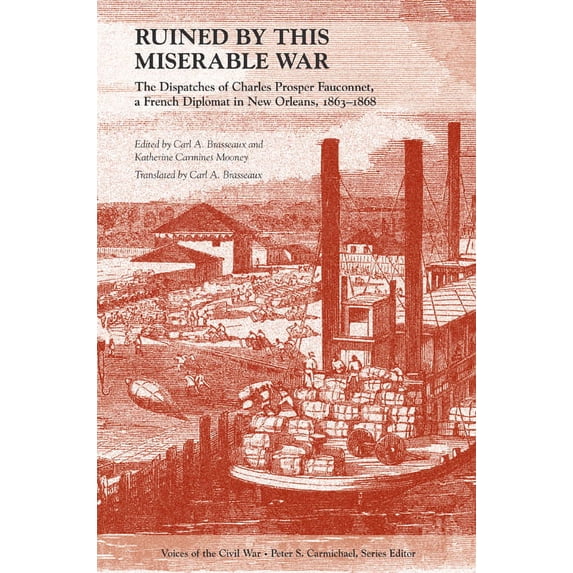
Hero image 0 of Voices of the Civil War: Ruined by This Miserable War : The Dispatches of Charles Prosper Fauconnet, a French Diplomat in New Orleans, 1863–1868 (Hardcover), 0 of 1
Voices of the Civil War: Ruined by This Miserable War : The Dispatches of Charles Prosper Fauconnet, a French Diplomat in New Orleans, 1863–1868 (Hardcover)
(No ratings yet)
Key item features
In March 1863, after Northern general Benjamin F. Butler demanded the recall of the French consul-general, an unabashed Confederate sympathizer, from Union-occupied New Orleans, Charles Prosper Fauconnet assumed the duties of acting consul. A seasoned diplomat who had risen slowly through the ranks in Latin America and the United States, Fauconnet quickly and effectively repaired the rift between local French and American authorities while striving valiantly to safeguard the interests of his government and the French nationals who found themselves literally and figuratively caught in the crossfire.
From 1863 through 1868, Fauconnet maintained a copybook of his official correspondence with the French Ministry of State. These confidential dispatches, collected for the first time in this valuable volume, provide not only a panoramic view of the Civil War and Reconstruction on the Gulf Coast but also new and important information on the transnational aspects of America’s Civil War.
Eager to explain complicated issues to a French government concerned over the fate of one of its former territories, Fauconnet painstakingly laid out what was happening in New Orleans by drawing on war news, newspaper columns, and summaries of speeches and promises of Union commanding officers. His commentary peeled away the layers of contradiction and moral dilemmas that confronted citizens of Southern, Northern, and French heritages during the war years and early postwar period. Among the topics he considered were whether emancipated slaves deserved the same rights as naturalized citizens, the state of the cotton market, and the harassment of French-speaking immigrants by both Union and Confederate authorities. Informative and detailed, Fauconnet’s communications became increasingly acerbic and uneasy as he documented and explained the Civil War to officials in his faraway homeland.
Breathtaking in its geographic scope and topical breadth, thanks in part to the acute observational and reporting skills of its author, Fauconnet’s correspondence offers a unique and thoroughly fascinating francophone perspective on New Orleans during some of the most tumultuous years in U.S. history.
CARL BRASSEAUX is the author of over thirty books related to the French presence in the Gulf Coast, including Refuge for All Ages: Immigration in Louisiana History; French Cajun, Creole, Houma: A Primer on Francophone Louisiana; and Stir the Pot: The History of Cajun Cuisine. Until his recent retirement, he was director of the Center for Louisiana Studies and professor of history at the University of Louisiana at Lafayette.
KATHERINE CARMINES MOONEY, a Ph.D. candidate at Yale University, is a specialist in nineteenth-century history. Her research includes the history of thoroughbred horse-racing culture from 1820 to 1910.
From 1863 through 1868, Fauconnet maintained a copybook of his official correspondence with the French Ministry of State. These confidential dispatches, collected for the first time in this valuable volume, provide not only a panoramic view of the Civil War and Reconstruction on the Gulf Coast but also new and important information on the transnational aspects of America’s Civil War.
Eager to explain complicated issues to a French government concerned over the fate of one of its former territories, Fauconnet painstakingly laid out what was happening in New Orleans by drawing on war news, newspaper columns, and summaries of speeches and promises of Union commanding officers. His commentary peeled away the layers of contradiction and moral dilemmas that confronted citizens of Southern, Northern, and French heritages during the war years and early postwar period. Among the topics he considered were whether emancipated slaves deserved the same rights as naturalized citizens, the state of the cotton market, and the harassment of French-speaking immigrants by both Union and Confederate authorities. Informative and detailed, Fauconnet’s communications became increasingly acerbic and uneasy as he documented and explained the Civil War to officials in his faraway homeland.
Breathtaking in its geographic scope and topical breadth, thanks in part to the acute observational and reporting skills of its author, Fauconnet’s correspondence offers a unique and thoroughly fascinating francophone perspective on New Orleans during some of the most tumultuous years in U.S. history.
CARL BRASSEAUX is the author of over thirty books related to the French presence in the Gulf Coast, including Refuge for All Ages: Immigration in Louisiana History; French Cajun, Creole, Houma: A Primer on Francophone Louisiana; and Stir the Pot: The History of Cajun Cuisine. Until his recent retirement, he was director of the Center for Louisiana Studies and professor of history at the University of Louisiana at Lafayette.
KATHERINE CARMINES MOONEY, a Ph.D. candidate at Yale University, is a specialist in nineteenth-century history. Her research includes the history of thoroughbred horse-racing culture from 1820 to 1910.
Specs
- Book formatHardcover
- Fiction/nonfictionNon-Fiction
- GenreHistory
- Publication dateJanuary, 2013
- Pages272
- Series titleVoices of the Civil War
Current price is USD$44.92
Price when purchased online
Out of stock
How do you want your item?
Out of stock
About this item
Product details
9781572338593. New condition. Hard cover. Language: English. Contains: Unspecified. Voices of the Civil War . Includes unspecified. In March 1863, after Northern general Benjamin F. Butler demanded the recall of the French consul-general, an unabashed Confederate sympathiser, from Union-occupied New Orleans, Charles Prosper Fauconnet assumed the duties of acting consul. A seasoned diplomat who had risen slowly through the ranks in Latin America and the United States, Fauconnet quickly and effectively repaired the rift between local French and American authorities while striving valiantly to safeguard the interests of his government and the French nationals who found themselves literally and figuratively caught in the crossfire. From 1863 through 1868, Fauconnet maintained a copybook of his official correspondence with the French Ministry of State. These confidential dispatches, collected for the first time in this valuable volume, provide not only a panoramic view of the Civil War and Reconstruction on the Gulf Coast but also new and important information on the transnational aspects of America's Civil War. Eager to explain complicated issues to a French government concerned over the fate of one of its former territories, Fauconnet painstakingly laid out what was happening in New Orleans by drawing on war news, newspaper columns, and summaries of speeches and promises of Union commanding officers. His commentary peeled away the layers of contradiction and moral dilemmas that confronted citizens of Southern, Northern, and French heritages during the war years and early postwar period. Among the topics he considered were whether emancipated slaves deserved the same rights as naturalised citizens, the state of the cotton market, and the harassment of French-speaking immigrants by both Union and Confederate authorities. Informative and detailed, Fauconnet's communications became increasingly acerbic and uneasy as he documented and explained the Civil War to officials in his faraway homeland. Breathtaking in its geographic scope and topical breadth, thanks in part to the acute observational and reporting skills of its author, Fauconnet's correspondence offers a unique and thoroughly fascinating francophone perspective on New Orleans during some of the most tumultuous years in U.S. history.
In March 1863, after Northern general Benjamin F. Butler demanded the recall of the French consul-general, an unabashed Confederate sympathizer, from Union-occupied New Orleans, Charles Prosper Fauconnet assumed the duties of acting consul. A seasoned diplomat who had risen slowly through the ranks in Latin America and the United States, Fauconnet quickly and effectively repaired the rift between local French and American authorities while striving valiantly to safeguard the interests of his government and the French nationals who found themselves literally and figuratively caught in the crossfire.
From 1863 through 1868, Fauconnet maintained a copybook of his official correspondence with the French Ministry of State. These confidential dispatches, collected for the first time in this valuable volume, provide not only a panoramic view of the Civil War and Reconstruction on the Gulf Coast but also new and important information on the transnational aspects of America’s Civil War.
Eager to explain complicated issues to a French government concerned over the fate of one of its former territories, Fauconnet painstakingly laid out what was happening in New Orleans by drawing on war news, newspaper columns, and summaries of speeches and promises of Union commanding officers. His commentary peeled away the layers of contradiction and moral dilemmas that confronted citizens of Southern, Northern, and French heritages during the war years and early postwar period. Among the topics he considered were whether emancipated slaves deserved the same rights as naturalized citizens, the state of the cotton market, and the harassment of French-speaking immigrants by both Union and Confederate authorities. Informative and detailed, Fauconnet’s communications became increasingly acerbic and uneasy as he documented and explained the Civil War to officials in his faraway homeland.
Breathtaking in its geographic scope and topical breadth, thanks in part to the acute observational and reporting skills of its author, Fauconnet’s correspondence offers a unique and thoroughly fascinating francophone perspective on New Orleans during some of the most tumultuous years in U.S. history.
CARL BRASSEAUX is the author of over thirty books related to the French presence in the Gulf Coast, including Refuge for All Ages: Immigration in Louisiana History; French Cajun, Creole, Houma: A Primer on Francophone Louisiana; and Stir the Pot: The History of Cajun Cuisine. Until his recent retirement, he was director of the Center for Louisiana Studies and professor of history at the University of Louisiana at Lafayette.
KATHERINE CARMINES MOONEY, a Ph.D. candidate at Yale University, is a specialist in nineteenth-century history. Her research includes the history of thoroughbred horse-racing culture from 1820 to 1910.
From 1863 through 1868, Fauconnet maintained a copybook of his official correspondence with the French Ministry of State. These confidential dispatches, collected for the first time in this valuable volume, provide not only a panoramic view of the Civil War and Reconstruction on the Gulf Coast but also new and important information on the transnational aspects of America’s Civil War.
Eager to explain complicated issues to a French government concerned over the fate of one of its former territories, Fauconnet painstakingly laid out what was happening in New Orleans by drawing on war news, newspaper columns, and summaries of speeches and promises of Union commanding officers. His commentary peeled away the layers of contradiction and moral dilemmas that confronted citizens of Southern, Northern, and French heritages during the war years and early postwar period. Among the topics he considered were whether emancipated slaves deserved the same rights as naturalized citizens, the state of the cotton market, and the harassment of French-speaking immigrants by both Union and Confederate authorities. Informative and detailed, Fauconnet’s communications became increasingly acerbic and uneasy as he documented and explained the Civil War to officials in his faraway homeland.
Breathtaking in its geographic scope and topical breadth, thanks in part to the acute observational and reporting skills of its author, Fauconnet’s correspondence offers a unique and thoroughly fascinating francophone perspective on New Orleans during some of the most tumultuous years in U.S. history.
CARL BRASSEAUX is the author of over thirty books related to the French presence in the Gulf Coast, including Refuge for All Ages: Immigration in Louisiana History; French Cajun, Creole, Houma: A Primer on Francophone Louisiana; and Stir the Pot: The History of Cajun Cuisine. Until his recent retirement, he was director of the Center for Louisiana Studies and professor of history at the University of Louisiana at Lafayette.
KATHERINE CARMINES MOONEY, a Ph.D. candidate at Yale University, is a specialist in nineteenth-century history. Her research includes the history of thoroughbred horse-racing culture from 1820 to 1910.
info:
We aim to show you accurate product information. Manufacturers, suppliers and others provide what you see here, and we have not verified it.
Specifications
Book format
Hardcover
Fiction/nonfiction
Non-Fiction
Genre
History
Publication date
January, 2013
Warranty
Warranty information
Please be aware that the warranty terms on items offered for sale by third party Marketplace sellers may differ from those displayed in this section (if any). To confirm warranty terms on an item offered for sale by a third party Marketplace seller, please use the 'Contact seller' feature on the third party Marketplace seller's information page and request the item's warranty terms prior to purchase.
Customer ratings & reviews
0 ratings|0 reviews
This item does not have any reviews yet

Related pages
- Robert D Patton
- Coming War Russia
- West History
- Lee Patton
- American Battle
- Revolutionary War People
- Imperialism Political Books
- Revolutionary History Books
- Wars & Conflicts Military History Books
- Stuart Era Great Britain History Books
- Persian Gulf War Military History Books
- 20th Century Great Britain History Books