

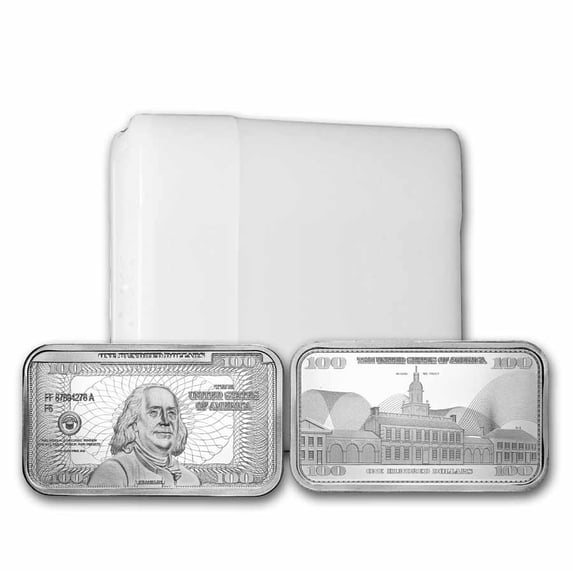
1 oz Silver Bar – Ben Franklin $100 Bill Design - Lot of 20
(No ratings yet)
Key item features
Crafted to resemble the look of a genuine U.S. $100 bill, this silver bar combines artistry with investment value, making it an ideal choice for collectors and silver investors alike.
Product Highlights:- Each bar contains 1 oz of .999 fine Silver for a total of 20 oz.
- This listing is for 20 x 1 oz silver bars.
- Bars are delivered in protective packaging
- Obverse: The well-known image of Benjamin Franklin from the $100 bill, capturing his likeness with intricate detail. Elements such as "United States of America," "100," and other features typical of the banknote design are meticulously engraved, offering a realistic appearance. Also included is the weight and purity.
- Reverse: Features an image of Independence Hall in Philadelphia, Pennsylvania.
History of the $100 Bill
The U.S. $100 bill has a long history dating back to its first issuance in 1862 during the Civil War, as part of a series of paper currency introduced by the U.S. Treasury to fund the war effort. Here's a look at its evolution:
1862 – Original Issue
The original $100 bill, issued in 1862, featured Abraham Lincoln and was part of the "Legal Tender Notes" series.
The reverse side depicted intricate scrollwork and patterns as a basic anti-counterfeiting measure.
Late 19th Century – Silver Certificates and Gold Certificates
By the late 1800s, the $100 bill appeared in Silver Certificates and Gold Certificates versions, backed by physical silver or gold held by the U.S. Treasury.
Gold Certificates (issued from 1865) featured Thomas Hart Benton on the $100 bill.
Silver Certificates later used James Monroe and eventually Benjamin Franklin for the $100 bill.
1929 – Introduction of Small-Size Notes
In 1929, U.S. currency was standardized in size to make it more uniform, and the familiar portrait of Benjamin Franklin was introduced on the $100 bill.
The reverse side featured Independence Hall for the first time, solidifying the imagery we know today.
1969 – Elimination of Larger Denominations
The $500, $1,000, $5,000, and $10,000 bills were discontinued, making the $100 bill the highest denomination in circulation, adding to its prominence in U.S. currency.
1996 – First Major Redesign
In 1996, the $100 bill was redesigned to incorporate advanced anti-counterfeiting features, such as a watermark, color-shifting ink, and a security thread that glowed under ultraviolet light. These features were introduced as part of efforts to combat increasingly sophisticated counterfeiting.
2013 – Current Design
The latest redesign, issued in 2013, retained Benjamin Franklin but added new features for security and accessibility.
New Security Features: The 2013 design includes a 3D blue security ribbon and a color-shifting Liberty Bell in an inkwell, both of which move or change color when tilted.
The large gold "100" on the back of the bill aids those with visual impairments.
Modern Aesthetic: The 2013 version also enhanced the vibrancy of the bill with color accents in blue and gold, while keeping Franklin’s image front and center.
Significance and Global Use
The $100 bill is one of the most widely circulated U.S. currency notes worldwide, valued both for transactions and as a store of value. It is the most widely held U.S. bill outside the United States, where it is often treated as a stable currency in times of economic uncertainty.
The bill’s history reflects not only changing design aesthetics but also evolving security needs and the enduring legacy of Benjamin Franklin as a symbol of American ingenuity and independence.- Bar
- Silver
Specs
- Precious metal formBar
- MaterialSilver
- Metal purity99.9 kt
- Coin typeBullion
- BrandUnbranded
- Metal nameSilver
Current price is USD$1,764.40
Price when purchased online
- Free shipping
How do you want your item?
Ships to
Arrives by Sat, May 23
|
Sold and shipped by APMEX, Inc.
4.646802875520242 stars out of 5, based on 5286 seller reviews(4.6)5286 seller reviews

Not returnable
About this item
Product details
This 1 oz silver bar features a detailed and iconic representation of the $100 bill, showcasing the portrait of Benjamin Franklin in stunning .999 fine silver.
Crafted to resemble the look of a genuine U.S. $100 bill, this silver bar combines artistry with investment value, making it an ideal choice for collectors and silver investors alike.
Product Highlights:- Each bar contains 1 oz of .999 fine Silver for a total of 20 oz.
- This listing is for 20 x 1 oz silver bars.
- Bars are delivered in protective packaging
- Obverse: The well-known image of Benjamin Franklin from the $100 bill, capturing his likeness with intricate detail. Elements such as "United States of America," "100," and other features typical of the banknote design are meticulously engraved, offering a realistic appearance. Also included is the weight and purity.
- Reverse: Features an image of Independence Hall in Philadelphia, Pennsylvania.
History of the $100 Bill
The U.S. $100 bill has a long history dating back to its first issuance in 1862 during the Civil War, as part of a series of paper currency introduced by the U.S. Treasury to fund the war effort. Here's a look at its evolution:
1862 – Original Issue
The original $100 bill, issued in 1862, featured Abraham Lincoln and was part of the "Legal Tender Notes" series.
The reverse side depicted intricate scrollwork and patterns as a basic anti-counterfeiting measure.
Late 19th Century – Silver Certificates and Gold Certificates
By the late 1800s, the $100 bill appeared in Silver Certificates and Gold Certificates versions, backed by physical silver or gold held by the U.S. Treasury.
Gold Certificates (issued from 1865) featured Thomas Hart Benton on the $100 bill.
Silver Certificates later used James Monroe and eventually Benjamin Franklin for the $100 bill.
1929 – Introduction of Small-Size Notes
In 1929, U.S. currency was standardized in size to make it more uniform, and the familiar portrait of Benjamin Franklin was introduced on the $100 bill.
The reverse side featured Independence Hall for the first time, solidifying the imagery we know today.
1969 – Elimination of Larger Denominations
The $500, $1,000, $5,000, and $10,000 bills were discontinued, making the $100 bill the highest denomination in circulation, adding to its prominence in U.S. currency.
1996 – First Major Redesign
In 1996, the $100 bill was redesigned to incorporate advanced anti-counterfeiting features, such as a watermark, color-shifting ink, and a security thread that glowed under ultraviolet light. These features were introduced as part of efforts to combat increasingly sophisticated counterfeiting.
2013 – Current Design
The latest redesign, issued in 2013, retained Benjamin Franklin but added new features for security and accessibility.
New Security Features: The 2013 design includes a 3D blue security ribbon and a color-shifting Liberty Bell in an inkwell, both of which move or change color when tilted.
The large gold "100" on the back of the bill aids those with visual impairments.
Modern Aesthetic: The 2013 version also enhanced the vibrancy of the bill with color accents in blue and gold, while keeping Franklin’s image front and center.
Significance and Global Use
The $100 bill is one of the most widely circulated U.S. currency notes worldwide, valued both for transactions and as a store of value. It is the most widely held U.S. bill outside the United States, where it is often treated as a stable currency in times of economic uncertainty.
The bill’s history reflects not only changing design aesthetics but also evolving security needs and the enduring legacy of Benjamin Franklin as a symbol of American ingenuity and independence.- Bar
- Silver
info:
We aim to show you accurate product information. Manufacturers, suppliers and others provide what you see here, and we have not verified it.
Specifications
Precious metal form
Bar
Material
Silver
Metal purity
99.9 kt
Coin type
Bullion
Warranty
Warranty information
Please be aware that the warranty terms on items offered for sale by third party Marketplace sellers may differ from those displayed in this section (if any). To confirm warranty terms on an item offered for sale by a third party Marketplace seller, please use the 'Contact seller' feature on the third party Marketplace seller's information page and request the item's warranty terms prior to purchase.
Customer ratings & reviews
0 ratings|0 reviews
This item does not have any reviews yet
