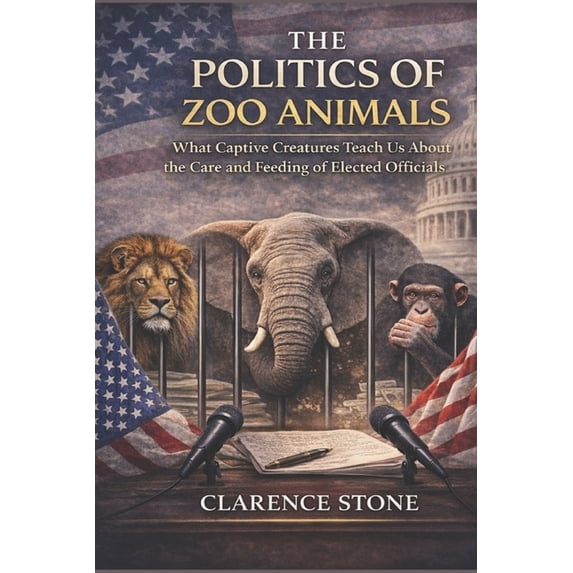
The Politics of Zoo Animals What Captive Creatures Teach Us About the Care and Feeding of Elected Officials --- It started at the Aquarium of the Pacific, where a marine mammal trainer named Darcy was explaining how sea lions are taught to perform complex behaviors through operant conditioning. Clarence Stone was sitting in the audience with his wife and their teenage twins. Susan leaned over and whispered: "You're going to compare the sea lion to a congressman, aren't you." He compared the sea lion to the entire political system. In his most ambitious and provocative book, Stone argues that the behavioral science used to train dolphins, condition chimpanzees, and manage primate hierarchies in zoos provides a more accurate framework for understanding American politics than anything produced by political science departments. Drawing on Skinner's operant conditioning, Brosnan and de Waal's famous capuchin grape-and-cucumber experiments, Seligman's learned helplessness research, and de Waal's chimpanzee coalition studies, Stone maps the behavioral dynamics of captive animal management directly onto the mechanics of campaign finance, lobbying, voter disengagement, and congressional dysfunction. The lobbyist is the clicker trainer. The campaign contribution is the fish. The fundraising call center is the barren concrete exhibit. And the politician is the captive animal whose behavior has been shaped so completely by the enclosure that the politician can no longer imagine a life outside it. "The politicians will not enjoy this comparison. The zoo animals, I suspect, would be indifferent." Welcome to the zoo.