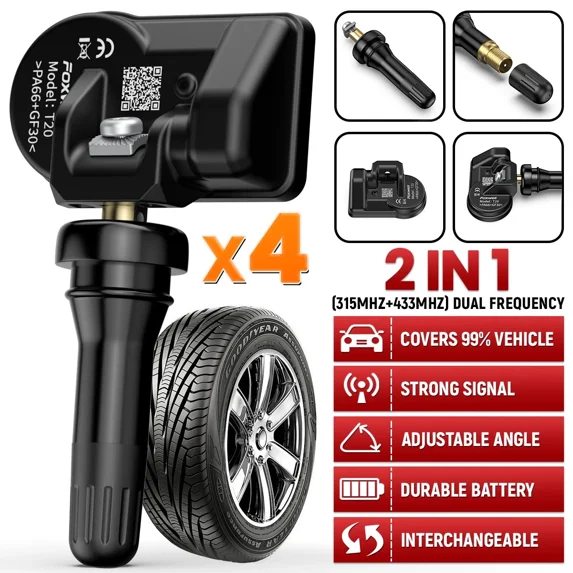
The T20 is a universal pro-gram-mable TPMS sensor developed by Foxwell. It integrates dual frequencies of 315MHz and 433MHz, replacing over 96% of original equipment direct tire pressure monitoring system sensors currently available on the market. When used with the Foxwell TPMS service tool, it can be easily activated and pro-gram-med in seconds.
⚙️Technical data
Battery life: over 5 years
Operating frequency: 315 MHz/433 MHz
Size: 4.62 x 2.78 x 1.77 cm
🔔Features
Real-time recording and monitoring of vehicle tire pressure data, replacing the original tire pressure sensor, solving the problem of the high price of the original sensor and the low model adaptation range, solving the problem of a large number of sensors for auto parts manufacturers and service shops, making all vehicles affordable. High-quality and high-precision tire pressure sensor.
🔔Wireless sensor pro-gram-ming with Foxwell T1000 and T2000
NOTE: The pro-gram does not support TPMS service tools from other brands. You can purchase T1000 and T2000 PRO in my store.
✅Comprehensive insurance for your vehicle
Compatible with more than 99% of vehicles equipped with a tire pressure monitoring system
✅2-in-1 dual frequency
FOXWELL T20 sensors combine dual frequencies (315 MHz + 433 MHz) in one. With 100% original sensor ID cloning, T20 sensors can be replaced directly in the same position without relearning.
💭How is it installed?
1. Deflate the tire
Remove the valve cap and valve insert to deflate the tire.
2. Remove the sensor
Place the tire in the tire pressure testing machine with the TPMS sensor 180° away from the depressurization arm. Break off the tire bead and remove the tire from the tire pressure testing machine. Then remove the TPMS sensor using a suitable tool. (Note: In some cases, the tire must be completely removed from the rim.)
3. Install the sensor (see illustration)
4. Inflate the tire
Remove the valve insert using the valve insert remover. Then inflate the tire to the pressure specified on the tire type label.
Insert the valve insert and screw the valve cap tightly into place.