Staring at waveforms that make no sense? Watching your circuit fail while expensive test equipment sits idle because you don't know how to use it properly?
You're not alone. Thousands of electronics enthusiasts, students, and technicians own oscilloscopes but struggle to move beyond basic voltage measurements. They miss intermittent faults, misinterpret signal problems, and waste hours troubleshooting because they never learned to harness the full power of their most valuable diagnostic tool. Meanwhile, complex circuits remain mysteries, and professional-level electronics work feels frustratingly out of reach.
The gap between owning an oscilloscope and actually using it effectively stops promising projects dead, turns simple repairs into nightmares, and keeps capable people from advancing their electronics skills. You know the oscilloscope holds answers-you just need someone to show you how to extract them.
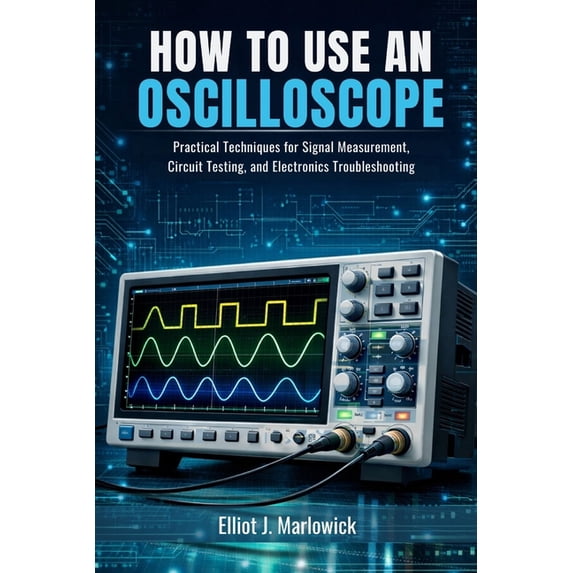
HOW TO USE AN OSCILLOSCOPE: Practical Techniques for Signal Measurement, Circuit Testing, and Electronics Troubleshooting is a comprehensive guide that takes you from fundamental setup through advanced troubleshooting techniques. This book explains not just what buttons to push but why each technique works and when to apply it.
You'll learn essential setup and configuration, including proper probe compensation, input coupling selection, and trigger configuration for capturing clean, stable waveforms. The book covers precision measurement techniques for voltage, frequency, timing, and phase relationships using both manual cursors and automatic measurement functions.
Waveform analysis sections teach you to recognize normal versus abnormal signals, identify different types of distortion and noise, and understand what waveform shapes reveal about circuit operation. Systematic troubleshooting methods provide proven procedures for isolating faults, tracing signals through circuits, and capturing intermittent problems.
Advanced chapters cover FFT analysis for frequency domain measurements, triggering techniques for complex signals, and data logging for long-term monitoring. Safety practices address grounding requirements, voltage ratings, probe selection, and isolation techniques that protect you and your equipment when working with real circuits.
Every chapter builds practical skills through clear explanations, real-world examples, and specific procedures you can apply to debugging power supplies, analyzing audio equipment, testing digital circuits, and learning electronics fundamentals.