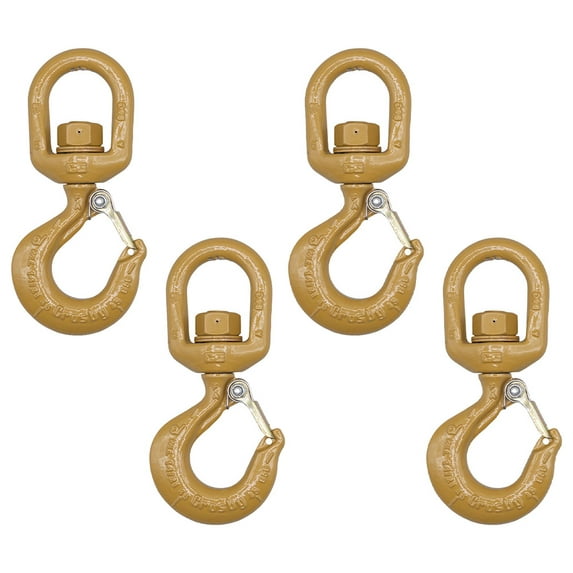
Get this Crosby L-322AN Swivel Hook w/Latch, 1-1/2 Ton WLL, Alloy Steel, Gold - 1048816. This Crosby swivel hook is ideal for lifting, rigging, and securing applications in different industries where load rotation is not necessary. Find in detail about this hook with swivel below:
- Size & Capacity: This Crosby hook with swivel comes with a working load limit of 1-1/2 tons or 3,300 lbs, and a safety factor of 4.5:1. The overall length is 6.71", with a reach (B-B) of 5.37". The inside eye size measures 1.50" wide by 1.31" long, while the throat opening is 0.91". This hook is built for overhead lifting.
- Material & Construction: This 1-1/2-ton swivel hook is forged from quenched and tempered alloy steel, providing strength and durability with a lightweight design. The high-grade Gold finish not only ensures visibility but also provides a corrosion-tolerant surface. Each hook is proof-tested at 2.5x its WLL for safe, long-term use in rigorous applications.
- Flipper Latch: This swivel hook is equipped with a flipper-style latch. This heavy-duty stamped latch interlocks easily with the hook tip and helps to avoid accidental opening. It is long-lasting for frequent and heavy-duty use.
- Application: This Crosby swivel hook excels in lifting operations and is ideal for construction, transportation & logistics, warehouses, and material handling where the load is lifted vertically and does not rotate. It works seamlessly with slings, chains, or wire ropes.
- Standard Compliance: The L-322AN hook features Crosby’s QUIC-CHECK indicators for throat stretch and load angle monitoring, which helps in safer and more accurate lifting. These deformation and angle indicators help ensure compliance with operational tolerances in overhead lifting scenarios.
How to Use It?
- Attach the hook’s eye securely to your lifting rigging hardware or sling assembly.
- Ensure the load is properly seated within the hook’s throat and the latch is closed over the opening.
- Regularly inspect the hook and latch system during use for any signs of wear, deformation, or loosening.
Safety Considerations
- Always use the lifting hook within its rated WLL to avoid overloading.
- Ensure proper alignment and avoid side pulls to maintain structural integrity.
- Inspect for visible damage, wear, or deformation before and after each use.
- Use compatible lifting components with equal or greater load capacity to maintain a safe lifting assembly.




 WARNING: