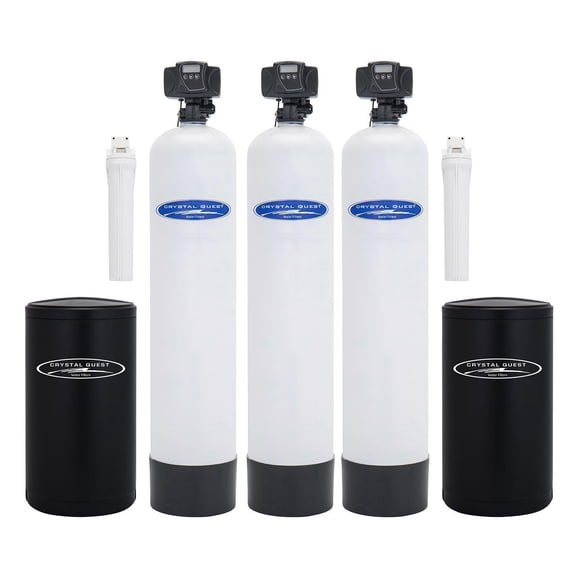
RemoveTannin from Your Drinking Water
Our Tannin Water Filters are self-backwashing systems that automatically remove the tannins within the filter bed and washes them down the drain. This is accomplished with the microprocessor control valve that is mounted on top of the Crystal Quest®Tannin Water Filters. This valve is controlled by a meter that calculates the amount of water being used. Once the meter reaches "X" amount of gallons, it then initiates the backwash cycle that cleans the bed of filtration media and resets it for the next period of filtration. These systems connect to the main line of your home and filters all of the incoming water to it. It requires a nearby power outlet for the control valve. Low maintenance. Just add sodium or potassium pellets to the brine tank.
- Approx. Gallons of water to Regenerate: 40
- Maximum Removal Capacities: 5ppm Tannins and 40 grains hardness
- Maximum Iron and Manganese Levels: Combined Manganese and Iron levels must be below 0.2ppm
Pre-filtration
Water flows through a 20” sediment cartridge that removes sediment, silt, sand, and dirt.
Post-filtration
Water flows through a 20" solid carbon cartridge for removing volatile organic carbon compounds (VOC's), & any remaining insecticides, pesticides and industrial solvents.
Tannin Removal Water Filter
Water flows through atannin-reducing mineral tank.
SMART Water Filter (optional)
Water flows through ourSMART Multimedia,whichincludes 2 types ofcoconut shell Granulated Activated Carbons (Standard&CatalyticGAC) infused with our Eagle Redox Alloys®6500&9500, and ion exchange resin to reduce contaminants such asheavy metals, i.e. lead & mercury, chlorine, chloramine, & inorganic products such as herbicides, pesticides, petroleum/pharmaceutical by-productsand Ceramic and Tourmaline balls to enhance the water and maintain a more alkaline pH.
Water Softener (optional)
Water flows through an ion exchange resin and brine water conditioner.
Media may increase hardness in the waterwhich is why awater softeneris recommended.Water is hard when it contains minerals like calcium and magnesium. You may see staining on your sinks, tubs, showers, and clothing. You may also notice less lather from your shampoos and soaps and even a feeling of film on your skin. All these are symptoms of the need for softened water.Hard water also causes a higher risk of limescale deposits in household water systems. The negative effect of limescale buildup is that pipes are blocked and the efficiency of hot boilers and tanks is reduced. This increases the cost of domestic water heating by about fifteen to twenty percent. Another negative effect of limescale is that it has damaging effects on household machinery, such as laundry machines. Water softening means expanding the lifespan of household machines, and the lifespan of pipelines.