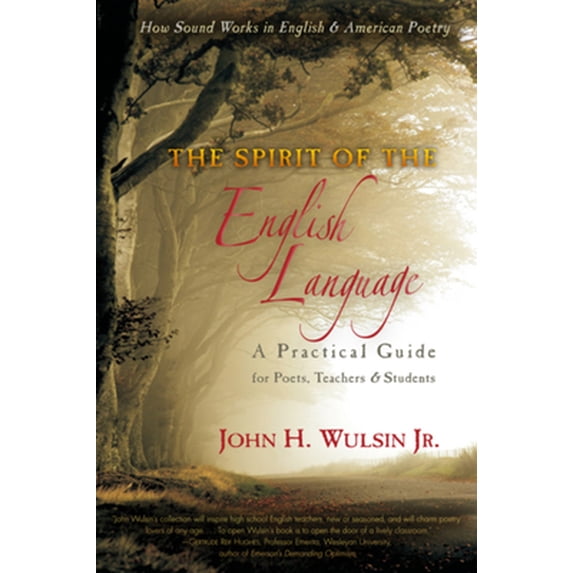
John Wulsin approaches the English language not as a conventional linguist, but as a poet interested in the spirit and evolution of our language. To show "how sound works in English and American poetry," the author traces the many changes, both subtle and radical, in how English has sounded over the past thirteen centuries, while also showing how those changes are related to the evolution of human consciousness in Western, English-speaking peoples.
The Spirit of the English Language is never dry but filled with the textures of the lives and works of the great English-language poets. Wulsin describes the evolving activity of poetry in the biography of each poet, beginning with the Old Anglo-Saxon in Beowulf and the later works of Chaucer, and following the spirit of the English language through to the nineteenth century's "primal/modern" language of Gerard Manley Hopkins and Dickinson's diamond-distilled language. Along the way, we discover how the very sounds of English have changed the ways in which not only poets think and express themselves, but, more important, how sound works and changes our human consciousness. The author also discusses specifically how, in teaching poetics, stages of the developing English language quicken corresponding stages of thinking in maturing adolescents.
Twelve years in the making, The Spirit of the English Language is the fruit of John Wulsin's thirty years of teaching language and literature to adolescents. The book is further informed and fructified by the author's fifteen years of teaching poetics to adults, as well as decades of writing poetry and participating in numerous poetry workshops.
This practical guide will become a classic for all poets, teachers of poetry and language, and students. It is a truly valuable resource for anyone interested in English, its development, its effects on consciousness, and how sound works in poetry.
C O N T E N T S
Introduction
Part I
1 A Language Is Born
2 Old Anglo-Saxon
3 Evolving Language in Evolving Adolescents: Ninth and Tenth Grades
4 The Norman Conquest
5 Chaucer's Middle English
6 The Language Wakes up, Renewed
7 Elizabethan English: Shakespeare
8 Expansion and Contraction: King James Bible
Part II
9 Lyric Activity in Metaphysical Poetry: John Donne
10 The English Epic: Milton
11 The Eighteenth Century and Blake
12 Wordsworth
13 Coleridge
14 Byron
15 Shelley
16 Keats
17 Elizabeth Barrett Browning
18 Robert Browning
19 Tennyson
20 Gerard Manley Hopkins
21 Eleventh Grade (Ages 16-17)
Part III
22 Alteration of the Early American Mind
23 Poetry in American Prose: The Novel
24 Whitman
25 Emily Dickinson
26 Twelfth Grade (Ages 17-18)
27 Contemporary American Speech
28 Speech and Drama in High School
29 Conclusion
Works Cited