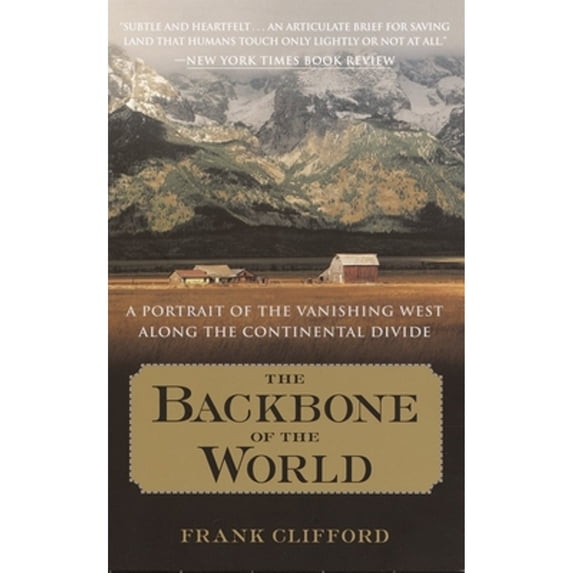
In recent years, Los Angeles Times writer and editor Frank Clifford has journeyed along the Continental Divide, the hemispheric watershed that spans North America from the alkali badlands of southernmost New Mexico to the roof of the Rockies in Montana and into Canada. The result is The Backbone of the World, an arresting exploration of America's longest wilderness corridor, a harsh and unforgiving region inhabited by men and women whose way of life is as imperiled as the neighboring wildlife. With the brutal beauty and stark cadences of a Cormac McCarthy novel, The Backbone of the World tells the story of the last remnants of the Old West, America's mythic landscape, where past and present are barely discernible from one another and where people's lives are still intrinsically linked to their natural surroundings. Clifford vividly captures the challenges of life along the Divide today through portraits of memorable characters: a ranching family whose isolated New Mexico homestead has become a mecca for illegal immigrants and drug smugglers; a sheep herder struggling to make a living tending his flock in the mountains above Vail, Colorado: an old mule packer who has spent years scouring the mountains of northwest Wyoming for the downed plane of his son; a Yellowstone Park ranger on a lone crusade to protect elk and grizzly bears from illegal hunters; and a group of Blackfeet Indians in northern Montana who are fearful that a wilderness sanctuary will be lost to oil and gas development. In each of their stories, the tide of change is looming as environmental, economic, social, and political forces threaten this uniquely unfettered population. Clifford's participatory approach offers a haunting and immediate evocation of character and geography and an unsentimental eulogy to the people whose disappearance will sever a link with the defining American pioneer spirit. Set in a world of isolated ranches, trail camps, mountain bivouacs, and forgotten hamlets, The Backbone of the World highlights the frontier values that have both ennobled and degraded us, values that symbolize the last breath of our founding character.
Publishers Weekly,Somewhere in the middle of America, far from the tourist-welcoming beaches of Los Angeles and buildings of New York, lies a land set back in time. Clifford, the environment editor of the Los Angeles Times, explores that land, the place where nature separates America the Pacific from America the Atlantic, the great wilderness known as the Continental Divide. Clifford seeks to dwell in the Continental Divide, to live and breathe its prejudices and people, to report on a Western way of life forgotten by most of the West. The author writes in stark, unadorned prose a style befitting the ways of life and people he describes. Yet despite his sympathies with the few remaining cowboys and his efforts to help steer cattle or hunt coyotes, he always seems to be left on the outside of the action, a city boy looking in at these rural folk. And this alienation, conveyed in unconventionally barren language, ends up marring the book rather than making it. Despite the abundantly esoteric subject matter, the country folk Clifford encounters remain stereotypes (a token cowboy, an old recluse, rich urbanites looking for adventure), and both his descriptions and his rendering of dialogue do little more than sketch two-dimensional outlines of human existence, a rugged way of life in a wilderness that few know still exists. (May 14) (c) Copyright PWxyz, LLC. All rights reserved