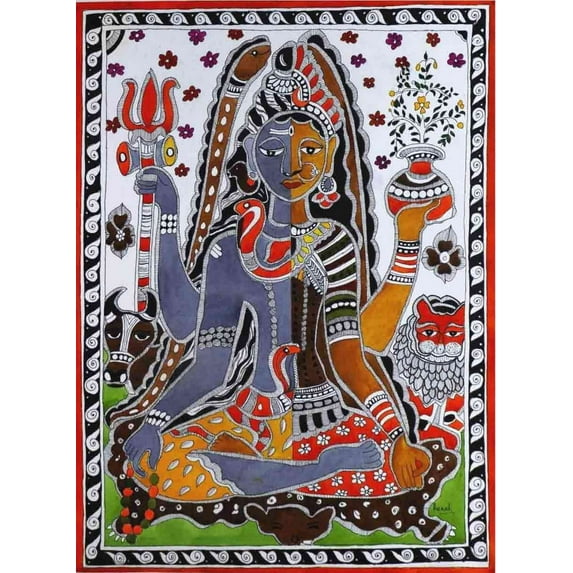
Shiva is one of the principal deities in Hindu mythology. Shiva has pre-Vedic tribal roots, and the figure of Shiva as we know it today is an amalgam of various older non-Vedic versions and Hindu deities, including Rigvedic storm god Rudra, who may have non-Vedic origins into a major deity. Ardhanariswar is a composite form of the Hindu deities Shiva and Parvati. Parvati is the wife of Shiva and is also known as Durga, Devi, Shakti, and Uma. “ARDHANARISWAR” is depicted as half male and half female equally split in the middle. The right half is usually a male illustrating his traditional attributes. It represents the synthesis of masculine and feminine energies of the universe. It demonstrates how Shakti, the female principle of God is inseparable from Shiva, the male principle of God, and vice versa. The union of these two principles is exalted as the root and womb of all creation. The hand-painted version of “ARDHANARISWAR” was done on Imperial size 300gsm (140 lb.) Cold Pressed Arches paper with Watercolour and Ink. This is a Limited edition A2 print version of the Hand-painted version on Gloss paper. This painting is based on the traditional Madhubani style of painting. Madhubani style of painting is also known as Mithila Painting. Mithila was a region that is presently part of Bihar in India and Nepal. The roots of this art form are believed to be during the Ramayana period, which was during the 7th century. This art form was unknown to the outside world until in 1934 an earthquake tumbled the houses of this region and the then British colonial officer in Madhubani stumbled upon the paintings. The myth goes that when Sita was to be married to Rama, the father of Sita, King Janaka, the ruler of Mithila commissioned local artists to paint murals in his palace. Originally, these paintings were done on the walls of Khobar Ghar or the nuptial chamber of newlyweds. The walls were coated with mud and cow dung, and Madhubani paintings were created on them. Like most art forms, Madhubani art took inspiration from nature and Hindu mythological motifs. Usually, the paintings do not leave any space, and the blank spaces are filled with designs of flowers, animals, birds, flowers, plants, or geometric patterns. Bright colours were used and they were sourced from natural ingredients like turmeric, lime, milk of the banyan tree, a red flower named Kusum, sandalwood, rose, rice powder, etc.