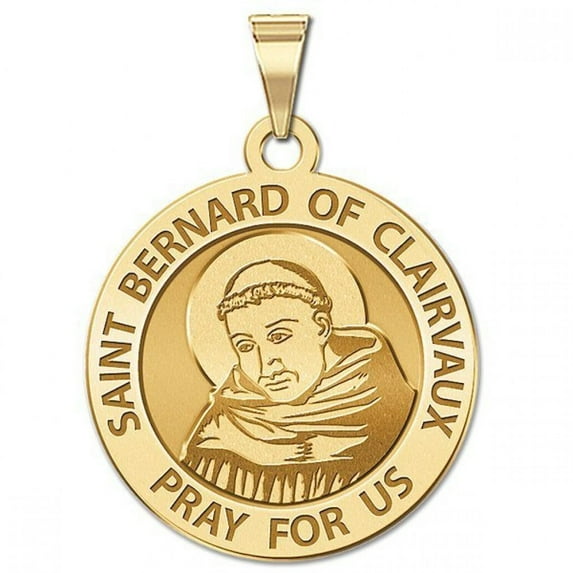
CHAIN IS NOT INCLUDED Available in Solid 10K &14K Yellow or White Gold, or Sterling Silver Size Reference: 17mm is the size of a US dime 19mm is the size of a US nickel 25mm is the size of a US quarter Bernard of Clairvaux (Latin: Bernardus Claraevallensis), O.Cist (1090 August 20, 1153) was a French abbot and the primary builder of the reforming Cistercian order. After the death of his mother, Bernard sought admission into the Cistercian order. "Three years later, he was sent to found a new abbey at an isolated clearing in a glen known as the Val dAbsinthe, about 15 km southeast of Bar-sur-Aube. According to tradition, Bernard founded the monastery on 25 June 1115, naming it Claire Valle, which evolved into Clairvaux. There Bernard would preach an immediate faith, in which the intercessor was the Virgin Mary." In the year 1128, Bernard assisted at the Council of Troyes, at which he traced the outlines of the Rule of the Knights Templar, who soon became the ideal of Christian nobility. On the death of Pope Honorius II on 13 February 1130, a schism broke out in the Church. Louis VI of France convened a national council of the French bishops at tampes in 1130, and Bernard was chosen to judge between the rivals for pope. After the council of tampes, Bernard went to speak with the King of England, Henry I, also known as Henry Beauclerc, about the kings reservations regarding Pope Innocent II. Beauclerc was sceptical because most of the bishops of England supported Anacletus II; Bernard convinced him to support Innocent. Germany had decided to support Innocent through Norbert of Xanten, who was a friend of Bernards. However, Innocent insisted on Bernards company when he met with Lothair III of Germany. Lothair became Innocents strongest ally among the nobility. Despite the councils of tampes, Wurzburg, Clermont, and Rheims all supporting Innocent, there were stil