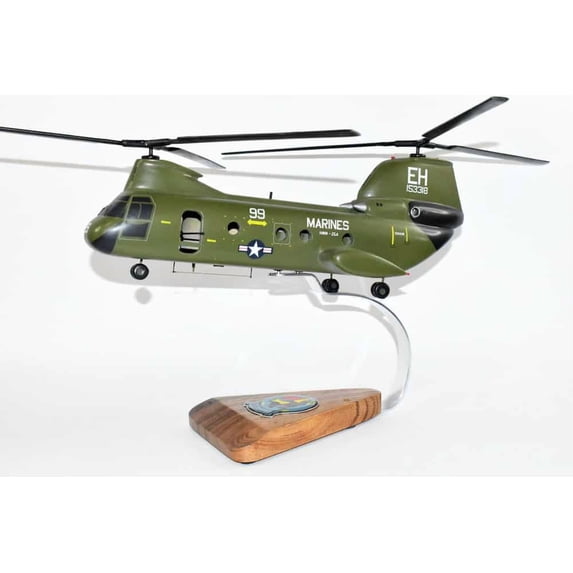
HMM-264 Black Knights CH-46 (1970s) Model Fly with the Black Knights of HMM-264 in this hand crafted CH-46. Each model is carved from wood and hand painted to provide a unique piece that will always be treasured. Length - 14 inches Early years The Black Knights of HMM-264 were activated on June 30, 1959. Originally designated as Marine Medium Transportation Squadron Light 264, it was later re-designated to its present title, Marine Medium Helicopter 264, in February 1962. In the fall of 1961, the squadron was called upon to assist in the evacuation and resupply of victims of Hurricane Hattie, which hit Belize. This tasking was the first mission in a now long-standing tradition of humanitarian service. On April 28, 1965, HMM-264 conducted the Marine Corps' first night all-helicopter assault into an unsecured landing zone during combat conditions in Santa Domingo, Dominican Republic from the deck of the USS BOXER during Operation Power Pack. Between HMM-264 and the LSTs more than 600 civilians were evacuated from the Embajador Hotel.This event marked the first landing of U.S. Marines on Dominican soil since the early 1930s. It was also the first ship-to-shore heliborne lift over a hostile beach without supporting units ashore. Over the course of the operation, the American embassy was secured and over 1,750 American citizens were evacuated from the war-torn Dominican Republic. In May 1965, HMM-264 was the first Marine helicopter squadron to surpass 25,000 mishap free flight hours. Over the next several years, the squadron maintained its demonstrated high standard of professional excellence by logging 30,000, 40,000, and 50,000 mishap free flight hour milestones. In 1968, the squadron retired the last of its aging fleet of UH-34 helicopters, receiving in its place the Boeing-Vertol CH-46 Sea Knight aircraft. The 1970s and 1980s Old HMM-264 insignia. HMM-264 served as part of the Multinational Peacekeeping Force in Beirut, Lebanon in 1983. Amongst other contributions, the squadron rescued a number of Lebanese civilians stranded by snow in the Chauf Mountains, resulting in a number of squadron awards including the Defense Transportation Safety Award, the Marine Corps Expeditionary Medal, the Navy Unit Commendation, and the 1983 Chief of Naval Operations Aviation Safety Award. Throughout the early 1980s, the Black Knights were frequent visitors to the Mediterranean as the Aviation Combat Element (ACE) for deploying east coast Marine Amphibious Units supporting Landing Force Sixth Fleet (LF6F) commitments. During this period, the squadron participated in numerous exercises and contingency operations from Spain to Lebanon. In 1987, HMM-264 became the first ACE to deploy with AV-8B Harriers and elements from the Marine Air Control Group (MACG). Deployed on the USS Nassau (LHA-4), the squadron participated in Spanish, Italian, and French PHILBEXs. These additions to the ACE force list later became the norm for deploying LF6F Marine Expeditionary Units (MEU). The 1990s In January 1990 (some reports say May 1989), upon returning from LF6F 2-90, HMM-264 was tasked to support Operation Top Kick off the coast of Colombia. The squadron provided support throughout this event, which culminated in the Presidential drug summit in Cartagena, Colombia in February 1990. The Black Knights earned a Joint Meritorious Unit Citation for their efforts during the operation. In April 1991, the squadron was diverted from operations in Sardinia and sailed to Iskendrun, Turkey. For 92 days, the Black Knights acted as the lead aviation element for coalition efforts to provide assistance and security to the Kurdish refugees in northern Iraq as part of Operation Provide Comfort. During the first two weeks of Operation Provide Comfort, the Black Knights flew more than 1000 hours delivering more than 450 tons of relief supplies to the isolated Kurdish camps high in the mountains of Iraq. The squadron was awarded the Joint Meritorious Unit Commendation, Humanitarian