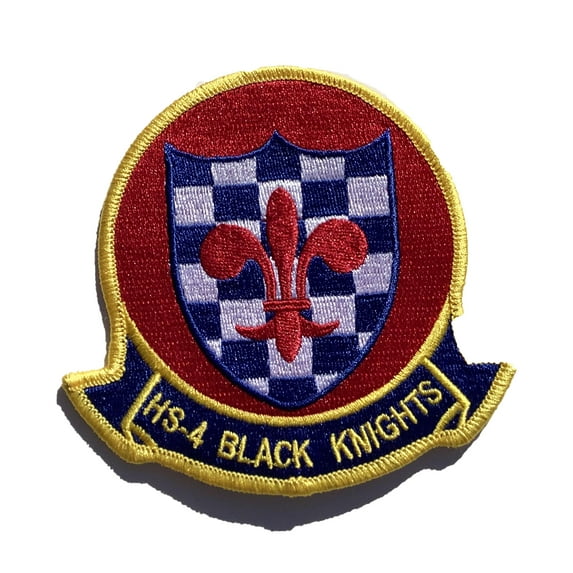
HS-4 Black Knights Squadron Patch – Sew On Aviators! Are you looking for a high-quality patch you'll proudly wear or display? Look no further than the HS-4 Black Knights Patch! 4" patch Embroidered US Naval Aviator Owned Business Sew On Plastic Backing (increases rigidity; the patch lasts longer and stays flat) Helicopter Antisubmarine Squadron FOUR (HS-4) was established on 30 June 1952 aboard Naval Air Station Imperial Beach flying the Sikorsky HO3S-1. It was the first anti-submarine warfare (ASW) helicopter squadron of the U.S. Navy to deploy aboard an aircraft carrier, the escort carrier USS Rendova (CVE-114). In 1954/55 HS-4 was deployed in Essex-class aircraft carrier USS Princeton (CV-37). In 1956 the squadron transitioned to the dipping sonar equipped HSS-1 Seabat vastly improving its antisubmarine capability and deployed aboard USS Boxer (CV-21). This was followed by a cruise aboard Princeton again in 1958. In 1959 the squadron upgraded to the doppler radar and autopilot equipped HSS-1N Seabat helicopter giving it the ability to operate at night and in marginal weather. HS-4 could be identified at that time by the tail code "TA" (1955–1960). In 1961, it became the first ASW squadron in Commander Naval Air Forces Pacific (COMNAVAIRPAC) to achieve around-the-clock ASW capability, earning HS-4 the name "Black Knights". From 1960 to 1968 HS-4 made six deployments aboard USS Yorktown (CV-10) to the Western Pacific as part of Carrier Anti-Submarine Air Group 55 (CVSG-55) (tail code "NU"). In September 1962 the squadron's HSS-1N helicopters were re-designated to the SH-35G Seabat in compliance with the 1962 United States Tri-Service aircraft designation system. In 1964 the squadron converted to the Sikorsky SH-3A Sea King. HS-4 was initiated into combat during its 1966 cruise to Southeast Asia. While operating in the Gulf of Tonkin, HS-4 pilots and aircrew rescued 24 downed airmen under hostile fire, a record for an ASW squadron in a single deployment. In 1968 HS-4 aboard Yorktown was part of the Task Force sent to the Sea of Japan at the beginning of the USS Pueblo incident. 1968–1990 In 1968 the squadron transitioned to the multi-sensor equipped SH-3D Sea King. From 1968 to 1970 HS-4 was assigned to Carrier Anti-Submarine Air Group 59 (CVSG-59) (tail code "NT") aboard USS Hornet (CVS-12). From late 1968 through the spring of 1970, the Black Knights of HS-4 participated in and pioneered techniques for the Apollo capsule recoveries. HS-4 was on scene for Apollo missions 8, 10, 11, 12, and 13. The recovery was always made by "Helicopter 66". The helicopter's side number was changed from "66" to "740" after the Apollo 11 recovery as the U.S. Navy had switched to a three digit aircraft number system - but the helicopter was repainted with the number "66" for each recovery thereafter for public relations reasons. HS-4 earned a Meritorious Unit Commendation (MUC) for these recoveries. For the recovery of Apollo 13 in April 1970, HS-4 was assigned to the Amphibious Assault Ship USS Iwo Jima (LPH-2). In 1971 HS-4 was deployed for the last time in an anti-submarine carrier, USS Ticonderoga (CVS-14). Between 1973 and 1979, HS-4 made three cruises aboard USS Ranger (CV-61) and USS Kitty Hawk (CV-63) as a part of Carrier Air Wing 11 (CVW-11) where they helped to develop the CV concept which integrated the former "Anti-Submarine Air Group" and "Attack Carrier Air Wing" into the new "Carrier Air Wing". They briefly sifted to Carrier Air Wing TWO (CVW-2) for the second cruise but shifted back to CVW-11 afterwards. On 15 October 1976, HS-4’s official homeport changed from NAS Imperial Beach to NAS North Island. In 1977 the squadron's SH-3D helicopters were replaced by the SH-3H Sea King which the squadron would fly for the next decade and a half. HS-4 was then assigned to Carrier Air Wing FIFTEEN (CVW-15) and made one more deployment aboard Kitty Hawk, followed by seven cruises aboard USS Carl Vinson (CVN-70) between 1983 and 1990. HS-