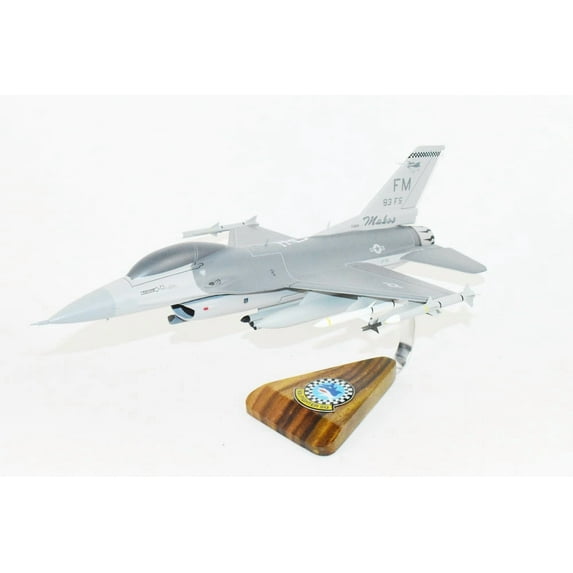
Lockheed Martin® F-16 Fighting Falcon®, 93d Fighter Squadron Fly with the 93d Fighter Squadron in this handcrafted F-16 Fighting Falcon Model. Each piece is carved from wood and handpainted to provide a piece you'll love. Length - 18 inches Made from Mahogany US Veteran Owned Business Official Licensed by Lockheed Martin The product is not intended to be used by children 12 years and younger. LOCKHEED MARTIN, F-16 Fighting Falcon, associated emblems and logos, and body designs of vehicles are either registered trademarks or trademarks of Lockheed Martin Corporation in the USA and/or other jurisdictions, used under license by Squadron Nostalgia LLC. The 93d Fighter Squadron, nicknamed the Makos, is part of the Air Force Reserve Command's 482d Fighter Wing at Homestead Air Reserve Base, Florida. Originally formed in June 1943 as the 93d Troop Carrier Squadron, the squadron participated on the Western Front flying Douglas C-47 Skytrains dropping paratroopers and releasing gliders during Operation Overlord, Operation Market Garden and the Siege of Bastogne before being inactivated in June 1946. The Makos were reactivated as a reserve squadron in June 1949, which they continue to be as of 2019. Between 1949 and 1989, the squadron flew a variety of types such as the Curtiss C-46 Commando, Lockheed F-80 Shooting Star and McDonnell Douglas F-4D Phantom II. Since 1995, the Makos have flown the General Dynamics F-16C/D Fighting Falcon, in which they have conducted air superiority missions over Iraq as part of Operation Northern Watch and Operation Iraqi Freedom. History World War II The squadron was initially activated on 1 June 1943 under I Troop Carrier Command and equipped with Douglas C-47 Skytrains as the 93d Troop Carrier Squadron. It trained in various parts of the eastern United States until the end of 1943 when it was deployed to the United Kingdom and assigned to IX Troop Carrier Command. Prepared for the invasion of Nazi-occupied Europe. Began operations by dropping paratroops of the 101st Airborne Division in Normandy on D-Day (6 June 1944) and releasing gliders with reinforcements on the following day. The unit received a Distinguished Unit Citation and a French citation for these missions. After the Normandy invasion the squadron ferried supplies in the United Kingdom. After moving to France in September, the unit dropped paratroops of the 82nd Airborne Division near Nijmegen and towed gliders carrying reinforcements during the airborne attack on the Netherlands. In December, it participated in the Battle of the Bulge by releasing gliders with supplies for the 101st Airborne Division near Bastogne. When the Allies made the air assault across the Rhine River in March 1945, each aircraft towed two gliders with troops of the 17th Airborne Division and released them near Wesel. The squadron also hauled food, clothing, medicine, gasoline, ordnance equipment, and other supplies to the front lines and evacuated patients to rear zone hospitals. It converted from C-47s to C-46s and the new aircraft to transport displaced persons from Germany to France and Belgium after V-E Day. Returned to the U.S. during the period July–September 1945, and trained with Curtiss C-46 Commando aircraft until inactivated. Air Force Reserve The squadron was reactivated as part of Air Force Reserve Command (AFRC) at Selfridge Air Force Base, Michigan, on 27 June 1949. From here they once again operated the C-46 Commando, training in troop carrier operations up until 3 April 1951. The squadron was reactivated as the 93d Fighter-Bomber Squadron on 15 June 1952, equipped with the North American F-51 Mustang. These were operated for only a year until the unit converted to their first jet – Lockheed F-80 Shooting Star, which was operated up until 1956. Converting to the Republic F-84 Thunderjet, the squadron continued fighter-bomber operations up until 16 November 1957 when they were inactivated. After lying dormant for almost 21 years, the unit was react