

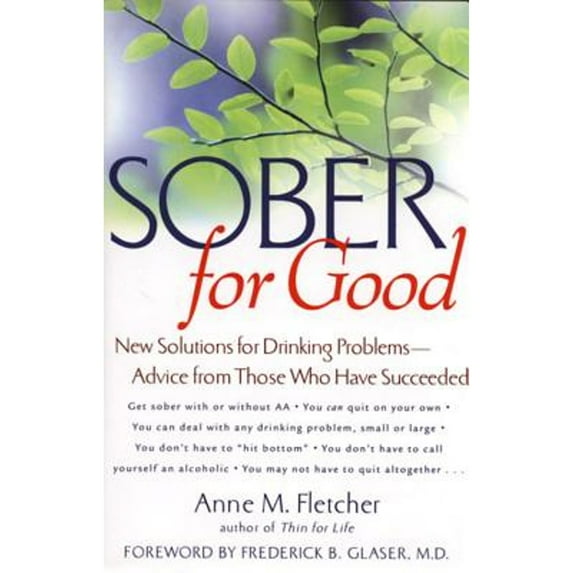
Hero image 0 of Sober for Good : New Solutions for Drinking Problems -- Advice from Those Who Have Succeeded, 0 of 1
Sober for Good : New Solutions for Drinking Problems -- Advice from Those Who Have Succeeded
(No ratings yet)
Key item features
Publishers Weekly,Although Alcoholics Anonymous has long been the preferred (and often court-mandated) regimen for the treatment of alcoholism, its ideology isn't for everyone. As Fletcher (Thin for Life) points out, some people are put off by AA's religious tone, others by the concept of powerlessness over alcohol. And, she says, contrary to AA beliefs, many more never "hit bottom," but nonetheless choose to reconsider their relationship with drinking. Additionally, she suggests, with managed care drastically cutting coverage of inpatient treatment, people with alcohol problems need to know about outpatient alternatives to AA. Fletcher, a health and medical journalist, provides a compendium of such approaches, drawing on the voices of "masters" former problem drinkers who have resolved their problems with alcohol and been sober for at least five years. Programs such as Women for Sobriety, Rational Recovery and Moderation Management provide a variety of approaches, and the "masters" themselves offer a collection of strategies for getting and staying sober with support groups, chemical dependency counselors or a combination of treatments. Unfortunately, Fletcher draws a fuzzy line between "problem drinkers" and "alcoholics," a word she avoids because some find it "pejorative." Maintaining that the distress and dysfunction of most people with drinking problems is not as "severe" as that associated with a stereotypical drunk, she promises that, although AA proponents insist otherwise, "you can quit on your own," "you don't have to quit altogether" and "you don't have to call yourself an alcoholic." Though she sometimes appears to bash AA, Fletcher provides a useful overview of the varieties of recovery programs and practices. (Apr. 17) (c) Copyright PWxyz, LLC. All rights reserved,Publishers Weekly,Publishers Weekly,Although Alcoholics Anonymous has long been the preferred (and often court-mandated) regimen for the treatment of alcoholism, its ideology isn't for everyone. As Fletcher (Thin for Life) points out, some people are put off by AA's religious tone, others by the concept of powerlessness over alcohol. And, she says, contrary to AA beliefs, many more never "hit bottom," but nonetheless choose to reconsider their relationship with drinking. Additionally, she suggests, with managed care drastically cutting coverage of inpatient treatment, people with alcohol problems need to know about outpatient alternatives to AA. Fletcher, a health and medical journalist, provides a compendium of such approaches, drawing on the voices of "masters" former problem drinkers who have resolved their problems with alcohol and been sober for at least five years. Programs such as Women for Sobriety, Rational Recovery and Moderation Management provide a variety of approaches, and the "masters" themselves offer a collection of strategies for getting and staying sober with support groups, chemical dependency counselors or a combination of treatments. Unfortunately, Fletcher draws a fuzzy line between "problem drinkers" and "alcoholics," a word she avoids because some find it "pejorative." Maintaining that the distress and dysfunction of most people with drinking problems is not as "severe" as that associated with a stereotypical drunk, she promises that, although AA proponents insist otherwise, "you can quit on your own," "you don't have to quit altogether" and "you don't have to call yourself an alcoholic." Though she sometimes appears to bash AA, Fletcher provides a useful overview of the varieties of recovery programs and practices. (Apr. 17) (c) Copyright PWxyz, LLC. All rights reserved
Specs
- Book formatHardcover
- Fiction/nonfictionNon-Fiction
- Publication dateApril, 2001
- Pages288
- EditionTCH
- PublisherHoughton Mifflin
Current price is USD$13.56
Price when purchased online
Out of stock
How do you want your item?
Out of stock
About this item
Product details
A bestselling health writer, the acclaimed author of "Thin for Life", presents a groundbreaking reevaluation of problem drinking and the many ways in which people recover. 288 p. Radio drive-time tour.
Publishers Weekly,Although Alcoholics Anonymous has long been the preferred (and often court-mandated) regimen for the treatment of alcoholism, its ideology isn't for everyone. As Fletcher (Thin for Life) points out, some people are put off by AA's religious tone, others by the concept of powerlessness over alcohol. And, she says, contrary to AA beliefs, many more never "hit bottom," but nonetheless choose to reconsider their relationship with drinking. Additionally, she suggests, with managed care drastically cutting coverage of inpatient treatment, people with alcohol problems need to know about outpatient alternatives to AA. Fletcher, a health and medical journalist, provides a compendium of such approaches, drawing on the voices of "masters" former problem drinkers who have resolved their problems with alcohol and been sober for at least five years. Programs such as Women for Sobriety, Rational Recovery and Moderation Management provide a variety of approaches, and the "masters" themselves offer a collection of strategies for getting and staying sober with support groups, chemical dependency counselors or a combination of treatments. Unfortunately, Fletcher draws a fuzzy line between "problem drinkers" and "alcoholics," a word she avoids because some find it "pejorative." Maintaining that the distress and dysfunction of most people with drinking problems is not as "severe" as that associated with a stereotypical drunk, she promises that, although AA proponents insist otherwise, "you can quit on your own," "you don't have to quit altogether" and "you don't have to call yourself an alcoholic." Though she sometimes appears to bash AA, Fletcher provides a useful overview of the varieties of recovery programs and practices. (Apr. 17) (c) Copyright PWxyz, LLC. All rights reserved,Publishers Weekly,Publishers Weekly,Although Alcoholics Anonymous has long been the preferred (and often court-mandated) regimen for the treatment of alcoholism, its ideology isn't for everyone. As Fletcher (Thin for Life) points out, some people are put off by AA's religious tone, others by the concept of powerlessness over alcohol. And, she says, contrary to AA beliefs, many more never "hit bottom," but nonetheless choose to reconsider their relationship with drinking. Additionally, she suggests, with managed care drastically cutting coverage of inpatient treatment, people with alcohol problems need to know about outpatient alternatives to AA. Fletcher, a health and medical journalist, provides a compendium of such approaches, drawing on the voices of "masters" former problem drinkers who have resolved their problems with alcohol and been sober for at least five years. Programs such as Women for Sobriety, Rational Recovery and Moderation Management provide a variety of approaches, and the "masters" themselves offer a collection of strategies for getting and staying sober with support groups, chemical dependency counselors or a combination of treatments. Unfortunately, Fletcher draws a fuzzy line between "problem drinkers" and "alcoholics," a word she avoids because some find it "pejorative." Maintaining that the distress and dysfunction of most people with drinking problems is not as "severe" as that associated with a stereotypical drunk, she promises that, although AA proponents insist otherwise, "you can quit on your own," "you don't have to quit altogether" and "you don't have to call yourself an alcoholic." Though she sometimes appears to bash AA, Fletcher provides a useful overview of the varieties of recovery programs and practices. (Apr. 17) (c) Copyright PWxyz, LLC. All rights reserved
info:
We aim to show you accurate product information. Manufacturers, suppliers and others provide what you see here, and we have not verified it.
Specifications
Book format
Hardcover
Fiction/nonfiction
Non-Fiction
Publication date
April, 2001
Pages
288
Warranty
Warranty information
Please be aware that the warranty terms on items offered for sale by third party Marketplace sellers may differ from those displayed in this section (if any). To confirm warranty terms on an item offered for sale by a third party Marketplace seller, please use the 'Contact seller' feature on the third party Marketplace seller's information page and request the item's warranty terms prior to purchase.
Customer ratings & reviews
0 ratings|0 reviews
This item does not have any reviews yet

Related pages
- Alcohol Effect
- Easy Way Quit Smoking Allen Carr
- Thinking & Drinking
- Morning After Drinking
- Quit Alcohol
- Drink Questions
- Self-Help Books
- Green Lifestyle Self-Help Books
- Tobacco Substance Abuse & Addictions Self-Help Books
- Eating Disorders & Body Image Social Themes Teen & Young Adult Books
- Eating Disorders Psychopathology Books
- Eating Disorders & Body Image Self-Help Books