

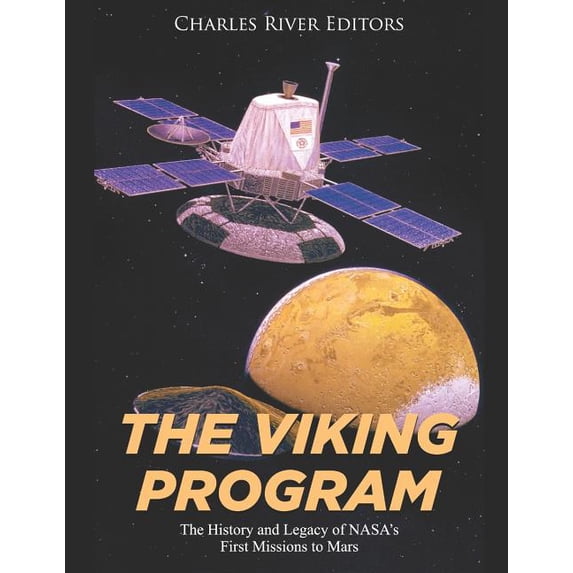
The Viking Program: The History and Legacy of NASA's First Missions to Mars, (Paperback)
(No ratings yet)
Key item features
- The Viking Program: The History and Legacy of NASA's First Missions to Mars, (Paperback)
- Author: Independently Published
- ISBN: 9781077061316
- Format: Paperback
- Publication Date: 2019-06-30
- Page Count: 104
Specs
- Book formatPaperback
- Fiction/nonfictionNon-Fiction
- GenreHistory
- Publication dateJune, 2019
- Pages104
- SubgenreModern
Current price is USD$11.14
Price when purchased online
 Free 90-day returns
How do you want your item?
Try 30 days of Free Shipping with Walmart+! Choose plan at checkout.
Columbus, 43215
Arrives by Wed, Apr 29
Sold and shipped by Walmart.com

Free 90-day returns

This item is gift eligible
More seller options (1)
Starting from $11.65

Get free delivery, shipping and more*
*Restrictions apply Try Walmart+ now
About this item
Product details
*Includes pictures
*Includes a bibliography for further reading
Today the Space Race is widely viewed poignantly and fondly as a race to the Moon that culminated with Apollo 11 "winning" the Race for the United States. In fact, it encompassed a much broader range of competition between the Soviet Union and the United States that affected everything from military technology to successfully launching satellites that could land on Mars or orbit other planets in the Solar System. Moreover, the notion that America "won" the Space Race at the end of the 1960s overlooks just how competitive the Space Race actually was in launching people into orbit, as well as the major contributions the Space Race influenced in leading to today's International Space Station and continued space exploration.
In fact, the Soviet Union had spent much of the 1950s leaving the United States in its dust (and rocket fuel). President Eisenhower and other Americans who could view Soviet rockets in the sky were justifiably worried that Soviet satellites in orbit could soon be spying on them, or, even worse, dropping nuclear bombs on them. And in 1960, when Eisenhower's administration began planning and funding for the famous Apollo program that would land the first men on the Moon in 1969, the Soviet Union was already thinking further ahead, literally. In one of the worst kept secrets of the Space Race, the Soviet Union launched two probes, Korabl 4 and Korabl 5, toward Mars in October 1960.
Even had the Soviet Union managed to keep the probes a secret, it wouldn't have mattered because both probes fell out of the sky before reaching Earth's orbit. The Soviets' rocket systems had failed, which would be a recurring problem for them throughout the 1960s. The race to Mars was off to a rough start, but it had started nonetheless.
Several years before Mariner 9's successful orbiting mission, NASA had begun designing missions for unmanned landings on Mars that would use a spacecraft consisting of an orbiter module and a landing module. The design of the modular spacecraft came from NASA's successful use of a similar spacecraft delivery system for the Apollo program's manned missions to the Moon.
The Viking 1 landing on Mars had originally been scheduled to coincide with the nation's bicentennial on July 4, 1976, but the dual celebration did not work out as planned because the original landing site was found to be unfit due to the number of large boulders that would be able to upend the craft upon landing. By then, Viking 1 had been heading to Mars for nearly a year, and Viking 2 was on its way as well. Viking 1's lander would successfully land on the Red Planet on July 20, 1976. Both Viking landers were huge successes just for landing on Mars and transmitting data, but they would end up exceeding NASA's wildest expectations. NASA hoped the Viking missions would provide better images of Mars' surface and the ability to determine the chemistry and biology of the soil, which might indicate signs of life. The Viking missions ended up providing an extremely comprehensive overview of the Martian surface and atmosphere.
The Viking orbiters successfully orbited around Mars thousands of times, taking thousands of pictures, looking for signs of water in the atmosphere, and thermally mapping the heat on Mars' surface. Most importantly, the orbiters' pictures indicated wide, deep valleys on the surface, which was strong evidence of water. Both orbiters continued to transmit their data and the landers' data for a few years before running out of fuel. The Viking landers were even more successful. Both Viking landers functioned on Mars' surface for several years, successfully analyzing Martian soil,
*Includes a bibliography for further reading
Today the Space Race is widely viewed poignantly and fondly as a race to the Moon that culminated with Apollo 11 "winning" the Race for the United States. In fact, it encompassed a much broader range of competition between the Soviet Union and the United States that affected everything from military technology to successfully launching satellites that could land on Mars or orbit other planets in the Solar System. Moreover, the notion that America "won" the Space Race at the end of the 1960s overlooks just how competitive the Space Race actually was in launching people into orbit, as well as the major contributions the Space Race influenced in leading to today's International Space Station and continued space exploration.
In fact, the Soviet Union had spent much of the 1950s leaving the United States in its dust (and rocket fuel). President Eisenhower and other Americans who could view Soviet rockets in the sky were justifiably worried that Soviet satellites in orbit could soon be spying on them, or, even worse, dropping nuclear bombs on them. And in 1960, when Eisenhower's administration began planning and funding for the famous Apollo program that would land the first men on the Moon in 1969, the Soviet Union was already thinking further ahead, literally. In one of the worst kept secrets of the Space Race, the Soviet Union launched two probes, Korabl 4 and Korabl 5, toward Mars in October 1960.
Even had the Soviet Union managed to keep the probes a secret, it wouldn't have mattered because both probes fell out of the sky before reaching Earth's orbit. The Soviets' rocket systems had failed, which would be a recurring problem for them throughout the 1960s. The race to Mars was off to a rough start, but it had started nonetheless.
Several years before Mariner 9's successful orbiting mission, NASA had begun designing missions for unmanned landings on Mars that would use a spacecraft consisting of an orbiter module and a landing module. The design of the modular spacecraft came from NASA's successful use of a similar spacecraft delivery system for the Apollo program's manned missions to the Moon.
The Viking 1 landing on Mars had originally been scheduled to coincide with the nation's bicentennial on July 4, 1976, but the dual celebration did not work out as planned because the original landing site was found to be unfit due to the number of large boulders that would be able to upend the craft upon landing. By then, Viking 1 had been heading to Mars for nearly a year, and Viking 2 was on its way as well. Viking 1's lander would successfully land on the Red Planet on July 20, 1976. Both Viking landers were huge successes just for landing on Mars and transmitting data, but they would end up exceeding NASA's wildest expectations. NASA hoped the Viking missions would provide better images of Mars' surface and the ability to determine the chemistry and biology of the soil, which might indicate signs of life. The Viking missions ended up providing an extremely comprehensive overview of the Martian surface and atmosphere.
The Viking orbiters successfully orbited around Mars thousands of times, taking thousands of pictures, looking for signs of water in the atmosphere, and thermally mapping the heat on Mars' surface. Most importantly, the orbiters' pictures indicated wide, deep valleys on the surface, which was strong evidence of water. Both orbiters continued to transmit their data and the landers' data for a few years before running out of fuel. The Viking landers were even more successful. Both Viking landers functioned on Mars' surface for several years, successfully analyzing Martian soil,
- The Viking Program: The History and Legacy of NASA's First Missions to Mars, (Paperback)
- Author: Independently Published
- ISBN: 9781077061316
- Format: Paperback
- Publication Date: 2019-06-30
- Page Count: 104
info:
We aim to show you accurate product information. Manufacturers, suppliers and others provide what you see here, and we have not verified it.
Specifications
Book format
Paperback
Fiction/nonfiction
Non-Fiction
Genre
History
Publication date
June, 2019
Warranty
Warranty information
Please be aware that the warranty terms on items offered for sale by third party Marketplace sellers may differ from those displayed in this section (if any). To confirm warranty terms on an item offered for sale by a third party Marketplace seller, please use the 'Contact seller' feature on the third party Marketplace seller's information page and request the item's warranty terms prior to purchase.
Customer ratings & reviews
0 ratings|0 reviews
This item does not have any reviews yet
