

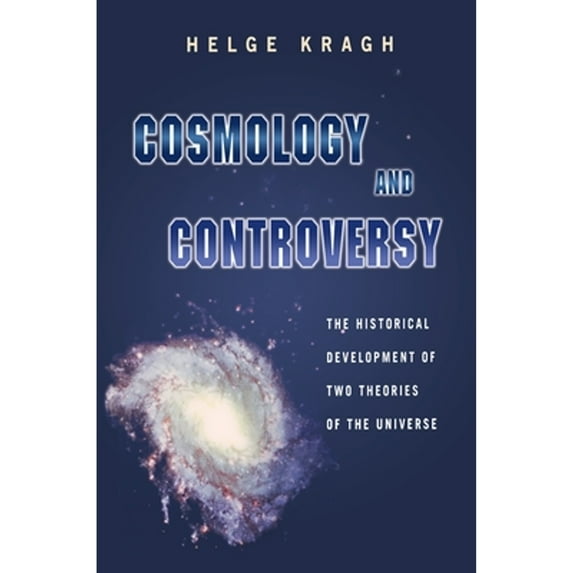
Hero image 0 of Cosmology and Controversy: The Historical Development of Two Theories of the Universe (Hardcover) by Helge Kragh, 0 of 1
Cosmology and Controversy: The Historical Development of Two Theories of the Universe (Hardcover) by Helge Kragh
(No ratings yet)
Key item features
- ISBN: 9780691026237
- Condition: New
- Hard cover
- Language: English
- Pages: 488
- Sewn binding. Cloth over boards. 488 p. Contains: Illustrations.
- For over three millennia, most people could understand the universe only in terms of myth, religion, and philosophy. Between 1920 and 1970, cosmology transformed into a branch of physics. With this remarkably rapid change came a theory that would finally lend empirical support to many long-held beliefs about the origins and development of the entire universe: the theory of the big bang. In this book, Helge Kragh presents the development of scientific cosmology for the first time as a historical event, one that embroiled many famous scientists in a controversy over the very notion of an evolving universe with a beginning in time. In rich detail he examines how the big-bang theory drew inspiration from and eventually triumphed over rival views, mainly the steady-state theory and its concept of a stationary universe of infinite age. In the 1920s, Alexander Friedmann and Georges Lemaitre showed that Einstein's general relativity equations possessed solutions for a universe expanding in time. Kragh follows the story from here, showing how the big-bang theory evolved, from Edwin Hubble's observation that most galaxies are receding from us, to the discovery of the cosmic microwave background radiation. Sir Fred Hoyle proposed instead the steady-state theory, a model of dynamic equilibrium involving the continuous creation of matter throughout the universe. Although today it is generally accepted that the universe started some ten billion years ago in a big bang, any readers may not fully realize that this standard view owed much of its formation to the steady-state theory. By exploring the similarities and tensions between the theories , Kragh provides the reader with indispensable background for understanding much of today's commentary about our universe.
Specs
- Book formatHardcover
- Fiction/nonfictionNon-Fiction
- Publication dateOctober, 1996
- Pages488
- PublisherPrinceton University Press
- Original languagesEnglish
Current price is USD$96.41
Price when purchased online
Out of stock
How do you want your item?
Out of stock
About this item
Product details
9780691026237. New condition. Hard cover. Language: English. Pages: 488. Sewn binding. Cloth over boards. 488 p. Contains: Illustrations. For over three millennia, most people could understand the universe only in terms of myth, religion, and philosophy. Between 1920 and 1970, cosmology transformed into a branch of physics. With this remarkably rapid change came a theory that would finally lend empirical support to many long-held beliefs about the origins and development of the entire universe: the theory of the big bang. In this book, Helge Kragh presents the development of scientific cosmology for the first time as a historical event, one that embroiled many famous scientists in a controversy over the very notion of an evolving universe with a beginning in time. In rich detail he examines how the big-bang theory drew inspiration from and eventually triumphed over rival views, mainly the steady-state theory and its concept of a stationary universe of infinite age. In the 1920s, Alexander Friedmann and Georges Lemaitre showed that Einstein's general relativity equations possessed solutions for a universe expanding in time. Kragh follows the story from here, showing how the big-bang theory evolved, from Edwin Hubble's observation that most galaxies are receding from us, to the discovery of the cosmic microwave background radiation. Sir Fred Hoyle proposed instead the steady-state theory, a model of dynamic equilibrium involving the continuous creation of matter throughout the universe. Although today it is generally accepted that the universe started some ten billion years ago in a big bang, any readers may not fully realize that this standard view owed much of its formation to the steady-state theory. By exploring the similarities and tensions between the theories , Kragh provides the reader with indispensable background for understanding much of today's commentary about our universe.
- ISBN: 9780691026237
- Condition: New
- Hard cover
- Language: English
- Pages: 488
- Sewn binding. Cloth over boards. 488 p. Contains: Illustrations.
- For over three millennia, most people could understand the universe only in terms of myth, religion, and philosophy. Between 1920 and 1970, cosmology transformed into a branch of physics. With this remarkably rapid change came a theory that would finally lend empirical support to many long-held beliefs about the origins and development of the entire universe: the theory of the big bang. In this book, Helge Kragh presents the development of scientific cosmology for the first time as a historical event, one that embroiled many famous scientists in a controversy over the very notion of an evolving universe with a beginning in time. In rich detail he examines how the big-bang theory drew inspiration from and eventually triumphed over rival views, mainly the steady-state theory and its concept of a stationary universe of infinite age. In the 1920s, Alexander Friedmann and Georges Lemaitre showed that Einstein's general relativity equations possessed solutions for a universe expanding in time. Kragh follows the story from here, showing how the big-bang theory evolved, from Edwin Hubble's observation that most galaxies are receding from us, to the discovery of the cosmic microwave background radiation. Sir Fred Hoyle proposed instead the steady-state theory, a model of dynamic equilibrium involving the continuous creation of matter throughout the universe. Although today it is generally accepted that the universe started some ten billion years ago in a big bang, any readers may not fully realize that this standard view owed much of its formation to the steady-state theory. By exploring the similarities and tensions between the theories , Kragh provides the reader with indispensable background for understanding much of today's commentary about our universe.
info:
We aim to show you accurate product information. Manufacturers, suppliers and others provide what you see here, and we have not verified it.
Specifications
Book format
Hardcover
Fiction/nonfiction
Non-Fiction
Publication date
October, 1996
Pages
488
Warranty
Warranty information
Please be aware that the warranty terms on items offered for sale by third party Marketplace sellers may differ from those displayed in this section (if any). To confirm warranty terms on an item offered for sale by a third party Marketplace seller, please use the 'Contact seller' feature on the third party Marketplace seller's information page and request the item's warranty terms prior to purchase.
Customer ratings & reviews
0 ratings|0 reviews
This item does not have any reviews yet

Related pages
- Phenomenology Philosophy Movement Books
- Methodology Philosophy Books
- Best Sellers In Metaphysics
- Intelligent Design Creationism
- Epistemology Philosophy Books
- Metaphysics Philosophy Books
- Deconstruction Philosophy Movement Books
- Edgar Markov
- Freud Philosophy
- Empiricism Philosophy Movement Books
- Professor Of Political Science Bidyut Chakrabarty
- Occultbot Twitter Philosophy Social Aspect Science Books