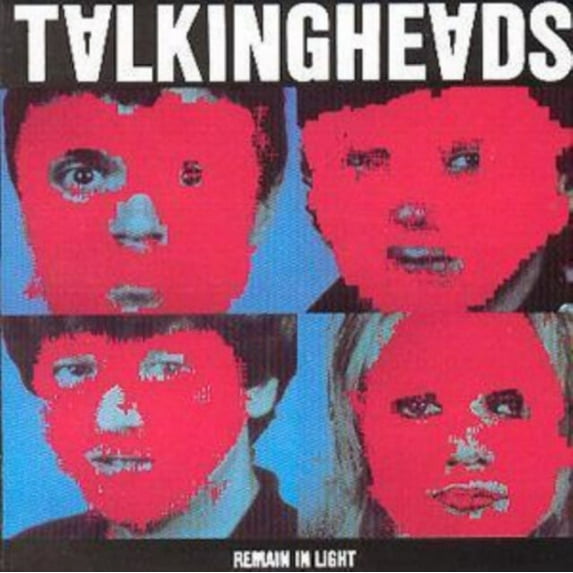
Way back in 1980, the original wave of Talking Heads fans were pleasantly stunned to hear Remain in Light, produced and co-written by Brian Eno, on which Byrne and company are joined by guitar god Adrian Belew, and funk legends Bernie Worrell (keyboards) and Steven Scales (percussion), among others, for a fuller, funkier sound nobody imagined they had in them. The first three songs are long, layered, full-body dance parties, with incessantly repeated phrases (musical and lyrical), and increasingly catchy melodic hooks that won't let go for days. "Once in a Lifetime" was the big hit, but the rockingest track is the third, "The Great Curve," after which the songs get more linear and subdued. It's still great stuff, right through to the especially Eno-like droner, "The Overload," but the second half is maybe better to sleep to than dance to. Which is fine: after the exuberance of the first three songs, you'll need a little nap.
The musical transition that seemed to have just begun with Fear of Music came to fruition on Talking Heads' fourth album, Remain in Light. "I Zimbra" and "Life During Wartime" from the earlier album served as the blueprints for a disc on which the group explored African polyrhythms on a series of driving groove tracks, over which David Byrne chanted and sang his typically disconnected lyrics. Remain in Light had more words than any previous Heads record, but they counted for less than ever in the sweep of the music. The album's single, "Once in a Lifetime," flopped upon release, but over the years it became an audience favorite due to a striking video, its inclusion in the band's 1984 concert film Stop Making Sense, and its second single release (in the live version) because of its use in the 1986 movie Down and Out in Beverly Hills, when it became a minor chart entry. Byrne sounded typically uncomfortable in the verses ("And you may find yourself in a beautiful house, with a beautiful wife/And you may ask yourself, well, how did I get here?"), which were undercut by the reassuring chorus ("Letting the days go by"). Even without a single, Remain in Light was a hit, indicating that Talking Heads were connecting with an audience ready to follow their musical evolution, and the album was so inventive and influential, it was no wonder. As it turned out, however, it marked the end of one aspect of the group's development and was their last new music for three years. ~ William Ruhlmann, Rovi