

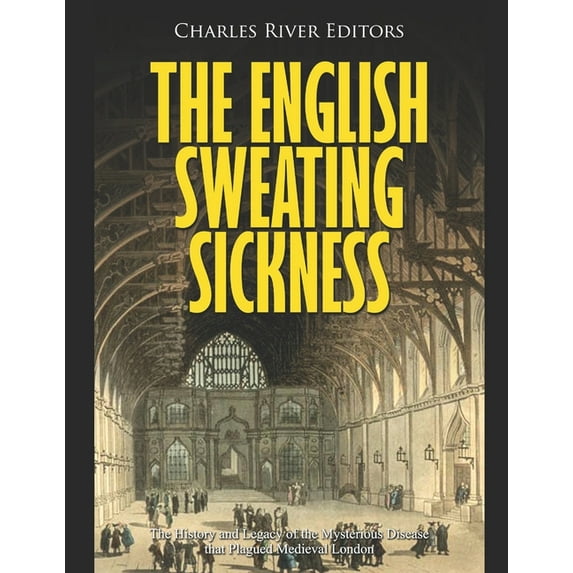
The English Sweating Sickness: The History and Legacy of the Mysterious Disease that Plagued (Paperback) by Charles River
(No ratings yet)
Key item features
- ISBN: 9798655879836
- Condition: New
- Trade paperback
- Language: English
- Pages: 42
- Trade paperback (US). Glued binding. 42 p.
- *Includes pictures
*Includes excerpts of contemporary accounts
*Includes a bibliography for further reading
Plague and pestilence have both fascinated and terrified humanity from the very beginning. Societies and individuals have struggled to make sense of them, and more importantly they've often struggled to avoid them. Before the scientific age, people had no knowledge of the microbiological agents - unseen bacteria and viruses - which afflicted them, and thus the maladies were often ascribed to wrathful supernatural forces. Even when advances in knowledge posited natural causes for epidemics and pandemics, medicine struggled to deal with them, and for hundreds of years religion continued to work hand-in-hand with medicine.
It was only in the mid-19th century that scientists established a definitive link between viruses and bacteria and disease, and this allowed the development of vaccines to prevent the spread of killers such as smallpox, typhus, and diphtheria. In the early 20th century, the development of antibiotics helped immensely, but as the Spanish Flu of 1918 and the recent Coronavirus demonstrated, people have not succeeded in conquering all infectious diseases. In fact, it was not until World War II that most of the pestilences that have afflicted people in the past could be effectively prevented, and the fear of contagion remains strong.
The plague, for all its horrors, became a known quantity that moved through a predictable progression, so by the 15th century, citizens learned to go on with their lives resigned to the fact that these curses seemed inescapable. However, in the mid-15th century, a new "febrile" disease of an entirely unknown cause struck again in Britain in a series of erratically paced and lethal outbreaks between 1485 and 1551. Confined almost entirely to England, the new and unfamiliar wave of illness paled before the statistical destruction caused by the Black Death. However, what came to be known as the "English sweating sickness" reappeared through the decades in a stunning display of unpredictable timing and terrifying symptoms. The anxiety produced by its rapid and grim emergence rivaled that of the previous continental scourge. Surviving the disease offered no defense against reinfection, and what began as mild discomfort in the morning often left a victim dead by nightfall. The new plague's arrival was indeed poorly timed for a country still recovering from the Black Death. To worsen the burden, respiratory diseases already stalked various communities throughout the British Isles, and a syphilis epidemic was widespread. Typhus and malaria were well known to larger Britain. All that the citizens of England knew was that the new peril was different, lacking the rash of typhus or the boils of bubonic plague, cold comfort at best. The new "sweating sickness" was not preying on Britain - only England.
In an uncustomary manner, the sweating sickness chose the aristocracy for its primary target rather than the usual assault on the poor. Worse for the wealthy and ruling class, including the royals, the sweating sickness uncharacteristically infiltrated the ranks of young men aspiring to high places in society and government. In turn, few men and women in their households were spared. The poor suffered as well, but as with the plague, they were mandated to continue their daily regimens in the absence of any alternative. For the well-to-do, the disease struck at the heart of England's existence, personal and economical, with a predilection for those being groomed for state leadership or royal positions. Historically, wealth had enabled the ruling classes to evade the worst of European epidemics, but with the sweating sickness' assault on the highest tiers of the realm, the idea of acceptable losses vanished. Suddenly, no one among the elites was safe, and all efforts would be made to save them.
Specs
- Book formatPaperback
- Fiction/nonfictionNon-Fiction
- GenreHistory
- Publication dateJune, 2020
- Pages40
- SubgenreMedieval
Current price is USD$11.14
Price when purchased online
 Free 90-day returns
How do you want your item?
Try 30 days for just $1! Choose a plan at checkout.
Ships to
Arrives by Thu, May 14
Sold and shipped by Walmart.com

Free 90-day returns

This item is gift eligible
More seller options (2)
Starting from $13.46

Try 30 days of Walmart+ for just $1!
T&C apply. Claim offer now
About this item
Product details
9798655879836. New condition. Trade paperback. Language: English. Pages: 42. Trade paperback (US). Glued binding. 42 p. *Includes pictures
*Includes excerpts of contemporary accounts
*Includes a bibliography for further reading
Plague and pestilence have both fascinated and terrified humanity from the very beginning. Societies and individuals have struggled to make sense of them, and more importantly they've often struggled to avoid them. Before the scientific age, people had no knowledge of the microbiological agents - unseen bacteria and viruses - which afflicted them, and thus the maladies were often ascribed to wrathful supernatural forces. Even when advances in knowledge posited natural causes for epidemics and pandemics, medicine struggled to deal with them, and for hundreds of years religion continued to work hand-in-hand with medicine.
It was only in the mid-19th century that scientists established a definitive link between viruses and bacteria and disease, and this allowed the development of vaccines to prevent the spread of killers such as smallpox, typhus, and diphtheria. In the early 20th century, the development of antibiotics helped immensely, but as the Spanish Flu of 1918 and the recent Coronavirus demonstrated, people have not succeeded in conquering all infectious diseases. In fact, it was not until World War II that most of the pestilences that have afflicted people in the past could be effectively prevented, and the fear of contagion remains strong.
The plague, for all its horrors, became a known quantity that moved through a predictable progression, so by the 15th century, citizens learned to go on with their lives resigned to the fact that these curses seemed inescapable. However, in the mid-15th century, a new "febrile" disease of an entirely unknown cause struck again in Britain in a series of erratically paced and lethal outbreaks between 1485 and 1551. Confined almost entirely to England, the new and unfamiliar wave of illness paled before the statistical destruction caused by the Black Death. However, what came to be known as the "English sweating sickness" reappeared through the decades in a stunning display of unpredictable timing and terrifying symptoms. The anxiety produced by its rapid and grim emergence rivaled that of the previous continental scourge. Surviving the disease offered no defense against reinfection, and what began as mild discomfort in the morning often left a victim dead by nightfall. The new plague's arrival was indeed poorly timed for a country still recovering from the Black Death. To worsen the burden, respiratory diseases already stalked various communities throughout the British Isles, and a syphilis epidemic was widespread. Typhus and malaria were well known to larger Britain. All that the citizens of England knew was that the new peril was different, lacking the rash of typhus or the boils of bubonic plague, cold comfort at best. The new "sweating sickness" was not preying on Britain - only England.
In an uncustomary manner, the sweating sickness chose the aristocracy for its primary target rather than the usual assault on the poor. Worse for the wealthy and ruling class, including the royals, the sweating sickness uncharacteristically infiltrated the ranks of young men aspiring to high places in society and government. In turn, few men and women in their households were spared. The poor suffered as well, but as with the plague, they were mandated to continue their daily regimens in the absence of any alternative. For the well-to-do, the disease struck at the heart of England's existence, personal and economical, with a predilection for those being groomed for state leadership or royal positions. Historically, wealth had enabled the ruling classes to evade the worst of European epidemics, but with the sweating sickness' assault on the highest tiers of the realm, the idea of acceptable losses vanished. Suddenly, no one among the elites was safe, and all efforts would be made to save them.
*Includes excerpts of contemporary accounts
*Includes a bibliography for further reading
Plague and pestilence have both fascinated and terrified humanity from the very beginning. Societies and individuals have struggled to make sense of them, and more importantly they've often struggled to avoid them. Before the scientific age, people had no knowledge of the microbiological agents - unseen bacteria and viruses - which afflicted them, and thus the maladies were often ascribed to wrathful supernatural forces. Even when advances in knowledge posited natural causes for epidemics and pandemics, medicine struggled to deal with them, and for hundreds of years religion continued to work hand-in-hand with medicine.
It was only in the mid-19th century that scientists established a definitive link between viruses and bacteria and disease, and this allowed the development of vaccines to prevent the spread of killers such as smallpox, typhus, and diphtheria. In the early 20th century, the development of antibiotics helped immensely, but as the Spanish Flu of 1918 and the recent Coronavirus demonstrated, people have not succeeded in conquering all infectious diseases. In fact, it was not until World War II that most of the pestilences that have afflicted people in the past could be effectively prevented, and the fear of contagion remains strong.
The plague, for all its horrors, became a known quantity that moved through a predictable progression, so by the 15th century, citizens learned to go on with their lives resigned to the fact that these curses seemed inescapable. However, in the mid-15th century, a new "febrile" disease of an entirely unknown cause struck again in Britain in a series of erratically paced and lethal outbreaks between 1485 and 1551. Confined almost entirely to England, the new and unfamiliar wave of illness paled before the statistical destruction caused by the Black Death. However, what came to be known as the "English sweating sickness" reappeared through the decades in a stunning display of unpredictable timing and terrifying symptoms. The anxiety produced by its rapid and grim emergence rivaled that of the previous continental scourge. Surviving the disease offered no defense against reinfection, and what began as mild discomfort in the morning often left a victim dead by nightfall. The new plague's arrival was indeed poorly timed for a country still recovering from the Black Death. To worsen the burden, respiratory diseases already stalked various communities throughout the British Isles, and a syphilis epidemic was widespread. Typhus and malaria were well known to larger Britain. All that the citizens of England knew was that the new peril was different, lacking the rash of typhus or the boils of bubonic plague, cold comfort at best. The new "sweating sickness" was not preying on Britain - only England.
In an uncustomary manner, the sweating sickness chose the aristocracy for its primary target rather than the usual assault on the poor. Worse for the wealthy and ruling class, including the royals, the sweating sickness uncharacteristically infiltrated the ranks of young men aspiring to high places in society and government. In turn, few men and women in their households were spared. The poor suffered as well, but as with the plague, they were mandated to continue their daily regimens in the absence of any alternative. For the well-to-do, the disease struck at the heart of England's existence, personal and economical, with a predilection for those being groomed for state leadership or royal positions. Historically, wealth had enabled the ruling classes to evade the worst of European epidemics, but with the sweating sickness' assault on the highest tiers of the realm, the idea of acceptable losses vanished. Suddenly, no one among the elites was safe, and all efforts would be made to save them.
- ISBN: 9798655879836
- Condition: New
- Trade paperback
- Language: English
- Pages: 42
- Trade paperback (US). Glued binding. 42 p.
- *Includes pictures
*Includes excerpts of contemporary accounts
*Includes a bibliography for further reading
Plague and pestilence have both fascinated and terrified humanity from the very beginning. Societies and individuals have struggled to make sense of them, and more importantly they've often struggled to avoid them. Before the scientific age, people had no knowledge of the microbiological agents - unseen bacteria and viruses - which afflicted them, and thus the maladies were often ascribed to wrathful supernatural forces. Even when advances in knowledge posited natural causes for epidemics and pandemics, medicine struggled to deal with them, and for hundreds of years religion continued to work hand-in-hand with medicine.
It was only in the mid-19th century that scientists established a definitive link between viruses and bacteria and disease, and this allowed the development of vaccines to prevent the spread of killers such as smallpox, typhus, and diphtheria. In the early 20th century, the development of antibiotics helped immensely, but as the Spanish Flu of 1918 and the recent Coronavirus demonstrated, people have not succeeded in conquering all infectious diseases. In fact, it was not until World War II that most of the pestilences that have afflicted people in the past could be effectively prevented, and the fear of contagion remains strong.
The plague, for all its horrors, became a known quantity that moved through a predictable progression, so by the 15th century, citizens learned to go on with their lives resigned to the fact that these curses seemed inescapable. However, in the mid-15th century, a new "febrile" disease of an entirely unknown cause struck again in Britain in a series of erratically paced and lethal outbreaks between 1485 and 1551. Confined almost entirely to England, the new and unfamiliar wave of illness paled before the statistical destruction caused by the Black Death. However, what came to be known as the "English sweating sickness" reappeared through the decades in a stunning display of unpredictable timing and terrifying symptoms. The anxiety produced by its rapid and grim emergence rivaled that of the previous continental scourge. Surviving the disease offered no defense against reinfection, and what began as mild discomfort in the morning often left a victim dead by nightfall. The new plague's arrival was indeed poorly timed for a country still recovering from the Black Death. To worsen the burden, respiratory diseases already stalked various communities throughout the British Isles, and a syphilis epidemic was widespread. Typhus and malaria were well known to larger Britain. All that the citizens of England knew was that the new peril was different, lacking the rash of typhus or the boils of bubonic plague, cold comfort at best. The new "sweating sickness" was not preying on Britain - only England.
In an uncustomary manner, the sweating sickness chose the aristocracy for its primary target rather than the usual assault on the poor. Worse for the wealthy and ruling class, including the royals, the sweating sickness uncharacteristically infiltrated the ranks of young men aspiring to high places in society and government. In turn, few men and women in their households were spared. The poor suffered as well, but as with the plague, they were mandated to continue their daily regimens in the absence of any alternative. For the well-to-do, the disease struck at the heart of England's existence, personal and economical, with a predilection for those being groomed for state leadership or royal positions. Historically, wealth had enabled the ruling classes to evade the worst of European epidemics, but with the sweating sickness' assault on the highest tiers of the realm, the idea of acceptable losses vanished. Suddenly, no one among the elites was safe, and all efforts would be made to save them.
info:
We aim to show you accurate product information. Manufacturers, suppliers and others provide what you see here, and we have not verified it.
Specifications
Book format
Paperback
Fiction/nonfiction
Non-Fiction
Genre
History
Publication date
June, 2020
Warranty
Warranty information
Please be aware that the warranty terms on items offered for sale by third party Marketplace sellers may differ from those displayed in this section (if any). To confirm warranty terms on an item offered for sale by a third party Marketplace seller, please use the 'Contact seller' feature on the third party Marketplace seller's information page and request the item's warranty terms prior to purchase.
Customer ratings & reviews
0 ratings|0 reviews
This item does not have any reviews yet
