

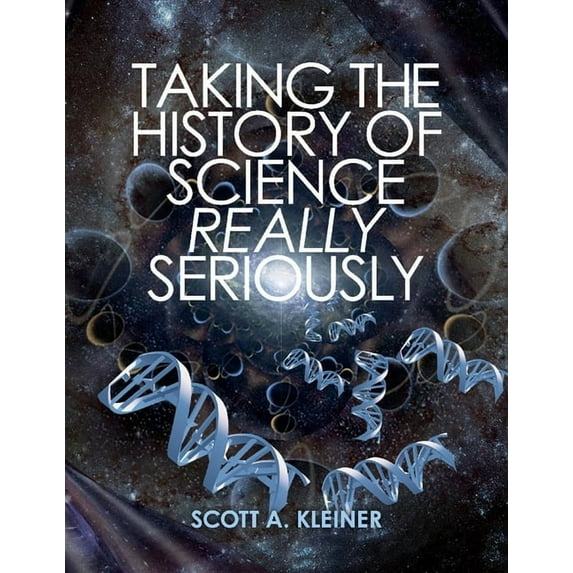
Hero image 0 of Taking the History of Science Really Seriously (Paperback), 0 of 1
Taking the History of Science Really Seriously (Paperback)
(No ratings yet)
Key item features
This book is intended to offer a historical, conceptual and methodological analysis of selected iconic shifts (revolutions) in scientific belief and practice. Part I is a reexamination of The Copernican Revolution in the light of philosophical thinking about the history of science that has emerged in the last 60 years since its publication in 1959 (Kuhn I). The philosophy and historiography drawn from Part I is then sought and compared with that evident in the history of evolutionary inquiries (Part II) and genetics (Part III). Since turning my focus to the Philosophy of Biology in the early 1970's, I have sought studies in its history with the objective of articulating a theory of change and discovery with the guidance of epistemic values realized in inquiries (questioning strategies) in the physical sciences (Kleiner, 1968, 1970).
Particularly evident in the three disciplines here studied are the trade-offs between those willing to sacrifice realism (ontic comprehensiveness) for mathematical fruitfulness (instrumentalism). I was surprised to learn from Rosenberg's Instrumental Biology that there was instrumentalism in biology, because wasn't it obvious that Darwinian histories (Kitcher, 1984) had to be fully realistic to be causally efficacious? in explaining phylogeny? But, of course, R.A. Fisher's fruitful program articulated in articles (1915-1921) and a book in 1930 was instrumental biology. As with Galileo, Kepler and Newton, the pursuit of the goal of enhancing the realism of mathematical models was a driver of discovery as the Copernican Revolution unfolded (Kleiner, 197?), but also as the Darwinian-Mendelian revolutions unfolded. I thus advocate a heuristic and qualified realism, not the unrealizable 'literal' realism brought up in recent philosophical debates (Laudan, 1986)
Newton settles for an ontology that gives progressively epistemically accurate models only up to a point, the point at which empirical resolution is technically limited and, as we now know, causal determinativeness declines into chaos (Randall, 2014). Mendelism and evolutionary theory has a similar escalation of realism and indeterminism from linkage, adding chromosomes to the ontology (late 19th century cytology), to karyotypes and sub-karyotypes, to subpopulations emerging within genetic populations, to cells, developing biological individuals, reproductive and symbiotic groups, genes, their sequences, enzymes and theirs, regulators, enhancers and repressors, major transitions (Michod, 1999), and comparative developmental studies (Raff, 1996).
Mendelian populations were initially studied with single-locus models and were, like the Laplacian Ideal, fully deterministic in their etiology (at least in Fisher's ideal infinite populations). Introducing linkage in computer models of the Mendelian reproductive cycle gives rise to chaos, where small variations of allelic fitnesses produce diverging evolutionary trajectories. The same outcome occurs with the proliferation of small Mendelian isolates, where sampling error generates sampling error and disparity among these isolates.
Particularly evident in the three disciplines here studied are the trade-offs between those willing to sacrifice realism (ontic comprehensiveness) for mathematical fruitfulness (instrumentalism). I was surprised to learn from Rosenberg's Instrumental Biology that there was instrumentalism in biology, because wasn't it obvious that Darwinian histories (Kitcher, 1984) had to be fully realistic to be causally efficacious? in explaining phylogeny? But, of course, R.A. Fisher's fruitful program articulated in articles (1915-1921) and a book in 1930 was instrumental biology. As with Galileo, Kepler and Newton, the pursuit of the goal of enhancing the realism of mathematical models was a driver of discovery as the Copernican Revolution unfolded (Kleiner, 197?), but also as the Darwinian-Mendelian revolutions unfolded. I thus advocate a heuristic and qualified realism, not the unrealizable 'literal' realism brought up in recent philosophical debates (Laudan, 1986)
Newton settles for an ontology that gives progressively epistemically accurate models only up to a point, the point at which empirical resolution is technically limited and, as we now know, causal determinativeness declines into chaos (Randall, 2014). Mendelism and evolutionary theory has a similar escalation of realism and indeterminism from linkage, adding chromosomes to the ontology (late 19th century cytology), to karyotypes and sub-karyotypes, to subpopulations emerging within genetic populations, to cells, developing biological individuals, reproductive and symbiotic groups, genes, their sequences, enzymes and theirs, regulators, enhancers and repressors, major transitions (Michod, 1999), and comparative developmental studies (Raff, 1996).
Mendelian populations were initially studied with single-locus models and were, like the Laplacian Ideal, fully deterministic in their etiology (at least in Fisher's ideal infinite populations). Introducing linkage in computer models of the Mendelian reproductive cycle gives rise to chaos, where small variations of allelic fitnesses produce diverging evolutionary trajectories. The same outcome occurs with the proliferation of small Mendelian isolates, where sampling error generates sampling error and disparity among these isolates.
Specs
- Book formatPaperback
- Fiction/nonfictionNon-Fiction
- GenreNonfiction
- Publication dateNovember, 2020
- Pages284
- Reading levelGeneral (US: Trade)
Current price is USD$29.90
Price when purchased online
Out of stock
How do you want your item?
Out of stock
About this item
Product details
The scientific revolution is a many-faceted realization of Kuhn's phylogenic tree (1962), whose trunk is ancient astronomy with ramifications into terrestrial physics (Galileo, Descartes. Huygens, Newton) and biology and medicine (Aristotle, Galen, Vesalius, Harvey, Descartes, Steno, Linnaeus, Darwin, Fisher,Morgan, Mayr, Rapp).
'Revolutions' of the sort documented in Kuhn's Structure (1962) are pervasive in the history of science, both physical and biological. Some of these are analyzed in this book , but continuity within a tradtion is sought. As Kuhn argues in The Copernican Revolution (1959), scientific change is gradual with overlapping concepts and ideals, so discovery can be the rational pursuit of an ideal recognized as yet unfulflled.
'Revolutions' of the sort documented in Kuhn's Structure (1962) are pervasive in the history of science, both physical and biological. Some of these are analyzed in this book , but continuity within a tradtion is sought. As Kuhn argues in The Copernican Revolution (1959), scientific change is gradual with overlapping concepts and ideals, so discovery can be the rational pursuit of an ideal recognized as yet unfulflled.
This book is intended to offer a historical, conceptual and methodological analysis of selected iconic shifts (revolutions) in scientific belief and practice. Part I is a reexamination of The Copernican Revolution in the light of philosophical thinking about the history of science that has emerged in the last 60 years since its publication in 1959 (Kuhn I). The philosophy and historiography drawn from Part I is then sought and compared with that evident in the history of evolutionary inquiries (Part II) and genetics (Part III). Since turning my focus to the Philosophy of Biology in the early 1970's, I have sought studies in its history with the objective of articulating a theory of change and discovery with the guidance of epistemic values realized in inquiries (questioning strategies) in the physical sciences (Kleiner, 1968, 1970).
Particularly evident in the three disciplines here studied are the trade-offs between those willing to sacrifice realism (ontic comprehensiveness) for mathematical fruitfulness (instrumentalism). I was surprised to learn from Rosenberg's Instrumental Biology that there was instrumentalism in biology, because wasn't it obvious that Darwinian histories (Kitcher, 1984) had to be fully realistic to be causally efficacious? in explaining phylogeny? But, of course, R.A. Fisher's fruitful program articulated in articles (1915-1921) and a book in 1930 was instrumental biology. As with Galileo, Kepler and Newton, the pursuit of the goal of enhancing the realism of mathematical models was a driver of discovery as the Copernican Revolution unfolded (Kleiner, 197?), but also as the Darwinian-Mendelian revolutions unfolded. I thus advocate a heuristic and qualified realism, not the unrealizable 'literal' realism brought up in recent philosophical debates (Laudan, 1986)
Newton settles for an ontology that gives progressively epistemically accurate models only up to a point, the point at which empirical resolution is technically limited and, as we now know, causal determinativeness declines into chaos (Randall, 2014). Mendelism and evolutionary theory has a similar escalation of realism and indeterminism from linkage, adding chromosomes to the ontology (late 19th century cytology), to karyotypes and sub-karyotypes, to subpopulations emerging within genetic populations, to cells, developing biological individuals, reproductive and symbiotic groups, genes, their sequences, enzymes and theirs, regulators, enhancers and repressors, major transitions (Michod, 1999), and comparative developmental studies (Raff, 1996).
Mendelian populations were initially studied with single-locus models and were, like the Laplacian Ideal, fully deterministic in their etiology (at least in Fisher's ideal infinite populations). Introducing linkage in computer models of the Mendelian reproductive cycle gives rise to chaos, where small variations of allelic fitnesses produce diverging evolutionary trajectories. The same outcome occurs with the proliferation of small Mendelian isolates, where sampling error generates sampling error and disparity among these isolates.
Particularly evident in the three disciplines here studied are the trade-offs between those willing to sacrifice realism (ontic comprehensiveness) for mathematical fruitfulness (instrumentalism). I was surprised to learn from Rosenberg's Instrumental Biology that there was instrumentalism in biology, because wasn't it obvious that Darwinian histories (Kitcher, 1984) had to be fully realistic to be causally efficacious? in explaining phylogeny? But, of course, R.A. Fisher's fruitful program articulated in articles (1915-1921) and a book in 1930 was instrumental biology. As with Galileo, Kepler and Newton, the pursuit of the goal of enhancing the realism of mathematical models was a driver of discovery as the Copernican Revolution unfolded (Kleiner, 197?), but also as the Darwinian-Mendelian revolutions unfolded. I thus advocate a heuristic and qualified realism, not the unrealizable 'literal' realism brought up in recent philosophical debates (Laudan, 1986)
Newton settles for an ontology that gives progressively epistemically accurate models only up to a point, the point at which empirical resolution is technically limited and, as we now know, causal determinativeness declines into chaos (Randall, 2014). Mendelism and evolutionary theory has a similar escalation of realism and indeterminism from linkage, adding chromosomes to the ontology (late 19th century cytology), to karyotypes and sub-karyotypes, to subpopulations emerging within genetic populations, to cells, developing biological individuals, reproductive and symbiotic groups, genes, their sequences, enzymes and theirs, regulators, enhancers and repressors, major transitions (Michod, 1999), and comparative developmental studies (Raff, 1996).
Mendelian populations were initially studied with single-locus models and were, like the Laplacian Ideal, fully deterministic in their etiology (at least in Fisher's ideal infinite populations). Introducing linkage in computer models of the Mendelian reproductive cycle gives rise to chaos, where small variations of allelic fitnesses produce diverging evolutionary trajectories. The same outcome occurs with the proliferation of small Mendelian isolates, where sampling error generates sampling error and disparity among these isolates.
info:
We aim to show you accurate product information. Manufacturers, suppliers and others provide what you see here, and we have not verified it.
Specifications
Book format
Paperback
Fiction/nonfiction
Non-Fiction
Genre
Nonfiction
Publication date
November, 2020
Warranty
Warranty information
Please be aware that the warranty terms on items offered for sale by third party Marketplace sellers may differ from those displayed in this section (if any). To confirm warranty terms on an item offered for sale by a third party Marketplace seller, please use the 'Contact seller' feature on the third party Marketplace seller's information page and request the item's warranty terms prior to purchase.
Similar items you might like
Based on what customers bought
Science of Being Rich, (Paperback) $8.99
 $899current price $8.99
Science of Being Rich, (Paperback)
Autopoesis, (Paperback) $34.43
 $3443current price $34.43
Autopoesis, (Paperback)
Symboles de la Science sacrée, (Paperback) $30.26
 $3026current price $30.26
Symboles de la Science sacrée, (Paperback)
The Science Of Being Well, (Paperback) $18.72
 $1872current price $18.72
The Science Of Being Well, (Paperback)
The Science of Being Great, (Paperback) $7.99
 $799current price $7.99
The Science of Being Great, (Paperback)
Sciences: Le Cresson (Paperback) $16.95
 $1695current price $16.95
Sciences: Le Cresson (Paperback)
The Art Of The SlowFlip, (Paperback) $17.59 Was $19.95
 $1759current price $17.59, Was $19.95$19.95
The Art Of The SlowFlip, (Paperback)
Science of Being Well, (Paperback) $7.99
 $799current price $7.99
Science of Being Well, (Paperback)
The Writing of American History, (Paperback) $23.37 Was $26.95
 $2337current price $23.37, Was $26.95$26.95
The Writing of American History, (Paperback)
Safranbolu Through History, (Paperback) $22.51
 $2251current price $22.51
Safranbolu Through History, (Paperback)
The Pickleball Effect, (Paperback) $8.67
 $867current price $8.67
The Pickleball Effect, (Paperback)
Best seller The Coworker (Paperback) $9.46
Best seller $946current price $9.46
The Coworker (Paperback)
3354.8 out of 5 Stars. 335 reviewsEthnosociology Ethnos and Society, Book 2, (Paperback) $24.50
 $2450current price $24.50
Ethnosociology Ethnos and Society, Book 2, (Paperback)
Sciences: Éléments de Botanique. 2e Édition (Paperback) $19.70
 $1970current price $19.70
Sciences: Éléments de Botanique. 2e Édition (Paperback)
The Life Of Science (Paperback) $20.95
 $2095current price $20.95
The Life Of Science (Paperback)
Discover Yourself: Understand Who You Are, What You Do Well, and What You Are Passionate About, (Paperback) $14.99
 $1499current price $14.99
Discover Yourself: Understand Who You Are, What You Do Well, and What You Are Passionate About, (Paperback)
Science of Getting Rich, (Paperback) $14.76
 $1476current price $14.76
Science of Getting Rich, (Paperback)
General Science, (Paperback) $21.99
 $2199current price $21.99
General Science, (Paperback)
Sciences: Les Greffes Uretérales (Paperback) $26.05
 $2605current price $26.05
Sciences: Les Greffes Uretérales (Paperback)
Customer ratings & reviews
0 ratings|0 reviews
This item does not have any reviews yet

Related pages
- History Timeline Event
- Distinguished Research Professor Peter Charles Hoffer
- Essay History Books
- Empire Learning
- Study & Teaching History Books
- Professor Of History Eric Foner
- For The Republic
- Babylon Map
- Social History Books
- Global Warming & Climate Change Science Books
- Historical Geography Books
- Geopolitics Books