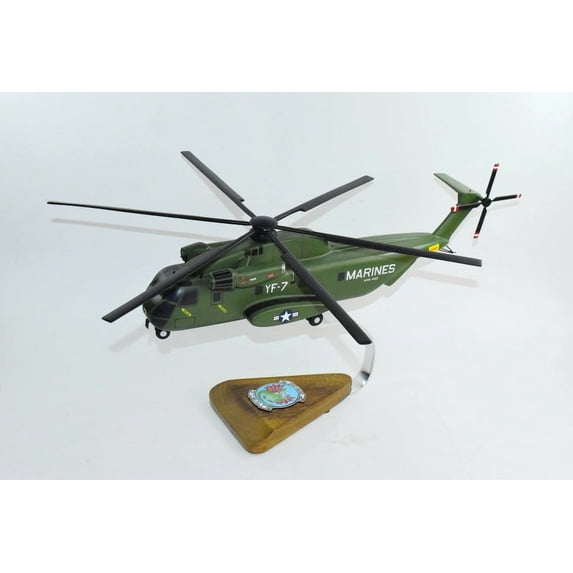
Sikorsky® CH-53D SEA STALLION™, HMH-462 Heavy Haulers (1970 YF-7) Fly with the Heavy Haulers of HMH-462 in this handcrafted CH-53D model. Each model is carved from wood and hand painted to provide a piece you'll love. Length - 16 inches Made from Mahogany US Veteran-Owned Business Officially Licensed by Sikorsky The product is not intended to be used by children 12 years and younger. Sikorsky®, SEA STALLION™, associated emblems and logos, and body designs of vehicles are either registered trademarks or trademarks of Sikorsky Aircraft Corporation in the USA and/or other jurisdictions, used under license by Squadron Nostalgia LLC. Marine Fighting Squadron 462 (VMF-462) was activated Marine Corps Air Station El Centro, California on April 15, 1944. On October 10, 1944 the squadron absorbed personnel and equipment from VMF-481 and they were redesignated a fighter pilot replacement training unit. The unit flew the Vought F4U-1 Corsair during this time. Shortly thereafter they transferred to Marine Corps Air Station El Toro, California and remained there until the end of the war. The squadron was quickly deactivated after the war's end on September 10, 1945.[1] 1950s and early 1960s[edit] A HMH-462 CH-37C with an UH-34D from HMM-363 near MCAS Tustin, 1964. On November 1, 1957, 462 was reactivated at Marine Corps Air Facility Santa Ana, California as Marine Helicopter Transport Squadron (Medium) 462 HMR(M)-462. In March 1958 the squadron received the Sikorsky HR2S-1(CH-37 Mojave), known as the "Deuce." In July 1958 the squadron participated in NASA’s abort recovery tests of the Mercury space capsule in the Salton Sea. During July 1959 HMR(M)-462 worked with the United States Army in El Paso, Texas to conduct the initial aerial transport tests of the Hawk missile system. One year later, the squadron worked with Convair Astronautics Corporation in San Diego to help construct Atlas missile silos. Also during 1960, HMR(M)-462 joined with the Federal Aviation Administration, Sikorsky Aircraft, the U.S. Army, New York Airways and British technical representatives of the Decca Corporation to establish Instrument Flight Procedures for helicopters. In June 1965 the squadron was once again decommissioned and placed in a cadre status as the Marine Corps awaited the arrival of the CH-53A "Sea Stallion." Vietnam War[edit] CH-53 from HMH-462 atop a mountain side base in Vietnam, in 1968. In August 1968, the "Heavy Haulers" deployed to the Republic of Vietnam for combat operations. Assigned to Marine Aircraft Group 36 at Phu Bai, the squadron was tasked with the tactical retrieval of downed aircraft and heavy equipment during Operation End Sweep. In March 1971, HMH-462 was transferred to Okinawa to provide support to Marine forces in Japan. In 1975 HMH-462, still stationed in Okinawa, was assigned to the 9th MAB and 31st Marine Expeditionary Unit. On 12 April 1975 the "Heavy Haulers" operating from USS Okinawa (LPH-3), participated in Operation Eagle Pull, the evacuation of Phnom Penh. Seventeen days later from 29–30 April, HMH-462 participated in Operation Frequent Wind, the evacuation of Saigon.[2] Shortly thereafter, the squadron was embarked upon the USS Hancock (CV-19) and sailed back towards Cambodia to participate in the rescue operation of the SS Mayaguez. The Mayaguez rescue was completed before the Hancock arrived on station and the Hancock returned to Subic Bay. Post Vietnam and the 1990s[edit] After nearly ten years of continuous overseas service, HMH-462 was relocated to Marine Corps Air Station Tustin, California and assigned to Marine Aircraft Group 16. They also participated in the Unit Deployment Program to MCAS Futenma, Okinawa, In December 1989, a squadron detachment was assigned to participate in coup contingency operations in the Republic of the Philippines as part of Marine Aircraft Group 90. In August 1990, the "Heavy Haulers" were assigned to Marine Aircraft Group 70 and deployed to Jubail, Saudi Arabia as part transpor