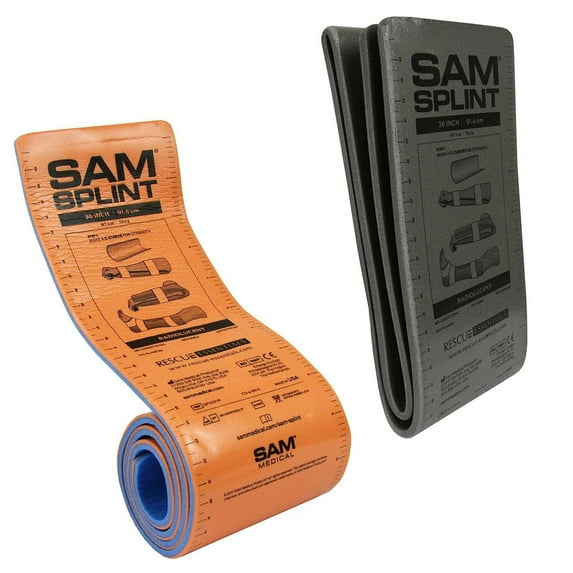
36" SAM Splint
The Original SAM® Splint is available in orange/blue or gray, in either rolled or flat-folded packaging. A veterinary model is also available with vet applications depicted. Also check out our combo packs for even more outstanding value!
Splints are sold individually.
Trusted by medics and first responders worldwide, the SAM® Splint is a compact, versatile solution for immobilizing fractures and soft tissue injuries in the field or clinical settings. Built with a core of soft aluminum sandwiched between two layers of closed-cell foam, the splint can be bent into structural “C-curves” for strong, reliable support—then flattened out and reused as needed.
Ideal for EMS, tactical medics, athletic trainers, wilderness rescue, disaster response, and any setting where compact, high-performance splinting is critical.
Acclaimed by emergency care providers and outdoor enthusiasts worldwide, the SAM® Splint is based on an ancient physical principle: curves are strong. In the past, splints derived their strength from the materials from which they were constructed: metal, wood, plaster, etc. As a result they had to be heavy, bulky, and not easily adjustable to a wide variety of needs.
The SAM® Splint invokes a new paradigm: it is built from a thin, light core of aluminum alloy which is then sandwiched between two layers of closed-cell foam. Unroll it from its package and it is extremely pliable. But bend it into any of three simple curves, and it becomes extremely strong and supportive - adequate for stabilizing any fractured or injured limb. The secret lies in the physics of curved surfaces, the same physics that allow skyscrapers and bridges to be built of I-beams and hollow columns rather than heavy steel pillars. For splinting with the SAM® Splint, you need only three basic curves. With these, you can convert a simple SAM® Splint into something so strong that people have used it as an emergency canoe paddle and even a snow shovel. A well-formed SAM® Splint is more than strong enough for any conceivable splinting need yet extremely moldable, and soft enough to cut with ordinary household scissors.
With the proper choice of curves outlined in the training guide, almost any bone in the body can be splinte