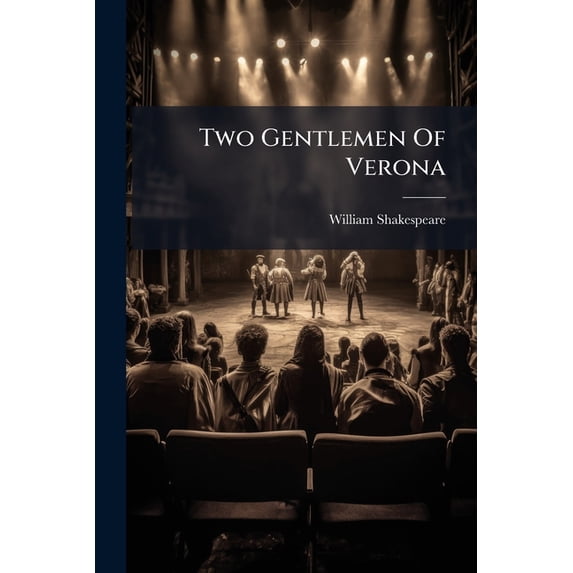
"Two Gentlemen of Verona" is one of William Shakespeare's early comedies, exploring the themes of friendship, love, and betrayal. Set in Verona and Milan, the play follows the intertwined fates of Valentine and Proteus, two close friends whose bond is tested by their shared affection for the beautiful Silvia.
Valentine travels to Milan to broaden his horizons, while Proteus remains in Verona, initially devoted to his sweetheart, Julia. However, Proteus's resolve falters when he is sent to Milan and becomes infatuated with Silvia himself, leading him to betray his friend in an attempt to win her heart. Meanwhile, Julia, disguised as a boy, follows Proteus, witnessing his infidelity and the unraveling of their love.
Through witty dialogue, mistaken identities, and dramatic twists, Shakespeare examines the complexities of human relationships and the challenges of remaining true to oneself and others. "Two Gentlemen of Verona," though an early work, showcases Shakespeare's developing talent for characterization and his enduring exploration of universal themes.
This work has been selected by scholars as being culturally important, and is part of the knowledge base of civilization as we know it. This work was reproduced from the original artifact, and remains as true to the original work as possible. Therefore, you will see the original copyright references, library stamps (as most of these works have been housed in our most important libraries around the world), and other notations in the work.
This work is in the public domain in the United States of America, and possibly other nations. Within the United States, you may freely copy and distribute this work, as no entity (individual or corporate) has a copyright on the body of the work.
As a reproduction of a historical artifact, this work may contain missing or blurred pages, poor pictures, errant marks, etc. Scholars believe, and we concur, that this work is important enough to be preserved, reproduced, and made generally available to the public. We appreciate your support of the preservation process, and thank you for being an important part of keeping this knowledge alive and relevant.