

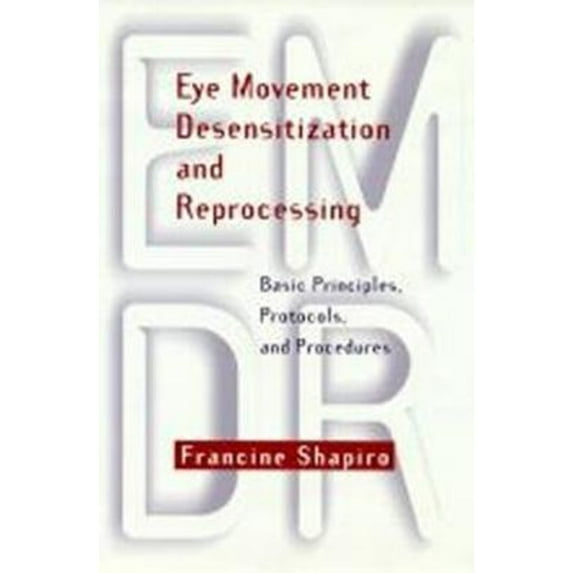
Hero image 0 of Eye Movement Desensitization and Reprocessing (EMDR) : Basic Principles, Protocols, and Procedures (Edition 1) (Hardcover), 0 of 2
Eye Movement Desensitization and Reprocessing (EMDR) : Basic Principles, Protocols, and Procedures (Edition 1) (Hardcover)
(No ratings yet)
Key item features
Eye Movement Desensitization and Reprocessing (EMDR) is a innovative clinical treatment for victims of trauma. Since its introduction in 1989, the approach has been taught to over 18,000 clinicians worldwide and has received an enormous amount of media attention. With very positive results emanating from recent studies, EMDR is now the most extensively researched treatment for Posttraumatic Stress Disorder and many other applications are also being explored.
EMDR is a time-efficient, comprehensive methodology for the treatment of the disturbing experiences that underlie many pathologies. An integrated model that draws from behavioral, cognitive, psychodynamic, body-based, and systems therapies, EMDR provides profound and stable treatment effects in a short period of time. Comprising an eight-phase treatment that includes the use of eye movements or other left-right stimulation, EMDR helps victims of trauma reprocess disturbing thoughts and memories. Although current knowledge of neurobiology does not provide a definitive explanation, a number of physiological studies are being carried out and theoretical suggestions have been put forth that link its effects to REM sleep, dual attention, and/or bihemispheric involvement.
This authoritative volume reviews research and development; discusses theoretical constructs and possible underlying mechanisms; and presents protocols and procedures for treatment of adults and children with a range of presenting problems. Among the many clinical populations for whom the material in this volume is applicable are survivors of sexual abuse, crime, and combat, as well as phobia sufferers. To facilitate the learning process, detailed descriptions and transcripts guide the clinician through every stage of therapeutic treatment, from client selection to the administration of EMDR and its integration within a comprehensive treatment plan.
This volume is essential reading for all clinicians and researchers interested in treating victims of trauma. The extensive and detailed exposition of each phase of treatment and myriad applications make it an invaluable handbook for experienced EMDR clinicians as well as those new to the approach. Accessibly written, it also serves as a text for advanced students of clinical psychology.
EMDR is a time-efficient, comprehensive methodology for the treatment of the disturbing experiences that underlie many pathologies. An integrated model that draws from behavioral, cognitive, psychodynamic, body-based, and systems therapies, EMDR provides profound and stable treatment effects in a short period of time. Comprising an eight-phase treatment that includes the use of eye movements or other left-right stimulation, EMDR helps victims of trauma reprocess disturbing thoughts and memories. Although current knowledge of neurobiology does not provide a definitive explanation, a number of physiological studies are being carried out and theoretical suggestions have been put forth that link its effects to REM sleep, dual attention, and/or bihemispheric involvement.
This authoritative volume reviews research and development; discusses theoretical constructs and possible underlying mechanisms; and presents protocols and procedures for treatment of adults and children with a range of presenting problems. Among the many clinical populations for whom the material in this volume is applicable are survivors of sexual abuse, crime, and combat, as well as phobia sufferers. To facilitate the learning process, detailed descriptions and transcripts guide the clinician through every stage of therapeutic treatment, from client selection to the administration of EMDR and its integration within a comprehensive treatment plan.
This volume is essential reading for all clinicians and researchers interested in treating victims of trauma. The extensive and detailed exposition of each phase of treatment and myriad applications make it an invaluable handbook for experienced EMDR clinicians as well as those new to the approach. Accessibly written, it also serves as a text for advanced students of clinical psychology.
Specs
- Book formatHardcover
- Fiction/nonfictionNon-Fiction
- GenreHealth, Mind & Body
- Publication dateApril, 1995
- Pages472
- Edition1
Current price is USDNow $24.48
You save $21.52
was $46.00$46.00
You save$21.52
Price when purchased online
Out of stock
How do you want your item?
Out of stock
About this item
Product details
Hard cover. Annotated. Language: English. Pages: 472. Sewn binding. Cloth over boards. 472 p. Contains: Illustrations. Written by the developer of the Eye Movement Desensitization and Reprocessing (EMDR) Method, this book details a comprehensive approach for the treatment of disturbing experiences that underlie many pathologies. The author, who runs hundreds of training workshops nationwide, presents a thorough explication of how to use the procedures of EMDR and integrate them into therapeutic practice. Widely reported in the media, this method has been used effectively with sexual abuse victims, survivors of combat and serious illness, and those who suffer from phobias, among others. This book will be of great interest to mental health professionals and those wishing to learn about this powerful new method.
Eye Movement Desensitization and Reprocessing (EMDR) is a innovative clinical treatment for victims of trauma. Since its introduction in 1989, the approach has been taught to over 18,000 clinicians worldwide and has received an enormous amount of media attention. With very positive results emanating from recent studies, EMDR is now the most extensively researched treatment for Posttraumatic Stress Disorder and many other applications are also being explored.
EMDR is a time-efficient, comprehensive methodology for the treatment of the disturbing experiences that underlie many pathologies. An integrated model that draws from behavioral, cognitive, psychodynamic, body-based, and systems therapies, EMDR provides profound and stable treatment effects in a short period of time. Comprising an eight-phase treatment that includes the use of eye movements or other left-right stimulation, EMDR helps victims of trauma reprocess disturbing thoughts and memories. Although current knowledge of neurobiology does not provide a definitive explanation, a number of physiological studies are being carried out and theoretical suggestions have been put forth that link its effects to REM sleep, dual attention, and/or bihemispheric involvement.
This authoritative volume reviews research and development; discusses theoretical constructs and possible underlying mechanisms; and presents protocols and procedures for treatment of adults and children with a range of presenting problems. Among the many clinical populations for whom the material in this volume is applicable are survivors of sexual abuse, crime, and combat, as well as phobia sufferers. To facilitate the learning process, detailed descriptions and transcripts guide the clinician through every stage of therapeutic treatment, from client selection to the administration of EMDR and its integration within a comprehensive treatment plan.
This volume is essential reading for all clinicians and researchers interested in treating victims of trauma. The extensive and detailed exposition of each phase of treatment and myriad applications make it an invaluable handbook for experienced EMDR clinicians as well as those new to the approach. Accessibly written, it also serves as a text for advanced students of clinical psychology.
EMDR is a time-efficient, comprehensive methodology for the treatment of the disturbing experiences that underlie many pathologies. An integrated model that draws from behavioral, cognitive, psychodynamic, body-based, and systems therapies, EMDR provides profound and stable treatment effects in a short period of time. Comprising an eight-phase treatment that includes the use of eye movements or other left-right stimulation, EMDR helps victims of trauma reprocess disturbing thoughts and memories. Although current knowledge of neurobiology does not provide a definitive explanation, a number of physiological studies are being carried out and theoretical suggestions have been put forth that link its effects to REM sleep, dual attention, and/or bihemispheric involvement.
This authoritative volume reviews research and development; discusses theoretical constructs and possible underlying mechanisms; and presents protocols and procedures for treatment of adults and children with a range of presenting problems. Among the many clinical populations for whom the material in this volume is applicable are survivors of sexual abuse, crime, and combat, as well as phobia sufferers. To facilitate the learning process, detailed descriptions and transcripts guide the clinician through every stage of therapeutic treatment, from client selection to the administration of EMDR and its integration within a comprehensive treatment plan.
This volume is essential reading for all clinicians and researchers interested in treating victims of trauma. The extensive and detailed exposition of each phase of treatment and myriad applications make it an invaluable handbook for experienced EMDR clinicians as well as those new to the approach. Accessibly written, it also serves as a text for advanced students of clinical psychology.
info:
We aim to show you accurate product information. Manufacturers, suppliers and others provide what you see here, and we have not verified it.
Specifications
Book format
Hardcover
Fiction/nonfiction
Non-Fiction
Genre
Health, Mind & Body
Publication date
April, 1995
Warranty
Warranty information
Please be aware that the warranty terms on items offered for sale by third party Marketplace sellers may differ from those displayed in this section (if any). To confirm warranty terms on an item offered for sale by a third party Marketplace seller, please use the 'Contact seller' feature on the third party Marketplace seller's information page and request the item's warranty terms prior to purchase.
Similar items you might like
Based on what customers bought
Eye Movement Desensitization and Reprocessing (Emdr) Therapy: Basic Principles, Protocols, and Procedures (Hardcover) $61.00
 $6100current price $61.00
Eye Movement Desensitization and Reprocessing (Emdr) Therapy: Basic Principles, Protocols, and Procedures (Hardcover)
184.4 out of 5 Stars. 18 reviewsEMDR Group Therapy: Emerging Principles and Protocols to Treat Trauma and Beyond, (Paperback) $37.35
 $3735current price $37.35
EMDR Group Therapy: Emerging Principles and Protocols to Treat Trauma and Beyond, (Paperback)
What Fascinates Human: How Do I Look?: Principles Behind Your Profile and The Right Approach (Paperback) $10.63
 $1063current price $10.63
What Fascinates Human: How Do I Look?: Principles Behind Your Profile and The Right Approach (Paperback)
Visceral Leishmaniasis: Signalling Approaches, (Hardcover) $25.42
 $2542current price $25.42
Visceral Leishmaniasis: Signalling Approaches, (Hardcover)
Esoteric Roots of Cranio Practice: Guiding Principles, (Hardcover) $24.14
 $2414current price $24.14
Esoteric Roots of Cranio Practice: Guiding Principles, (Hardcover)
Emergent Strategy Liberated to the Bone: Histories. Bodies. Futures., Book 7, (Paperback) $15.31
 $1531current price $15.31
Emergent Strategy Liberated to the Bone: Histories. Bodies. Futures., Book 7, (Paperback)
Wired for Peace: Using 7 Neuroscience-Based Principles to Resolve Conflicts, (Hardcover) $28.00
 $2800current price $28.00
Wired for Peace: Using 7 Neuroscience-Based Principles to Resolve Conflicts, (Hardcover)
Bodydreaming in the Treatment of Developmental Trauma: An Embodied Therapeutic Approach, (Paperback) $33.89
 $3389current price $33.89
Bodydreaming in the Treatment of Developmental Trauma: An Embodied Therapeutic Approach, (Paperback)
Generalities of the ICU and Working Principles (Paperback) $25.81
 $2581current price $25.81
Generalities of the ICU and Working Principles (Paperback)
Les Principes de la Connaissance Humaine, (Hardcover) $17.99
 $1799current price $17.99
Les Principes de la Connaissance Humaine, (Hardcover)
Handbook of EMDR and Family Therapy Processes, (Hardcover) $74.87
 $7487current price $74.87
Handbook of EMDR and Family Therapy Processes, (Hardcover)
Du Traitement Préventif de la Rage Par Le Hoàng-Nàn (Paperback) $13.08
 $1308current price $13.08
Du Traitement Préventif de la Rage Par Le Hoàng-Nàn (Paperback)
Principles of Psychoanalytic Psychotherapy, (Paperback) $24.33
 $2433current price $24.33
Principles of Psychoanalytic Psychotherapy, (Paperback)
The Educator′s Guide to Autism Spectrum Disorder: Interventions and Treatments, (Paperback) $24.99
 $2499current price $24.99
The Educator′s Guide to Autism Spectrum Disorder: Interventions and Treatments, (Paperback)
The Moral Tendency of the Doctrine of Falling From Grace Examined (Hardcover) $17.67
 $1767current price $17.67
The Moral Tendency of the Doctrine of Falling From Grace Examined (Hardcover)
Your Shadow and Your God, (Paperback) $15.99
 $1599current price $15.99
Your Shadow and Your God, (Paperback)
The Complexity of Trauma: Jungian and Psychoanalytic Approaches to the Treatment of Trauma, (Paperback) $34.71
 $3471current price $34.71
The Complexity of Trauma: Jungian and Psychoanalytic Approaches to the Treatment of Trauma, (Paperback)
Just Start: Take Action, Embrace Uncertainty, Create the Future, (Hardcover) $3.99
 $399current price $3.99
Just Start: Take Action, Embrace Uncertainty, Create the Future, (Hardcover)
Child Abduction During the Covid Pandemic, (Paperback) $14.95
 $1495current price $14.95
Child Abduction During the Covid Pandemic, (Paperback)

Customer ratings & reviews
0 ratings|0 reviews
This item does not have any reviews yet
