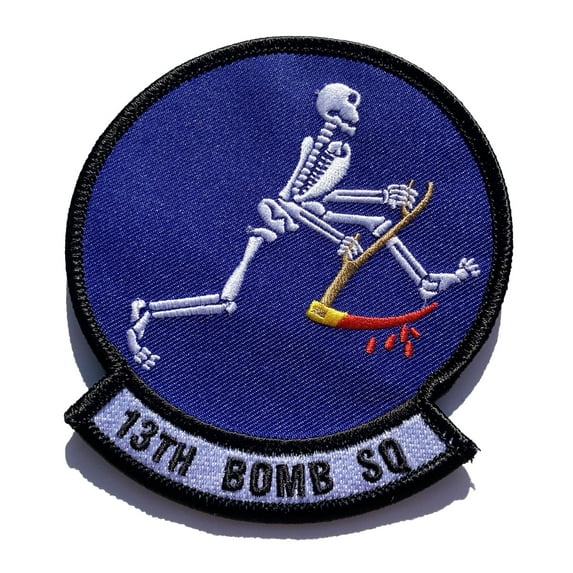
13th Bomb Squadron Patch Pilots, Airmen and fans! Enjoy this beautifully embroidered 13th Bomb Squadron Patch. You'll love the quality and detail of the stitching. 3.75 inch Embroidered/ Hook and Loop US Veteran Owned Business World War I Main article: 13th Aero Squadron The 13th Aero Squadron was formed at Camp Kelly (later Kelly Field), Texas, on 14 June 1917. 13th Aero Squadron – SPAD XIII, Souilly Aerodrome, France. 1918 The "Devil’s Own Grim Reapers" as they came to be known was a Pursuit (Fighter) squadron on the Western Front in France during 1918, flying the French SPAD S.XIII. The 13th claimed several "aces" from this period of its history: Charles J Biddle, Murray K Guthrie, Frank K Hays, John J Seerly, and William H Stovall. Major Carl Spaatz was attached to the unit at his request, and had two victories. He would rise to four-star rank during WW II. The Unit's first combat loss was Lt. George Kull on 14 September 1918 during the St. Mihiel Offensive. There would be others to follow: During the Meuse Argonne Offensive, the squadron lost Lts. Gerald D. Stivers, Henry Guion Armstrong, Clarence A. Brodie and Robert H. Stiles killed in action. It returned to the United States in March 1919 when it was demobilized. It remained inactive until it was reconstituted in 1936.[1] Main article: 104th Aero Squadron The 104th Aero Squadron was organized on 25 August 1917, also at Kelly Field. As a Corps Observation (Reconnaissance) Squadron flying the French Salmson 2A2 observation aircraft, the 104th flew reconnaissance, directed Allied artillery fire and pinpointed troop movements on the Western Front. The demand for artillery fire adjustments through aerial observation was constant in spite of difficulties encountered in air-to-ground communications. It was largely due to the photos made by aerial reconnaissance that the Allied infantry knew where it was advancing. It returned to the United States in April 1919 and became part of the permanent United States Army Air Service in 1921.[1] Inter-War period After its arrival at Roosevelt Field, Long Island, most of the 104th Aero Squadron's men returned to civilian life. In May 1919, the squadron moved to neighboring Mitchel Field; the squadron was down to one officer and one enlisted man and was administratively carried by the Air Service as an active unit.[7] About 15 May, the 104th moved to Fort Bliss, Texas, and during June to Kelly Field, Texas, still manned in name only. On 25 May 1919 it was redesignated as the 104th Surveillance Squadron, and assigned to the Army Surveillance Group on 1 July along with the 8th, 12th and 90th Aero Squadrons. During August 1919, nearly 200 men from Mitchel Field were moved to Kelly Field to bring the squadron up to strength. The 104th quickly adapted to peacetime soldiering in the nation's infant air organization It was also equipped with new Dayton-Wright DH-4 aircraft, surplus from the World War.[7][8] Mexican Border patrol see also: United States Army Border Air Patrol The mission of the Army Surveillance Group was to carry out observation overflights along the Mexican Border. During this period, Mexico was enduring a period of revolution and unrest, which led to border violations and the deaths of American citizens. After being manned and equipped, in November 1919 the squadron split into three flights: Headquarters Flight and Flight A went to Fort Bliss, Texas, while Flight B deployed to Marfa Field, Texas. From 10 September to 4 November, Flight B was located at Post Field, Oklahoma, but it returned to Marfa Field on 17 November 1920, and remained there until June 1921 flying observation flights along the Big Bend area of the Texas/Mexico border.[7][8] 13th Squadron (Attack) 13th Squadron (Attack) – Dayton-Wright XB-1A, Kelly Field, Texas, 1921. 13th Attack Squadron Curtiss A-3B. On 14 March 1921 with the establishment of the permanent Army Air Service, the 104th Surveillance Squadron was redesignated as the 13th Squadron (Attack).