

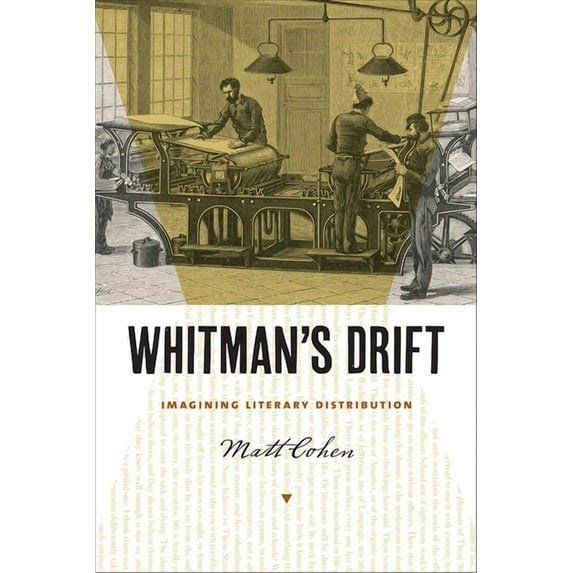
Hero image 0 of Iowa Whitman Series: Whitman's Drift : Imagining Literary Distribution (Paperback), 0 of 1
Iowa Whitman Series: Whitman's Drift : Imagining Literary Distribution (Paperback)
(No ratings yet)
Key item features
The American nineteenth century witnessed a media explosion unprecedented in human history. New communications technologies seemed to be everywhere, offering opportunities and threats that seem powerfully familiar to us as we experience today’s digital revolution. Walt Whitman’s poetry reveled in the potentials of his time: “See, the many-cylinder’d steam printing-press,” he wrote, “See, the electric telegraph, stretching across the Continent, from the Western Sea to Manhattan.”
Still, as the budding poet learned, books neither sell themselves nor move themselves: without an efficient set of connections to get books to readers, the democratic media-saturated future Whitman imagined would have remained warehoused. Whitman’s works sometimes ran through the “many-cylinder’d steam printing press” and were carried in bulk on “the strong and quick locomotive.” Yet during his career, his publications did not follow a progressive path toward mass production and distribution. Even at the end of his life, in the 1890s as his fame was growing, the poet was selling copies of his latest works by hand to visitors at his small house in Camden, New Jersey. Mass media and centralization were only one part of the rich media world that Whitman embraced.
Whitman’s Drift asks how the many options for distributing books and newspapers shaped the way writers wrote and readers read. Writers like Whitman spoke to the imagination inspired by media transformations by calling attention to connectedness, to how literature not only moves us emotionally, but moves around in the world among people and places. Studying that literature and how it circulated can help us understand not just how to read Whitman’s works and times, but how to understand what is happening to our imaginations now, in the midst of the twenty-first century media explosion.
Still, as the budding poet learned, books neither sell themselves nor move themselves: without an efficient set of connections to get books to readers, the democratic media-saturated future Whitman imagined would have remained warehoused. Whitman’s works sometimes ran through the “many-cylinder’d steam printing press” and were carried in bulk on “the strong and quick locomotive.” Yet during his career, his publications did not follow a progressive path toward mass production and distribution. Even at the end of his life, in the 1890s as his fame was growing, the poet was selling copies of his latest works by hand to visitors at his small house in Camden, New Jersey. Mass media and centralization were only one part of the rich media world that Whitman embraced.
Whitman’s Drift asks how the many options for distributing books and newspapers shaped the way writers wrote and readers read. Writers like Whitman spoke to the imagination inspired by media transformations by calling attention to connectedness, to how literature not only moves us emotionally, but moves around in the world among people and places. Studying that literature and how it circulated can help us understand not just how to read Whitman’s works and times, but how to understand what is happening to our imaginations now, in the midst of the twenty-first century media explosion.
Specs
- Book formatPaperback
- Fiction/nonfictionNon-Fiction
- Pub date2017-07-01
- Pages316
- SubgenreBooks & Reading, Modern - 19th Century, General
- Series titleIowa Whitman
Current price is USD$58.99
Price when purchased online
Out of stock
How do you want your item?
Out of stock
About this item
Product details
Whitman’s Drift asks how the many options for distributing books and newspapers shaped the way writers wrote and readers read. Writers like Whitman spoke to the imagination inspired by media transformations by calling attention to connectedness, to how literature not only moves us emotionally, but moves around in the world among people and places. Studying that literature and how it circulated can help us understand not just how to read Whitman’s works and times, but how to understand what is happening to our imaginations now, in the midst of the twenty-first century media explosion.
The American nineteenth century witnessed a media explosion unprecedented in human history. New communications technologies seemed to be everywhere, offering opportunities and threats that seem powerfully familiar to us as we experience today’s digital revolution. Walt Whitman’s poetry reveled in the potentials of his time: “See, the many-cylinder’d steam printing-press,” he wrote, “See, the electric telegraph, stretching across the Continent, from the Western Sea to Manhattan.”
Still, as the budding poet learned, books neither sell themselves nor move themselves: without an efficient set of connections to get books to readers, the democratic media-saturated future Whitman imagined would have remained warehoused. Whitman’s works sometimes ran through the “many-cylinder’d steam printing press” and were carried in bulk on “the strong and quick locomotive.” Yet during his career, his publications did not follow a progressive path toward mass production and distribution. Even at the end of his life, in the 1890s as his fame was growing, the poet was selling copies of his latest works by hand to visitors at his small house in Camden, New Jersey. Mass media and centralization were only one part of the rich media world that Whitman embraced.
Whitman’s Drift asks how the many options for distributing books and newspapers shaped the way writers wrote and readers read. Writers like Whitman spoke to the imagination inspired by media transformations by calling attention to connectedness, to how literature not only moves us emotionally, but moves around in the world among people and places. Studying that literature and how it circulated can help us understand not just how to read Whitman’s works and times, but how to understand what is happening to our imaginations now, in the midst of the twenty-first century media explosion.
Still, as the budding poet learned, books neither sell themselves nor move themselves: without an efficient set of connections to get books to readers, the democratic media-saturated future Whitman imagined would have remained warehoused. Whitman’s works sometimes ran through the “many-cylinder’d steam printing press” and were carried in bulk on “the strong and quick locomotive.” Yet during his career, his publications did not follow a progressive path toward mass production and distribution. Even at the end of his life, in the 1890s as his fame was growing, the poet was selling copies of his latest works by hand to visitors at his small house in Camden, New Jersey. Mass media and centralization were only one part of the rich media world that Whitman embraced.
Whitman’s Drift asks how the many options for distributing books and newspapers shaped the way writers wrote and readers read. Writers like Whitman spoke to the imagination inspired by media transformations by calling attention to connectedness, to how literature not only moves us emotionally, but moves around in the world among people and places. Studying that literature and how it circulated can help us understand not just how to read Whitman’s works and times, but how to understand what is happening to our imaginations now, in the midst of the twenty-first century media explosion.
info:
We aim to show you accurate product information. Manufacturers, suppliers and others provide what you see here, and we have not verified it.
Specifications
Book format
Paperback
Fiction/nonfiction
Non-Fiction
Pub date
2017-07-01
Pages
316
Warranty
Warranty information
Please be aware that the warranty terms on items offered for sale by third party Marketplace sellers may differ from those displayed in this section (if any). To confirm warranty terms on an item offered for sale by a third party Marketplace seller, please use the 'Contact seller' feature on the third party Marketplace seller's information page and request the item's warranty terms prior to purchase.
Similar items you might like
Based on what customers bought
Iowa Whitman Series: "This Mighty Convulsion" : Whitman and Melville Write the Civil War (Paperback) $61.37
 $6137current price $61.37
Iowa Whitman Series: "This Mighty Convulsion" : Whitman and Melville Write the Civil War (Paperback)
Literary Lives Sylvia Plath: A Literary Life, (Paperback) $54.99
 $5499current price $54.99
Literary Lives Sylvia Plath: A Literary Life, (Paperback)
Speculative Poetry and the Modern Alliterative Revival: A Critical Anthology, (Paperback) $34.95
 $3495current price $34.95
Speculative Poetry and the Modern Alliterative Revival: A Critical Anthology, (Paperback)
The Made Thing : An Anthology of Contemporary Southern Poetry (Hardcover) $53.27
 $5327current price $53.27
The Made Thing : An Anthology of Contemporary Southern Poetry (Hardcover)
The Annotated Abbott and Costello: A Complete Viewer's Guide to the Comedy Team and Their 38 Films, (Paperback) $48.45
 $4845current price $48.45
The Annotated Abbott and Costello: A Complete Viewer's Guide to the Comedy Team and Their 38 Films, (Paperback)
Literary Lives Graham Greene: A Literary Life, (Paperback) $51.10
 $5110current price $51.10
Literary Lives Graham Greene: A Literary Life, (Paperback)
American Literature Readings in the 21st Wallace Stevens and Martin Heidegger: Poetry as Appropriative Proximity, (Paperback) $96.76
 $9676current price $96.76
American Literature Readings in the 21st Wallace Stevens and Martin Heidegger: Poetry as Appropriative Proximity, (Paperback)
Best seller A Court of Mist and Fury (Paperback) $12.82
Best seller $1282current price $12.82
A Court of Mist and Fury (Paperback)
3864.9 out of 5 Stars. 386 reviewsThe Networked Wilderness: Communicating in Early New England, (Paperback) $25.09
 $2509current price $25.09
The Networked Wilderness: Communicating in Early New England, (Paperback)
Continuum Literary Studies Pastoral Elegy in Contemporary British and Irish Poetry, (Paperback) $52.55
 $5255current price $52.55
Continuum Literary Studies Pastoral Elegy in Contemporary British and Irish Poetry, (Paperback)
Poetry Collection Vol 1, (Paperback) $24.51
 $2451current price $24.51
Poetry Collection Vol 1, (Paperback)
Longman Annotated English Poets Tennyson: A Selected Edition, (Paperback) $41.69
 $4169current price $41.69
Longman Annotated English Poets Tennyson: A Selected Edition, (Paperback)
Literary Lives T. S. Eliot: A Literary Life, (Paperback) $49.99
 $4999current price $49.99
Literary Lives T. S. Eliot: A Literary Life, (Paperback)
Iowa Poetry Prize: Lo (Paperback) $19.97
 $1997current price $19.97
Iowa Poetry Prize: Lo (Paperback)
Modernist Crisis and the Pedagogy of Form: Woolf, Delany, and Coetzee at the Limits of Fiction, (Paperback) $52.75
 $5275current price $52.75
Modernist Crisis and the Pedagogy of Form: Woolf, Delany, and Coetzee at the Limits of Fiction, (Paperback)
Reconciling Nature: Literary Representations of the Natural, 1876-1945, (Paperback) $39.66
 $3966current price $39.66
Reconciling Nature: Literary Representations of the Natural, 1876-1945, (Paperback)
Studies in Major Literary Authors Yeats and Theosophy, (Paperback) $64.99
 $6499current price $64.99
Studies in Major Literary Authors Yeats and Theosophy, (Paperback)
Soul Refraction: A Contemporary Poetry Collection, (Paperback) $19.99
 $1999current price $19.99
Soul Refraction: A Contemporary Poetry Collection, (Paperback)
Humor in Modern American Poetry, (Paperback) $55.97
 $5597current price $55.97
Humor in Modern American Poetry, (Paperback)
All Fine in the Floating World: The Collected Poetry of Miriam Pederson, (Paperback) $24.95
 $2495current price $24.95
All Fine in the Floating World: The Collected Poetry of Miriam Pederson, (Paperback)
Customer ratings & reviews
0 ratings|0 reviews
This item does not have any reviews yet
