

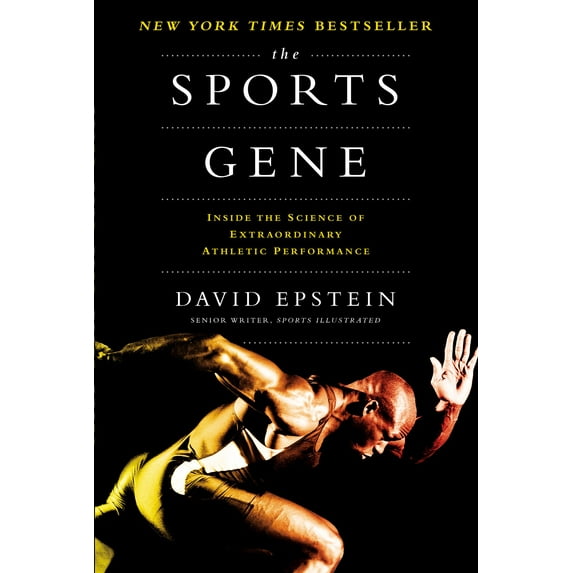
Hero image 0 of The Sports Gene : Inside the Science of Extraordinary Athletic Performance, 0 of 1
The Sports Gene : Inside the Science of Extraordinary Athletic Performance
Key item features
The New York Times bestseller – with a new afterword added to the paperback – from the author of Range: Why Generalists Triumph in a Specialized World.
In high school, I wondered whether the Jamaican Americans who made our track team so successful might carry some special speed gene from their tiny island. In college, I ran against Kenyans, and wondered whether endurance genes might have traveled with them from East Africa. At the same time, I began to notice that a training group on my team could consist of five men who run next to one another, stride for stride, day after day, and nonetheless turn out five entirely different runners. How could this be?
We all knew a star athlete in high school. The one who made it look so easy. He was the starting quarterback and shortstop; she was the all-state point guard and high-jumper. Naturals. Or were they?
The debate is as old as physical competition. Are stars like Usain Bolt, Michael Phelps, and Serena Williams genetic freaks put on Earth to dominate their respective sports? Or are they simply normal people who overcame their biological limits through sheer force of will and obsessive training?
The truth is far messier than a simple dichotomy between nature and nurture. In the decade since the sequencing of the human genome, researchers have slowly begun to uncover how the relationship between biological endowments and a competitor’s training environment affects athleticism. Sports scientists have gradually entered the era of modern genetic research.
In this controversial and engaging exploration of athletic success, Sports Illustrated senior writer David Epstein tackles the great nature vs. nurture debate and traces how far science has come in solving this great riddle. He investigates the so-called 10,000-hour rule to uncover whether rigorous and consistent practice from a young age is the only route to athletic excellence.
Along the way, Epstein dispels many of our perceptions about why top athletes excel. He shows why some skills that we assume are innate, like the bullet-fast reactions of a baseball or cricket batter, are not, and why other characteristics that we assume are entirely voluntary, like an athlete’s will to train, might in fact have important genetic components.
This subject necessarily involves digging deep into sensitive topics like race and gender. Epstein explores controversial questions such as:
• Are black athletes genetically predetermined to dominate both sprinting and distance running, and are their abilities influenced by Africa’s geography?
• Are there genetic reasons to separate male and female athletes in competition?
• Should we test the genes of young children to determine if they are destined for stardom?
• Can genetic testing determine who is at risk of injury, brain damage, or even death on the field?
Through on-the-ground reporting from below the equator and above the Arctic Circle, revealing conversations with leading scientists and Olympic champions, and interviews with athletes who have rare genetic mutations or physical traits, Epstein forces us to rethink the very nature of athleticism.
In high school, I wondered whether the Jamaican Americans who made our track team so successful might carry some special speed gene from their tiny island. In college, I ran against Kenyans, and wondered whether endurance genes might have traveled with them from East Africa. At the same time, I began to notice that a training group on my team could consist of five men who run next to one another, stride for stride, day after day, and nonetheless turn out five entirely different runners. How could this be?
We all knew a star athlete in high school. The one who made it look so easy. He was the starting quarterback and shortstop; she was the all-state point guard and high-jumper. Naturals. Or were they?
The debate is as old as physical competition. Are stars like Usain Bolt, Michael Phelps, and Serena Williams genetic freaks put on Earth to dominate their respective sports? Or are they simply normal people who overcame their biological limits through sheer force of will and obsessive training?
The truth is far messier than a simple dichotomy between nature and nurture. In the decade since the sequencing of the human genome, researchers have slowly begun to uncover how the relationship between biological endowments and a competitor’s training environment affects athleticism. Sports scientists have gradually entered the era of modern genetic research.
In this controversial and engaging exploration of athletic success, Sports Illustrated senior writer David Epstein tackles the great nature vs. nurture debate and traces how far science has come in solving this great riddle. He investigates the so-called 10,000-hour rule to uncover whether rigorous and consistent practice from a young age is the only route to athletic excellence.
Along the way, Epstein dispels many of our perceptions about why top athletes excel. He shows why some skills that we assume are innate, like the bullet-fast reactions of a baseball or cricket batter, are not, and why other characteristics that we assume are entirely voluntary, like an athlete’s will to train, might in fact have important genetic components.
This subject necessarily involves digging deep into sensitive topics like race and gender. Epstein explores controversial questions such as:
• Are black athletes genetically predetermined to dominate both sprinting and distance running, and are their abilities influenced by Africa’s geography?
• Are there genetic reasons to separate male and female athletes in competition?
• Should we test the genes of young children to determine if they are destined for stardom?
• Can genetic testing determine who is at risk of injury, brain damage, or even death on the field?
Through on-the-ground reporting from below the equator and above the Arctic Circle, revealing conversations with leading scientists and Olympic champions, and interviews with athletes who have rare genetic mutations or physical traits, Epstein forces us to rethink the very nature of athleticism.
Specs
- Book formatHardcover
- Fiction/nonfictionNon-Fiction
- GenreSports & Recreation
- Publication dateAugust, 2013
- Pages352
- Reading levelGrade 2
Current price is USDNow $14.97
You save $4.60
was $19.57$19.57
You save$4.60
Price when purchased online
- Free shipping
 Free 30-day returns
$14.97
$3.99
How do you want your item?
Ships to
Arrives by Tue, May 19
|
Sold and shipped by upick
4.5 stars out of 5, based on 36 seller reviews(4.5)36 seller reviews

Free 30-day returns
About this item
Product details
The New York Times bestseller - with a new afterword added to the paperback - from the author of Range: Why Generalists Triumph in a Specialized World. In high school, I wondered whether the Jamaican Americans who made our track team so successful might carry some special speed gene from their tiny island. In college, I ran against Kenyans, and wondered whether endurance genes might have traveled with them from East Africa. At the same time, I began to notice that a training group on my team could consist of five men who run next to one another, stride for stride, day after day, and nonetheless turn out five entirely different runners. How could this be? We all knew a star athlete in high school. The one who made it look so easy. He was the starting quarterback and shortstop; she was the all-state point guard and high-jumper. Naturals. Or were they? The debate is as old as physical competition. Are stars like Usain Bolt, Michael Phelps, and Serena Williams genetic freaks put on Earth to dominate their respective sports? Or are they simply normal people who overcame their biological limits through sheer force of will and obsessive training?
The truth is far messier than a simple dichotomy between nature and nurture. In the decade since the sequencing of the human genome, researchers have slowly begun to uncover how the relationship between biological endowments and a competitor's training environment affects athleticism. Sports scientists have gradually entered the era of modern genetic research. In this controversial and engaging exploration of athletic success, Sports Illustrated senior writer David Epstein tackles the great nature vs. nurture debate and traces how far science has come in solving this great riddle. He investigates the so-called 10,000-hour rule to uncover whether rigorous and consistent practice from a young age is the only route to athletic excellence. Along the way, Epstein dispels many of our perceptions about why top athletes excel. He shows why some skills that we assume are innate, like the bullet-fast reactions of a baseball or cricket batter, are not, and why other characteristics that we assume are entirely voluntary, like an athlete's will to train, might in fact have important genetic components. This subject necessarily involves digging deep into sensitive topics like race and gender. Epstein explores controversial questions such as: - Are black athletes genetically predetermined to dominate both sprinting and distance running, and are their abilities influenced by Africa's geography?
- Are there genetic reasons to separate male and female athletes in competition?
- Should we test the genes of young children to determine if they are destined for stardom?
- Can genetic testing determine who is at risk of injury, brain damage, or even death on the field?
Through on-the-ground reporting from below the equator and above the Arctic Circle, revealing conversations with leading scientists and Olympic champions, and interviews with athletes who have rare genetic mutations or physical traits, Epstein forces us to rethink the very nature of athleticism.
The truth is far messier than a simple dichotomy between nature and nurture. In the decade since the sequencing of the human genome, researchers have slowly begun to uncover how the relationship between biological endowments and a competitor's training environment affects athleticism. Sports scientists have gradually entered the era of modern genetic research. In this controversial and engaging exploration of athletic success, Sports Illustrated senior writer David Epstein tackles the great nature vs. nurture debate and traces how far science has come in solving this great riddle. He investigates the so-called 10,000-hour rule to uncover whether rigorous and consistent practice from a young age is the only route to athletic excellence. Along the way, Epstein dispels many of our perceptions about why top athletes excel. He shows why some skills that we assume are innate, like the bullet-fast reactions of a baseball or cricket batter, are not, and why other characteristics that we assume are entirely voluntary, like an athlete's will to train, might in fact have important genetic components. This subject necessarily involves digging deep into sensitive topics like race and gender. Epstein explores controversial questions such as: - Are black athletes genetically predetermined to dominate both sprinting and distance running, and are their abilities influenced by Africa's geography?
- Are there genetic reasons to separate male and female athletes in competition?
- Should we test the genes of young children to determine if they are destined for stardom?
- Can genetic testing determine who is at risk of injury, brain damage, or even death on the field?
Through on-the-ground reporting from below the equator and above the Arctic Circle, revealing conversations with leading scientists and Olympic champions, and interviews with athletes who have rare genetic mutations or physical traits, Epstein forces us to rethink the very nature of athleticism.
The New York Times bestseller – with a new afterword added to the paperback – from the author of Range: Why Generalists Triumph in a Specialized World.
In high school, I wondered whether the Jamaican Americans who made our track team so successful might carry some special speed gene from their tiny island. In college, I ran against Kenyans, and wondered whether endurance genes might have traveled with them from East Africa. At the same time, I began to notice that a training group on my team could consist of five men who run next to one another, stride for stride, day after day, and nonetheless turn out five entirely different runners. How could this be?
We all knew a star athlete in high school. The one who made it look so easy. He was the starting quarterback and shortstop; she was the all-state point guard and high-jumper. Naturals. Or were they?
The debate is as old as physical competition. Are stars like Usain Bolt, Michael Phelps, and Serena Williams genetic freaks put on Earth to dominate their respective sports? Or are they simply normal people who overcame their biological limits through sheer force of will and obsessive training?
The truth is far messier than a simple dichotomy between nature and nurture. In the decade since the sequencing of the human genome, researchers have slowly begun to uncover how the relationship between biological endowments and a competitor’s training environment affects athleticism. Sports scientists have gradually entered the era of modern genetic research.
In this controversial and engaging exploration of athletic success, Sports Illustrated senior writer David Epstein tackles the great nature vs. nurture debate and traces how far science has come in solving this great riddle. He investigates the so-called 10,000-hour rule to uncover whether rigorous and consistent practice from a young age is the only route to athletic excellence.
Along the way, Epstein dispels many of our perceptions about why top athletes excel. He shows why some skills that we assume are innate, like the bullet-fast reactions of a baseball or cricket batter, are not, and why other characteristics that we assume are entirely voluntary, like an athlete’s will to train, might in fact have important genetic components.
This subject necessarily involves digging deep into sensitive topics like race and gender. Epstein explores controversial questions such as:
• Are black athletes genetically predetermined to dominate both sprinting and distance running, and are their abilities influenced by Africa’s geography?
• Are there genetic reasons to separate male and female athletes in competition?
• Should we test the genes of young children to determine if they are destined for stardom?
• Can genetic testing determine who is at risk of injury, brain damage, or even death on the field?
Through on-the-ground reporting from below the equator and above the Arctic Circle, revealing conversations with leading scientists and Olympic champions, and interviews with athletes who have rare genetic mutations or physical traits, Epstein forces us to rethink the very nature of athleticism.
In high school, I wondered whether the Jamaican Americans who made our track team so successful might carry some special speed gene from their tiny island. In college, I ran against Kenyans, and wondered whether endurance genes might have traveled with them from East Africa. At the same time, I began to notice that a training group on my team could consist of five men who run next to one another, stride for stride, day after day, and nonetheless turn out five entirely different runners. How could this be?
We all knew a star athlete in high school. The one who made it look so easy. He was the starting quarterback and shortstop; she was the all-state point guard and high-jumper. Naturals. Or were they?
The debate is as old as physical competition. Are stars like Usain Bolt, Michael Phelps, and Serena Williams genetic freaks put on Earth to dominate their respective sports? Or are they simply normal people who overcame their biological limits through sheer force of will and obsessive training?
The truth is far messier than a simple dichotomy between nature and nurture. In the decade since the sequencing of the human genome, researchers have slowly begun to uncover how the relationship between biological endowments and a competitor’s training environment affects athleticism. Sports scientists have gradually entered the era of modern genetic research.
In this controversial and engaging exploration of athletic success, Sports Illustrated senior writer David Epstein tackles the great nature vs. nurture debate and traces how far science has come in solving this great riddle. He investigates the so-called 10,000-hour rule to uncover whether rigorous and consistent practice from a young age is the only route to athletic excellence.
Along the way, Epstein dispels many of our perceptions about why top athletes excel. He shows why some skills that we assume are innate, like the bullet-fast reactions of a baseball or cricket batter, are not, and why other characteristics that we assume are entirely voluntary, like an athlete’s will to train, might in fact have important genetic components.
This subject necessarily involves digging deep into sensitive topics like race and gender. Epstein explores controversial questions such as:
• Are black athletes genetically predetermined to dominate both sprinting and distance running, and are their abilities influenced by Africa’s geography?
• Are there genetic reasons to separate male and female athletes in competition?
• Should we test the genes of young children to determine if they are destined for stardom?
• Can genetic testing determine who is at risk of injury, brain damage, or even death on the field?
Through on-the-ground reporting from below the equator and above the Arctic Circle, revealing conversations with leading scientists and Olympic champions, and interviews with athletes who have rare genetic mutations or physical traits, Epstein forces us to rethink the very nature of athleticism.
info:
We aim to show you accurate product information. Manufacturers, suppliers and others provide what you see here, and we have not verified it.
Specifications
Book format
Hardcover
Fiction/nonfiction
Non-Fiction
Genre
Sports & Recreation
Publication date
August, 2013
Warranty
Warranty information
Please be aware that the warranty terms on items offered for sale by third party Marketplace sellers may differ from those displayed in this section (if any). To confirm warranty terms on an item offered for sale by a third party Marketplace seller, please use the 'Contact seller' feature on the third party Marketplace seller's information page and request the item's warranty terms prior to purchase.
Warnings
State Chemical Disclosure
california_state_chemical_warning_text
Similar items you might like
Based on what customers bought
Range: Why Generalists Triumph in a Specialized World $6.56
 $656current price $6.56
Range: Why Generalists Triumph in a Specialized World
What Great Teams Do Great: How Ordinary People Accomplish the Extraordinary, (Hardcover) $25.12
 $2512current price $25.12
What Great Teams Do Great: How Ordinary People Accomplish the Extraordinary, (Hardcover)
War Doctor: Surgery on the Front Line, (Paperback) $15.49
 $1549current price $15.49
War Doctor: Surgery on the Front Line, (Paperback)
Field Notes On Sports, Book 11, (Paperback) $13.99
 $1399current price $13.99
Field Notes On Sports, Book 11, (Paperback)
Pre-Owned The Sports Gene: Inside the Science of Extraordinary Athletic Performance (Hardcover) 1591845114 9781591845119 $4.08
 $408current price $4.08
Pre-Owned The Sports Gene: Inside the Science of Extraordinary Athletic Performance (Hardcover) 1591845114 9781591845119
Best seller Viagra, (Paperback) $21.55
Best seller $2155current price $21.55
Viagra, (Paperback)
93 out of 5 Stars. 9 reviewsThe Gift of Lift: Harnessing the Power of Stewardship to Elevate the World, (Paperback) $13.39
 $1339current price $13.39
The Gift of Lift: Harnessing the Power of Stewardship to Elevate the World, (Paperback)
Travel Guide 2015 Orlando $12.95
 $1295current price $12.95
Travel Guide 2015 Orlando
The Marvelous Creations Of Joseffy, (Paperback) $17.77
 $1777current price $17.77
The Marvelous Creations Of Joseffy, (Paperback)
Lamar Hunt: The Gentle Giant Who Revolutionized Professional Sports, (Paperback) $18.61
 $1861current price $18.61
Lamar Hunt: The Gentle Giant Who Revolutionized Professional Sports, (Paperback)
Remembering Henry, (Paperback) $19.95
 $1995current price $19.95
Remembering Henry, (Paperback)
The Sweet Science $17.26
 $1726current price $17.26
The Sweet Science
Building Powerful Athletes Through the O The Book on Cleans and Their Role in Sports Performance, (Paperback) $16.73
 $1673current price $16.73
Building Powerful Athletes Through the O The Book on Cleans and Their Role in Sports Performance, (Paperback)
How to Coach Youth Sports (Paperback) $12.95
 $1295current price $12.95
How to Coach Youth Sports (Paperback)
Growing Up Human : Harry D. Ape $19.99
 $1999current price $19.99
Growing Up Human : Harry D. Ape
The Lost Art and Science of Professional Wrestling, (Paperback) $16.06 Was $18.45
 $1606current price $16.06, Was $18.45$18.45
The Lost Art and Science of Professional Wrestling, (Paperback)
Scientific Basketball (Paperback) $21.11
 $2111current price $21.11
Scientific Basketball (Paperback)
Mind Over Muscle Mind Over Muscle: Unleashing the Hidden Power of Young Athletes, Book 1, (Paperback) $16.49
 $1649current price $16.49
Mind Over Muscle Mind Over Muscle: Unleashing the Hidden Power of Young Athletes, Book 1, (Paperback)
Middle Age : A Natural History $16.00 Was $19.04
 $1600current price $16.00, Was $19.04$19.04
Middle Age : A Natural History

Customer ratings & reviews
5 out of 5
5 out of 5 starsstars1 rating|0 reviews
How item rating is calculated
- 5 stars100% (1)
- 4 stars0% (0)
- 3 stars0% (0)
- 2 stars0% (0)
- 1 star0% (0)
Filtered and sorted results would be available on the new 'Customer ratings & reviews' page.
Sort by |
This item does not have any reviews yet
