

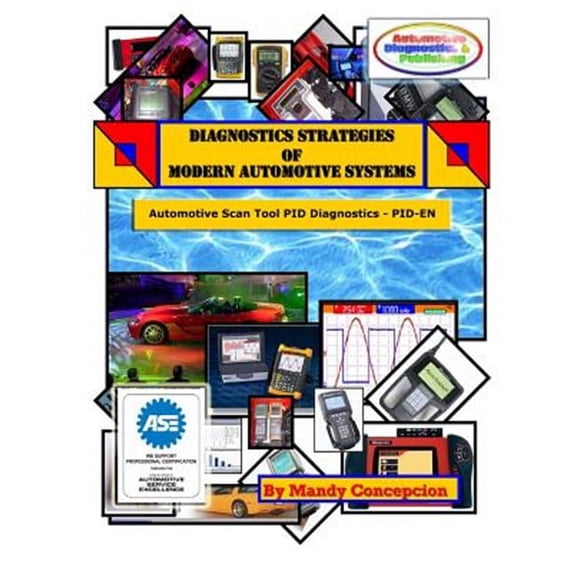
Hero image 0 of Automotive Scan Tool Pid Diagnostics : Diagnostic Strategies of Modern Automotive Systems, 0 of 1
Automotive Scan Tool Pid Diagnostics : Diagnostic Strategies of Modern Automotive Systems
(No ratings yet)
Key item features
Automotive Scan Tool PID Diagnostics (Diagnostics Strategies of Modern Automotive Systems ) By Mandy Concepcion In this section, the different techniques of scan tool parameter (PID) analysis will be exposed. Techniques involving PID analysis are quickly catching on, due to their speed and accuracy. By properly analyzing the different scanner PIDs, the technician can arrive at the source of the problem much faster and accurately. These procedures give rise to the new term "driver seat diagnostics", since most of the preliminary diagnostic work is done through the scanner. However, these techniques will in no way replace the final manual tests that are a part of every diagnostic path. They are simply geared to point the technician in the right direction. Table of Contents INTRODUCTION (Introduction to scan tool diagnostics and the relevance of using PIDs or scanner parameter to perform the first leg of all diagnostics.) - Theory of Operation Behind the Different PIDs (Describes CARB, the difference between generic and enhanced PIDs, the FTP) - OBD II Generic PIDs (PID calculated and actual values, calculated data relationships, base injection timing, ECM value substitution) - OBD I & II General PID analysis (erasing code-or not, recording, analyzing and pinpoint tests, separating PIDs into groups) - Fuel Delivery Fault Detection (fuel delivery issues, intake air temp. sensor, BARO sensor, Engine LOAD, RPM PID, Short-Term Fuel Trims, Long-Term Fuel Trims, 60% of check engine light issues, block learn/integrators, Example 1: injector fault, Example 2: intake gasket issues, fuel status, ignition timing, MAP/MAF, TPS, O2 sensor, IAC, Closed Throttle, injector pulse width, voltage power, injector dutycycle, fuel trim cell) - Test #1 (Determining an engine's fuel Consumption (rich-lean operation, duty-cycle to fuel trim relationship, O2 sensor to fuel trim relation, FT and vacuum leaks, ignition timing and idle control, test conclusion) - Test # 2 (Misfire Detection Strategy, EGR, Ignition and Mechanical misfires) (misfires and OBD2, scanner misfire detection - a time saver, OBD2 40 and 80 cycle misfire, ignition, injector and EGR density misfire, coil-on-plug, misfires and O2 sensor, lean O2 & Secondary misfire, O2 sensor & injector misfires, leaky injector, EGR and the MAP, Type A, B, C misfires, test conclusion) - Test # 3 (Air/Fuel Ratio Faults) (air-fuel imbalance, MAF and post O2 sensors, open-closed-loop, fuel enable, HC & CO relation to AF issues, test conclusion) - Test # 4 (BARO, MAP & MAF PID analysis) (MAP & valve timing faults, ECM behavior, fuel delivery or duty cycle test, volumetric efficiency, test conclusion) - Test # 5 (Clogged exhaust) (clogged catalytic converter detection, TPS, MAF and converters, idle and WOT or wide open throttle values, vacuum readings, MAP to WOT chats analysis, engine and MAP vacuum, test conclusion) - Test # 6 (EGR Fault Detection) (EGR and MAP values, ECM reaction to EGR issues, EGR temp sensor, DPFE sensor, EGR and O2-MAP and lift position sensor, EGR and engine pre-loading, EGR and the ECM erroneous high LOAD issues, test conclusion) - Test # 7 (O2 Sensor Heater) (O2 heaters and why?, tough to check O2 heater issues, O2 heater effect on signal output, O2 heater bias voltage, engine off and O2 changing value, test conclusion) - Test # 8 (Resetting Fuel Trims) (resetting injection pulse corrections, long-term and short-term fuel trims, learn condition, Lambda, case study on fuel trims, FT resetting according to manufacturer, test conclusion) - Test # 9 (Engine Cranking Vacuum Test) (MAP/MAF cranking vacuum, vacuum to PID analysis, vacuum leaks, gauge-PID test, sources of leaks, cranking values, test conclusion)
Specs
- Book formatPaperback
- Fiction/nonfictionNon-Fiction
- GenreNonfiction
- Pub date2011-01-01
- Pages64
- Number in series1
Current price is USD$28.63
Price when purchased online
- Free shipping
 Free 30-day returns
How do you want your item?
Columbus, 43215
Arrives between Apr 18 - Apr 21
|
Sold and shipped by Alibris Books
4.5643056849953405 stars out of 5, based on 10730 seller reviews(4.6)10730 seller reviews

Free 30-day returns
Other sellers
$28.37
+ $7.98 shippingShipping, arrives by Fri, Apr 17 to Columbus, 43215
Sold and shipped by Best Prices & Service
Free 30-day returns
About this item
Product details
Automotive Scan Tool Pid Diagnostics : Diagnostic Strategies of Modern Automotive Systems
Automotive Scan Tool PID Diagnostics (Diagnostics Strategies of Modern Automotive Systems ) By Mandy Concepcion In this section, the different techniques of scan tool parameter (PID) analysis will be exposed. Techniques involving PID analysis are quickly catching on, due to their speed and accuracy. By properly analyzing the different scanner PIDs, the technician can arrive at the source of the problem much faster and accurately. These procedures give rise to the new term "driver seat diagnostics", since most of the preliminary diagnostic work is done through the scanner. However, these techniques will in no way replace the final manual tests that are a part of every diagnostic path. They are simply geared to point the technician in the right direction. Table of Contents INTRODUCTION (Introduction to scan tool diagnostics and the relevance of using PIDs or scanner parameter to perform the first leg of all diagnostics.) - Theory of Operation Behind the Different PIDs (Describes CARB, the difference between generic and enhanced PIDs, the FTP) - OBD II Generic PIDs (PID calculated and actual values, calculated data relationships, base injection timing, ECM value substitution) - OBD I & II General PID analysis (erasing code-or not, recording, analyzing and pinpoint tests, separating PIDs into groups) - Fuel Delivery Fault Detection (fuel delivery issues, intake air temp. sensor, BARO sensor, Engine LOAD, RPM PID, Short-Term Fuel Trims, Long-Term Fuel Trims, 60% of check engine light issues, block learn/integrators, Example 1: injector fault, Example 2: intake gasket issues, fuel status, ignition timing, MAP/MAF, TPS, O2 sensor, IAC, Closed Throttle, injector pulse width, voltage power, injector dutycycle, fuel trim cell) - Test #1 (Determining an engine's fuel Consumption (rich-lean operation, duty-cycle to fuel trim relationship, O2 sensor to fuel trim relation, FT and vacuum leaks, ignition timing and idle control, test conclusion) - Test # 2 (Misfire Detection Strategy, EGR, Ignition and Mechanical misfires) (misfires and OBD2, scanner misfire detection - a time saver, OBD2 40 and 80 cycle misfire, ignition, injector and EGR density misfire, coil-on-plug, misfires and O2 sensor, lean O2 & Secondary misfire, O2 sensor & injector misfires, leaky injector, EGR and the MAP, Type A, B, C misfires, test conclusion) - Test # 3 (Air/Fuel Ratio Faults) (air-fuel imbalance, MAF and post O2 sensors, open-closed-loop, fuel enable, HC & CO relation to AF issues, test conclusion) - Test # 4 (BARO, MAP & MAF PID analysis) (MAP & valve timing faults, ECM behavior, fuel delivery or duty cycle test, volumetric efficiency, test conclusion) - Test # 5 (Clogged exhaust) (clogged catalytic converter detection, TPS, MAF and converters, idle and WOT or wide open throttle values, vacuum readings, MAP to WOT chats analysis, engine and MAP vacuum, test conclusion) - Test # 6 (EGR Fault Detection) (EGR and MAP values, ECM reaction to EGR issues, EGR temp sensor, DPFE sensor, EGR and O2-MAP and lift position sensor, EGR and engine pre-loading, EGR and the ECM erroneous high LOAD issues, test conclusion) - Test # 7 (O2 Sensor Heater) (O2 heaters and why?, tough to check O2 heater issues, O2 heater effect on signal output, O2 heater bias voltage, engine off and O2 changing value, test conclusion) - Test # 8 (Resetting Fuel Trims) (resetting injection pulse corrections, long-term and short-term fuel trims, learn condition, Lambda, case study on fuel trims, FT resetting according to manufacturer, test conclusion) - Test # 9 (Engine Cranking Vacuum Test) (MAP/MAF cranking vacuum, vacuum to PID analysis, vacuum leaks, gauge-PID test, sources of leaks, cranking values, test conclusion)
info:
We aim to show you accurate product information. Manufacturers, suppliers and others provide what you see here, and we have not verified it.
Specifications
Book format
Paperback
Fiction/nonfiction
Non-Fiction
Genre
Nonfiction
Pub date
2011-01-01
Warranty
Warranty information
Please be aware that the warranty terms on items offered for sale by third party Marketplace sellers may differ from those displayed in this section (if any). To confirm warranty terms on an item offered for sale by a third party Marketplace seller, please use the 'Contact seller' feature on the third party Marketplace seller's information page and request the item's warranty terms prior to purchase.
Customer ratings & reviews
0 ratings|0 reviews
This item does not have any reviews yet
