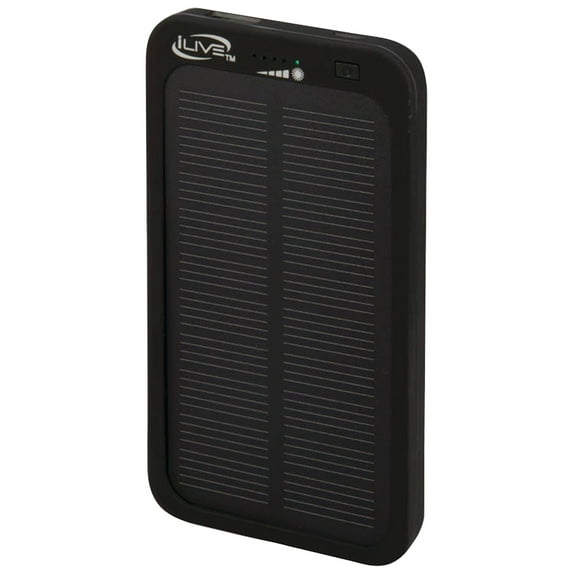
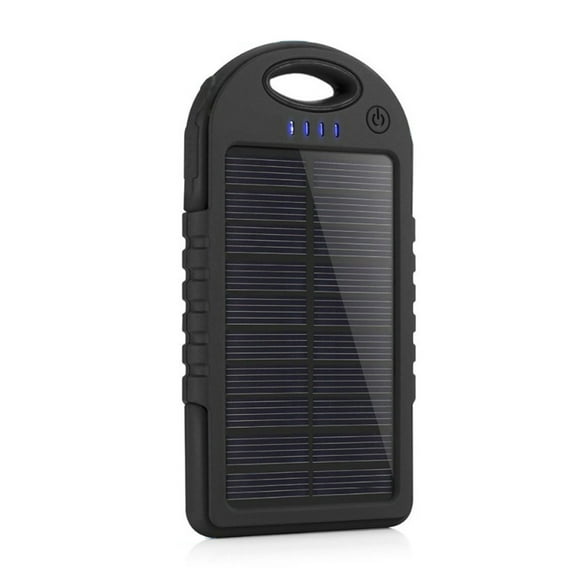
Product was received undamaged from Supplier. Product works as advertised. The Product came shipped with roughly 70% power already stored in the battery according to the device LED bar graph indicating available power. Per the first time use, the device was plugged in to initially bring the battery up to full power. This process was not actually timed but after 6 hours unattended, the device indicated it was fully charged and was removed from the external power source. This source was a laptops USB port, using the supplied USB charging cable. The device has never needed to be reattached to external power since. The Solar Panels pick up any available light seen and work to top off any power used. The device was obtained to provide a standalone power source to both a cell phone and an iPod Touch. When the iPod is not in use, it is plugged into the device and the display set to using a flashlight app. The iPod is then placed face down onto the solar panels. The resulting effect is the device powers the iPod and at the same time, the iPod is providing light to the solar panels maintaining a peak charge to them if they decline. This process has never depleted either of the batteries in either the device or the iPod, and provides continuous self generating charge to both, using a very simple exchange of light from the iPod to the solar panels to charge the reserve battery and at the same time, the reserve battery is providing power to recharge the iPods internal battery if the flashlight app drains it. Using this technique, the iPod no longer requires a physical charge cable to a wall socket to be recharged. The same process also used and tested on a brick style cell phone with similar results. Because both the phone and the iPod completely cover the solar panels, no external light is being used to drive the panels to charge the device battery. The light is provided by the flashlight app. As of this review, this energy exchange process and not resulted in any low battery conditions. This is a result of the fully charged device battery prior to first use. The solar panels are then used to maintain the peak charge when external devices are drawing from its battery. Light then just simply recharges it whenever there is enough of it present for the panels to convert into energy. As a simple School Science Fair Project the above process can be replicated to show how light is converted into energy and energy reconverted back into light again, using just two devices. The Product and another device that is able to produce light on its screen and cover the panels completely so no external light is permitted to be used by the panels. -- Acigan International, Research and Development Division.