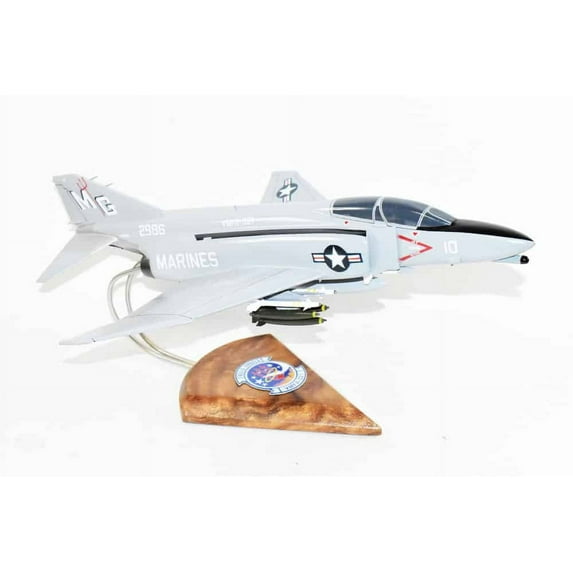
VMFA-321 1981 F-4N Model Fly with the VMFA-321 in this hand-crafted F-4 model. Each piece is carved from wood and hand-painted to provide a piece you'll love. Length - 18 inches Made from Mahogany US Veteran-Owned Business The product is not intended to be used by children 12 years and younger. The new model Phantom presented two challenges to the Hell's Angels: keeping the older F-4Ns in a mission-ready status throughout the transition, and ensuring a smooth transition to the F-4S. The squa- dron decided to emphasize air-to-air training because the pilots and RIOs would learn the F-4S' systems more quickly in that environment. An aggressive training program was established with two DACT detachments, one going to Oceana in September with four aircraft, and the second visiting Miramar in November with six aircraft. Coincidentally, the last F-4N in 321 retired on 30 November. Lieutenant Colonel Gould, who had flown Phan- toms in Vietnam with VMFA-314 and VMFA-122, remembered the first time he saw the F-4S in action: Our crews were scheduled for a 1 v 1 [F-4N vs F-4S] ACM sortie as part of the transition syllabus. The improved per- formance of the F-4S was immediately apparent. I flew against Major Tom Nicholson, who had prior F-4S time. I was impressed as I watched him convert his position from defensive to offensive, with my aircraft at his 6 o'clock in- side one-half mile. He took his F-4S through a loop begin- ning at 300 knots. I'd seen this maneuver before by low-wingloaded aircraft like the A-4, but not with such a high-wingloaded type as the F-4. 21 As VMFA-321 completed its transition to the F-4S in 1985, it also flew the impressive number of 3,109 flight hours for that year, 110 percent of the original- ly scheduled program, and a 28 percent increase over 1984's total. One reason for the increased flight time was the large number of exercises and training mis- sions with other squadrons, reflecting the Hell's An- gels' commitment to ACM training. VMFA-321 maintained the high operational tem- po in 1986 and 1987 by flying 2,917 hours and 2,944 hours, respectively. The squadron also participated in the regular series of exercises and visits with neigh- boring Navy, Marine, and Air Force squadrons across the country. Detachments visited NAS New Orleans in February, Nellis in March (where the F-4Ss flew against a wide variety of Navy and Air Force aircraft, as well as Royal Air Force Tornados), Oceana in May, and NAS Point Mugu, in addition to the regular train- ing at Yuma. On 15 January 1988, six squadron aircraft partici- pated in a ''Missing Man" formation flyover during the funeral at Arlington National Cemetery for Colonel Gregory "Pappy" Boyington, who died on 11 January. Boyington was one of the highest-scoring Marine aces of World War II.