

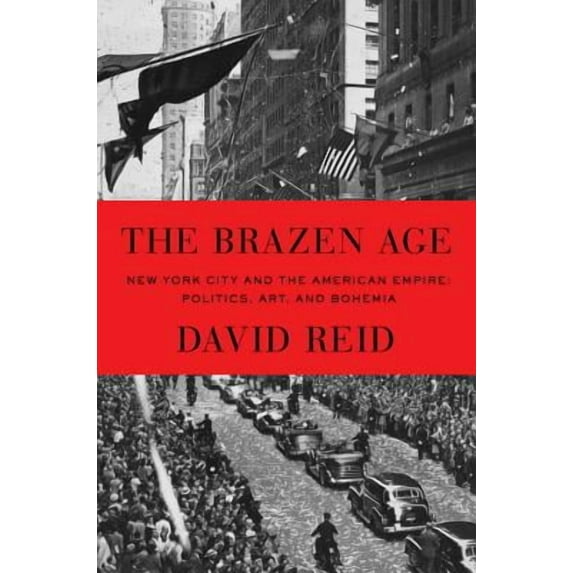
Hero image 0 of The Brazen Age : New York City and the American Empire: Politics, Art, and Bohemia, 0 of 1
The Brazen Age : New York City and the American Empire: Politics, Art, and Bohemia
(No ratings yet)
Key item features
A brilliant, sweeping, and unparalleled look at the extraordinarily rich culture and turbulent politics of New York City between the years 1945 and 1950, The Brazen Age opens with Franklin Delano Roosevelt’s campaign tour through the city’s boroughs in 1944. He would see little of what made New York the capital of modernity—though the aristocratic FDR was its paradoxical avatar—a city boasting an unprecedented and unique synthesis of genius, ambition, and the avant-garde. While concentrating on those five years, David Reid also reaches back to the turn of the twentieth century to explore the city’s progressive politics, radical artistic experimentation, and burgeoning bohemia.
From 1900 to 1929, New York City was a dynamic metropolis on the rise, and it quickly became a cultural nexus of new architecture; the home of a thriving movie business; the glittering center of theater and radio; and a hub of book, magazine, and newspaper publishing. In the 1930s, the rise of Hitler and World War II would send some of Europe’s most talented men and women to America’s shores, vastly enriching the fields of science, architecture, film, and arts and letters—the list includes Albert Einstein, Erwin Panofsky, Walter Gropius, George Grosz, André Kertész, Robert Capa, Thomas Mann, Hannah Arendt, Vladimir Nabokov, and John Lukacs.
Reid draws a portrait of the frenzied, creative energy of a bohemian Greenwich Village, from the taverns to the salons. Revolutionaries, socialists, and intelligentsia in the 1910s were drawn to the highly provocative monthly magazine The Masses, which attracted the era’s greatest talent, from John Reed to Sherwood Anderson, Djuna Barnes, John Sloan, and Stuart Davis. And summoned up is a chorus of witnesses to the ever-changing landscape of bohemia, from Malcolm Cowley to Anaïs Nin. Also present are the pioneering photographers who captured the city in black-and-white: Berenice Abbott’s dizzying aerial views, Samuel Gottscho’s photographs of the waterfront and the city’s architectural splendor, and Weegee’s masterful noir lowlife.
But the political tone would be set by the next president, and Reid looks closely at Thomas Dewey, Henry Wallace, and Harry Truman. James Forrestal, secretary of the navy under Roosevelt, would be influential in establishing a new position in the cabinet before ascending to it himself as secretary of defense under Truman, but not before helping to usher in the Cold War.
With The Brazen Age, David Reid has magnificently captured a complex and powerful moment in the history of New York City in the mid-twentieth century, a period of time that would ensure its place on the world stage for many generations.
From 1900 to 1929, New York City was a dynamic metropolis on the rise, and it quickly became a cultural nexus of new architecture; the home of a thriving movie business; the glittering center of theater and radio; and a hub of book, magazine, and newspaper publishing. In the 1930s, the rise of Hitler and World War II would send some of Europe’s most talented men and women to America’s shores, vastly enriching the fields of science, architecture, film, and arts and letters—the list includes Albert Einstein, Erwin Panofsky, Walter Gropius, George Grosz, André Kertész, Robert Capa, Thomas Mann, Hannah Arendt, Vladimir Nabokov, and John Lukacs.
Reid draws a portrait of the frenzied, creative energy of a bohemian Greenwich Village, from the taverns to the salons. Revolutionaries, socialists, and intelligentsia in the 1910s were drawn to the highly provocative monthly magazine The Masses, which attracted the era’s greatest talent, from John Reed to Sherwood Anderson, Djuna Barnes, John Sloan, and Stuart Davis. And summoned up is a chorus of witnesses to the ever-changing landscape of bohemia, from Malcolm Cowley to Anaïs Nin. Also present are the pioneering photographers who captured the city in black-and-white: Berenice Abbott’s dizzying aerial views, Samuel Gottscho’s photographs of the waterfront and the city’s architectural splendor, and Weegee’s masterful noir lowlife.
But the political tone would be set by the next president, and Reid looks closely at Thomas Dewey, Henry Wallace, and Harry Truman. James Forrestal, secretary of the navy under Roosevelt, would be influential in establishing a new position in the cabinet before ascending to it himself as secretary of defense under Truman, but not before helping to usher in the Cold War.
With The Brazen Age, David Reid has magnificently captured a complex and powerful moment in the history of New York City in the mid-twentieth century, a period of time that would ensure its place on the world stage for many generations.
Specs
- Book formatHardcover
- Fiction/nonfictionNon-Fiction
- GenreHistory
- Publication dateMarch, 2016
- Pages528
- EditionStandard Edition
Current price is USD$9.97
Price when purchased online
- Free shipping
 Free 30-day returns
How do you want your item?
Columbus, 43215
Arrives by Mon, Apr 27
|
Sold and shipped by High Five Distributing, Inc
4.645484949832776 stars out of 5, based on 299 seller reviews(4.6)299 seller reviews

Free 30-day returns - in store or online
More seller options (2)
Starting from $9.98
About this item
Product details
A brilliant, sweeping, and unparalleled look at the extraordinarily rich culture and turbulent politics of New York City between the years 1945 and 1950, The Brazen Age opens with Franklin Delano Roosevelt's campaign tour through the city's boroughs in 1944. He would see little of what made New York the capital of modernity--though the aristocratic FDR was its paradoxical avatar--a city boasting an unprecedented and unique synthesis of genius, ambition, and the avant-garde. While concentrating on those five years, David Reid also reaches back to the turn of the twentieth century to explore the city's progressive politics, radical artistic experimentation, and burgeoning bohemia. From 1900 to 1929, New York City was a dynamic metropolis on the rise, and it quickly became a cultural nexus of new architecture; the home of a thriving movie business; the glittering center of theater and radio; and a hub of book, magazine, and newspaper publishing. In the 1930s, the rise of Hitler and World War II would send some of Europe's most talented men and women to America's shores, vastly enriching the fields of science, architecture, film, and arts and letters--the list includes Albert Einstein, Erwin Panofsky, Walter Gropius, George Grosz, André Kertész, Robert Capa, Thomas Mann, Hannah Arendt, Vladimir Nabokov, and John Lukacs. Reid draws a portrait of the frenzied, creative energy of a bohemian Greenwich Village, from the taverns to the salons. Revolutionaries, socialists, and intelligentsia in the 1910s were drawn to the highly provocative monthly magazine The Masses, which attracted the era's greatest talent, from John Reed to Sherwood Anderson, Djuna Barnes, John Sloan, and Stuart Davis. And summoned up is a chorus of witnesses to the ever-changing landscape of bohemia, from Malcolm Cowley to Anaïs Nin. Also present are the pioneering photographers who captured the city in black-and-white: Berenice Abbott's dizzying aerial views, Samuel Gottscho's photographs of the waterfront and the city's architectural splendor, and Weegee's masterful noir lowlife. But the political tone would be set by the next president, and Reid looks closely at Thomas Dewey, Henry Wallace, and Harry Truman. James Forrestal, secretary of the navy under Roosevelt, would be influential in establishing a new position in the cabinet before ascending to it himself as secretary of defense under Truman, but not before helping to usher in the Cold War. With The Brazen Age, David Reid has magnificently captured a complex and powerful moment in the history of New York City in the mid-twentieth century, a period of time that would ensure its place on the world stage for many generations.
A brilliant, sweeping, and unparalleled look at the extraordinarily rich culture and turbulent politics of New York City between the years 1945 and 1950, The Brazen Age opens with Franklin Delano Roosevelt’s campaign tour through the city’s boroughs in 1944. He would see little of what made New York the capital of modernity—though the aristocratic FDR was its paradoxical avatar—a city boasting an unprecedented and unique synthesis of genius, ambition, and the avant-garde. While concentrating on those five years, David Reid also reaches back to the turn of the twentieth century to explore the city’s progressive politics, radical artistic experimentation, and burgeoning bohemia.
From 1900 to 1929, New York City was a dynamic metropolis on the rise, and it quickly became a cultural nexus of new architecture; the home of a thriving movie business; the glittering center of theater and radio; and a hub of book, magazine, and newspaper publishing. In the 1930s, the rise of Hitler and World War II would send some of Europe’s most talented men and women to America’s shores, vastly enriching the fields of science, architecture, film, and arts and letters—the list includes Albert Einstein, Erwin Panofsky, Walter Gropius, George Grosz, André Kertész, Robert Capa, Thomas Mann, Hannah Arendt, Vladimir Nabokov, and John Lukacs.
Reid draws a portrait of the frenzied, creative energy of a bohemian Greenwich Village, from the taverns to the salons. Revolutionaries, socialists, and intelligentsia in the 1910s were drawn to the highly provocative monthly magazine The Masses, which attracted the era’s greatest talent, from John Reed to Sherwood Anderson, Djuna Barnes, John Sloan, and Stuart Davis. And summoned up is a chorus of witnesses to the ever-changing landscape of bohemia, from Malcolm Cowley to Anaïs Nin. Also present are the pioneering photographers who captured the city in black-and-white: Berenice Abbott’s dizzying aerial views, Samuel Gottscho’s photographs of the waterfront and the city’s architectural splendor, and Weegee’s masterful noir lowlife.
But the political tone would be set by the next president, and Reid looks closely at Thomas Dewey, Henry Wallace, and Harry Truman. James Forrestal, secretary of the navy under Roosevelt, would be influential in establishing a new position in the cabinet before ascending to it himself as secretary of defense under Truman, but not before helping to usher in the Cold War.
With The Brazen Age, David Reid has magnificently captured a complex and powerful moment in the history of New York City in the mid-twentieth century, a period of time that would ensure its place on the world stage for many generations.
From 1900 to 1929, New York City was a dynamic metropolis on the rise, and it quickly became a cultural nexus of new architecture; the home of a thriving movie business; the glittering center of theater and radio; and a hub of book, magazine, and newspaper publishing. In the 1930s, the rise of Hitler and World War II would send some of Europe’s most talented men and women to America’s shores, vastly enriching the fields of science, architecture, film, and arts and letters—the list includes Albert Einstein, Erwin Panofsky, Walter Gropius, George Grosz, André Kertész, Robert Capa, Thomas Mann, Hannah Arendt, Vladimir Nabokov, and John Lukacs.
Reid draws a portrait of the frenzied, creative energy of a bohemian Greenwich Village, from the taverns to the salons. Revolutionaries, socialists, and intelligentsia in the 1910s were drawn to the highly provocative monthly magazine The Masses, which attracted the era’s greatest talent, from John Reed to Sherwood Anderson, Djuna Barnes, John Sloan, and Stuart Davis. And summoned up is a chorus of witnesses to the ever-changing landscape of bohemia, from Malcolm Cowley to Anaïs Nin. Also present are the pioneering photographers who captured the city in black-and-white: Berenice Abbott’s dizzying aerial views, Samuel Gottscho’s photographs of the waterfront and the city’s architectural splendor, and Weegee’s masterful noir lowlife.
But the political tone would be set by the next president, and Reid looks closely at Thomas Dewey, Henry Wallace, and Harry Truman. James Forrestal, secretary of the navy under Roosevelt, would be influential in establishing a new position in the cabinet before ascending to it himself as secretary of defense under Truman, but not before helping to usher in the Cold War.
With The Brazen Age, David Reid has magnificently captured a complex and powerful moment in the history of New York City in the mid-twentieth century, a period of time that would ensure its place on the world stage for many generations.
info:
We aim to show you accurate product information. Manufacturers, suppliers and others provide what you see here, and we have not verified it.
Specifications
Book format
Hardcover
Fiction/nonfiction
Non-Fiction
Genre
History
Publication date
March, 2016
Warranty
Warranty information
Please be aware that the warranty terms on items offered for sale by third party Marketplace sellers may differ from those displayed in this section (if any). To confirm warranty terms on an item offered for sale by a third party Marketplace seller, please use the 'Contact seller' feature on the third party Marketplace seller's information page and request the item's warranty terms prior to purchase.
Similar items you might like
Based on what customers bought
The Elder and His Work, (Paperback) $6.99
 $699current price $6.99
The Elder and His Work, (Paperback)
2025 People Magazine Crossword Puzzles For Adults: Engage with Historical Figures, Celebrities, and More in Every Challe, (Paperback) $7.99
 $799current price $7.99
2025 People Magazine Crossword Puzzles For Adults: Engage with Historical Figures, Celebrities, and More in Every Challe, (Paperback)
The Only Game in Town: Sportswriting from the New Yorker, (Paperback) $15.99 Was $44.83
 $1599current price $15.99, Was $44.83$44.83
The Only Game in Town: Sportswriting from the New Yorker, (Paperback)
Nineteen Sixty-Eight in America: Music, Politics, Chaos, Counterculture, and the Shaping of a Generation $10.49
 $1049current price $10.49
Nineteen Sixty-Eight in America: Music, Politics, Chaos, Counterculture, and the Shaping of a Generation
Pre-Owned The Bone House (Bright Empires, 2) (Hardcover) 159554805X 9781595548054 $5.92
 $592current price $5.92
Pre-Owned The Bone House (Bright Empires, 2) (Hardcover) 159554805X 9781595548054
133.9 out of 5 Stars. 13 reviewsConscience: What It Is, How to Train It, and Loving Those Who Differ, (Paperback) $19.39
 $1939current price $19.39
Conscience: What It Is, How to Train It, and Loving Those Who Differ, (Paperback)
Blitz - by David Horowitz (Hardcover) $8.50
 $850current price $8.50
Blitz - by David Horowitz (Hardcover)
424.7 out of 5 Stars. 42 reviewsDark Agenda: The War to Destroy Christian America $10.55
 $1055current price $10.55
Dark Agenda: The War to Destroy Christian America
184.8 out of 5 Stars. 18 reviewsPre-Owned One Nation Under God: Christian Faith and Political Action in America (Hardcover) 0060663030 9780060663032 $6.08
 $608current price $6.08
Pre-Owned One Nation Under God: Christian Faith and Political Action in America (Hardcover) 0060663030 9780060663032
And David Perceived He Was King, (Paperback) $13.51
 $1351current price $13.51
And David Perceived He Was King, (Paperback)
115 out of 5 Stars. 11 reviews1/3/06 $5.41
 $541current price $5.41
1/3/06
25 out of 5 Stars. 2 reviewsThe Conspiracy to End America: Five Ways My Old Party Is Driving Our Democracy to Autocracy (Hardcover) $9.49 Was $15.84
 $949current price $9.49, Was $15.84$15.84
The Conspiracy to End America: Five Ways My Old Party Is Driving Our Democracy to Autocracy (Hardcover)
25 out of 5 Stars. 2 reviewsHow to Become a Christian (American Tract Society 25-Pack), (Paperback) $9.36
 $936current price $9.36
How to Become a Christian (American Tract Society 25-Pack), (Paperback)
Pre-Owned The Good Soldiers (Hardcover) by David Finkel $4.28 Was $6.49
 $428current price $4.28, Was $6.49$6.49
Pre-Owned The Good Soldiers (Hardcover) by David Finkel


Customer ratings & reviews
0 ratings|0 reviews
This item does not have any reviews yet

Related pages
- Ny Po
- Zurich Canton
- Nahum 1804-1886 Ed Capen; John 1735-1826 Adams; Boston Public Library) John Adams Lib
- Tourism Zurich
- Northern Pakistan
- Stores Amsterdam Ny
- Caribbean & Latin American Political Books
- General Middle East Travel Books, Maps & Guides
- Cuban History Books
- Central America History Books
- Western Europe Travel Books
- Australian & New Zealand History Books