

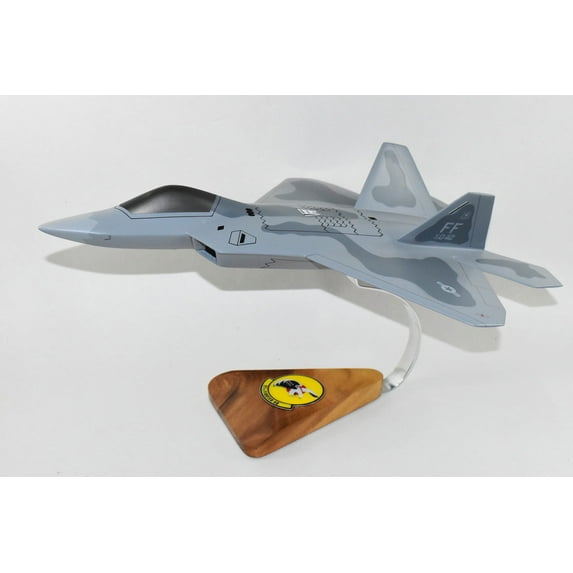
Lockheed Martin® F-22 Raptor®, 27th FS Fighting Eagles, Mahogany Scale Model
(No ratings yet)
Key item features
- Handmade
- Naval Aviator Owned Business
- Made from Mahogany
Specs
 BrandSquadron Nostalgia
 MaterialMahogany
 ColorGray
 Age range12 Years & Up
Price when purchased online
Not Available
How do you want your item?
Not available
About this item
Product details
Lockheed Martin® F-22 Raptor®, 27th FS Fighting Eagles Fly with the 27th FS Fighting Eagles in this hand-crafted Lockheed Martin F-22 Raptor model. Each piece is carefully carved from wood and hand painted to provide a model you’ll love. Length - 18 inches Made from Mahogany US Veteran-Owned Business Officially Licensed by Lockheed Martin The product is not intended to be used by children 12 years and younger. LOCKHEED MARTIN®, F-22 Raptor®, associated emblems and logos, and body designs of vehicles are either registered trademarks or trademarks of Lockheed Martin Corporation in the USA and/or other jurisdictions, used under license by Squadron Nostalgia LLC During World War I, the squadron was based at Toul (5 May 1918), Touquin (28 June 1918), Saints (9 July 1918) and Rembercourt (1 September 1918). Lieutenant Frank Luke, Jr., known as the "Arizona Balloon Buster," for his daring feats against German observation balloons, was the squadron's most colorful ace. His 18 victories cost him his life, and he was awarded the Medal of Honor. Aircraft flown by the 27th during World War I include the Nieuport 28, Spad XIII and Sopwith F-1 Camel. Between the wars In the period between the world wars, the 27th Pursuit Squadron, re-designated 25 January 1923, was stationed primarily at Selfridge Field, Michigan, with the 1st Fighter Group. 27th Pursuit Squadron pilots participated in air races. In 1922, Lt. Donald Stace of the 27th AS won the first Mitchell Trophy Race. Under extreme and austere conditions in the 1920s they tested the effects of cold weather on their aircraft. At times it was so cold, the engines of their P-1 Hawk aircraft would not start until steam was forced into the engines to thaw them. While they were stationed at Selfridge Field, Mich., pilots from the 27th AS put on aerial demonstrations all over the country throughout the 1920s. One of those was at Langley Field in March, 1925. A large silhouette of a battleship on the grass landing strip served as a target, which was successfully strafed and bombed for several duly impressed congressmen. The 1930s saw more training, additional cold weather tests and more modern aircraft. They participated in several air shows throughout the country, and even though they were in the military, the 27th Pursuit Squadron delivered the mail for a while. One of the pilots in this failed experiment went onto lead Strategic Air Command, then Lt. Curtis E. LeMay. World War II At the beginning of the United States' involvement in World War II, the 27th Fighter Squadron, redesignated 15 May 1942, briefly served in anti-submarine duty at San Diego Naval Air Station and in air defense duty at Reykjavík, Iceland. From October 1942 until May 1945, the 27th participated in the European and Mediterranean theaters of operation, flying Lockheed P-38 Lightnings. The squadron won three Distinguished Unit Citations in Italy 25 August 1943, and 30 August 1943; and at Ploesti, Romania, 18 May 1944. The 27th Fighter Squadron was the top-scoring unit of the 1st Fighter Group in World War II, with 83 of its pilots credited with 176.5 victories. Cold War Following World War II, the 27th was stationed at March Field, California, flying P-80 Shooting Stars, the United States' first operational jet aircraft. Upon the unit's redesignation as the 27th Fighter Interceptor Squadron, it moved to Niagara Falls Air Force Station, New York, flying the F-86, F-89 and F-94C aircraft while stationed at Griffis Air Force Base in Rome N.Y. until receiving the F-102 Delta Dagger in 1957. In October 1959, the 27th was transferred to Loring Air Force Base, Maine, where it assumed an air defense role flying F-106 Delta Darts in the Bangor Air Defense Sector. On 22 October 1962, before President John F. Kennedy told Americans that missiles were in place in Cuba, the squadron dispersed one third of its force, equipped with nuclear tipped missiles to Olmsted Air Force Base at the start of the Cuban Missile Crisis.[5][6] These
- Handmade
- Naval Aviator Owned Business
- Made from Mahogany
info:
We aim to show you accurate product information. Manufacturers, suppliers and others provide what you see here, and we have not verified it.
Specifications
Play vehicle type
Plane & Helicopter Play Vehicles
Brand
Squadron Nostalgia
Material
Mahogany
Color
Gray
Customer ratings & reviews
0 ratings|0 reviews
This item does not have any reviews yet
