

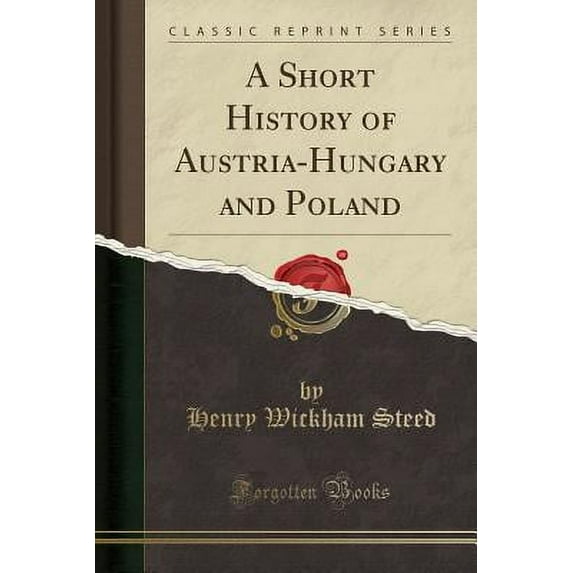
A Short History of Austria-Hungary and Poland (Classic Reprint)
(No ratings yet)
Key item features
Excerpt from A Short History of Austria-Hungary and Poland The empire of Austria, as the official designation of the territories ruled by the Habs burg monarchy, dates back only to 1804, when Francis II., the last of the Holy Roman emperors, proclaimed himself emperor of Austria as Francis I. His motive in doing so was to guard against the great house of Habsburg being relegated to a position inferior to the parvenus Bonapartes, in the event of the final collapse of the Holy Roman Empire, or of the possible election of Napoleon as his own successor on the throne of Charlemagne. The title emperor of Austria, then, replaced that of Imperator Romanorum semper Augustus when the Holy Empire came to an end in 1806. From the first, however, it was no more than a title, which represented but ill the actual relation of the Habsburg sovereigns to their several states. Magyars and Slavs never willingly recognized a style which ignored their national rights and implied the superi ority of the German elements of the monarchy to the Germans it was a poor substi tute for a title which had represented the political unity of the German race under the Holy Empire. For long after the Vienna Congress of 1814 - 1815 the Kaiser as such exercised a powerful influence over the imaginations of the German people outside the Habsburg dominions but this was because the title was still surrounded with its ancient halo and the essential change was not at once recognized. The out come of the long struggle with Prussia, which in 1866 finally broke the spell, and the proclamation of the German empire in 1871 left the title of emperor of Austria stripped of everything but a purely territorial significance. It had, moreover, by the compact with Hungary of 1867, ceased even fully to represent the relation of the emperor to all his dominions and the title which had been devised to cover the whole of the Habs burg monarchy sank into the official style of the sovereign of but a half while even within the Austrian empire proper it is resented by those peoples which, like the Bohemians, wish to obtain the same recognition of their national independence as was conceded to Hungary. In placing the account of the origin and development of the Habsburg monarchy under this heading, it is merely for the sake of convenience. About the Publisher Forgotten Books publishes hundreds of thousands of rare and classic books. Find more at www.forgottenbooks.com This book is a reproduction of an important historical work. Forgotten Books uses state-of-the-art technology to digitally reconstruct the work, preserving the original format whilst repairing imperfections present in the aged copy. In rare cases, an imperfection in the original, such as a blemish or missing page, may be replicated in our edition. We do, however, repair the vast majority of imperfections successfully; any imperfections that remain are intentionally left to preserve the state of such historical works.
Specs
- Book formatPaperback
- Fiction/nonfictionNon-Fiction
- GenreHistory/Europe - General
- Publication dateApril, 2018
- Pages192
- PublisherFb&c Ltd
Current price is USD$29.16
Price when purchased online
Out of stock
How do you want your item?
Out of stock
About this item
Product details
Excerpt from A Short History of Austria-Hungary and Poland The empire of Austria, as the official designation of the territories ruled by the Habs burg monarchy, dates back only to 1804, when Francis II., the last of the Holy Roman emperors, proclaimed himself emperor of Austria as Francis I. His motive in doing so was to guard against the great house of Habsburg being relegated to a position inferior to the parvenus Bonapartes, in the event of the final collapse of the Holy Roman Empire, or of the possible election of Napoleon as his own successor on the throne of Charlemagne. The title emperor of Austria, then, replaced that of Imperator Romanorum semper Augustus when the Holy Empire came to an end in 1806. From the first, however, it was no more than a title, which represented but ill the actual relation of the Habsburg sovereigns to their several states. Magyars and Slavs never willingly recognized a style which ignored their national rights and implied the superi ority of the German elements of the monarchy to the Germans it was a poor substi tute for a title which had represented the political unity of the German race under the Holy Empire. For long after the Vienna Congress of 1814 - 1815 the Kaiser as such exercised a powerful influence over the imaginations of the German people outside the Habsburg dominions but this was because the title was still surrounded with its ancient halo and the essential change was not at once recognized. The out come of the long struggle with Prussia, which in 1866 finally broke the spell, and the proclamation of the German empire in 1871 left the title of emperor of Austria stripped of everything but a purely territorial significance. It had, moreover, by the compact with Hungary of 1867, ceased even fully to represent the relation of the emperor to all his dominions and the title which had been devised to cover the whole of the Habs burg monarchy sank into the official style of the sovereign of but a half while even within the Austrian empire proper it is resented by those peoples which, like the Bohemians, wish to obtain the same recognition of their national independence as was conceded to Hungary. In placing the account of the origin and development of the Habsburg monarchy under this heading, it is merely for the sake of convenience. About the Publisher Forgotten Books publishes hundreds of thousands of rare and classic books. Find more at www.forgottenbooks.com This book is a reproduction of an important historical work. Forgotten Books uses state-of-the-art technology to digitally reconstruct the work, preserving the original format whilst repairing imperfections present in the aged copy. In rare cases, an imperfection in the original, such as a blemish or missing page, may be replicated in our edition. We do, however, repair the vast majority of imperfections successfully; any imperfections that remain are intentionally left to preserve the state of such historical works.
info:
We aim to show you accurate product information. Manufacturers, suppliers and others provide what you see here, and we have not verified it.
Specifications
Book format
Paperback
Fiction/nonfiction
Non-Fiction
Genre
History/Europe - General
Publication date
April, 2018
Warranty
Warranty information
Please be aware that the warranty terms on items offered for sale by third party Marketplace sellers may differ from those displayed in this section (if any). To confirm warranty terms on an item offered for sale by a third party Marketplace seller, please use the 'Contact seller' feature on the third party Marketplace seller's information page and request the item's warranty terms prior to purchase.
Customer ratings & reviews
0 ratings|0 reviews
This item does not have any reviews yet

Related pages
- Post-Confederation Canadian History Books
- Middle Atlantic State & Local United States History Books
- Italy Presidents
- Pre-Confederation Canadian History Books
- 1923 Events 20th Century United States History Books
- General Canadian History Books
- States Liberty
- 1920 Federal Census
- History Of Labor In The United States
- Washington Post Cover
- Reference History Books
- Austria & Hungary History Books