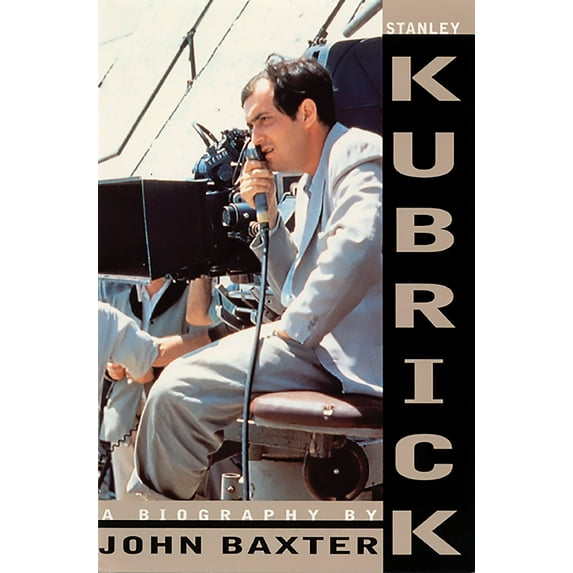
For decades, the films of Stanley Kubrick have staked out a claim at the core of the cultural landscape. In the 1950s he was one of the few American filmmakers, with Paths of Glory, to achieve the gravitas of European cinema. To 1960s audiences he was the man who made Dr. Strangelove, the influential anti-war movie, and the counterculture favorite 2001: A Space Odyssey. In the 1970s he created his hymn to urban violence, A Clockwork Orange, and in the 1980s distilled the nature of private madness and collective insanity in The Shining and Full Metal Jacket.Yet little is still known of the man and the influence exerted by his private life on his public art. Born in the Bronx, Kubrick has lived since 1961 in seclusion in rural England. From in-depth interviews with a range of people who have known the man best, from his childhood to the present, John Baxter has extracted the most complete account available of Kubrick's life: the conflicts with partners and stars, the failure to make Napoleon, the failed marriages and broken friendships, the use and abuse of writers and other creative collaborators.Kubrick emerges from this detailed and complex telling as a man both sensitive and ruthless, petulant and generous: a man who adulates reason but whose films reflect the wildest excesses of passion and who, above all, has dared to live life on his terms, whatever the price.
Publishers Weekly,The Bronx-born director of Dr. Strangelove, 2001: A Space Odyssey and A Clockwork Orange has lived reclusively in England since 1961. This somewhat prosaic life serves as a breezy introduction to his acclaimed oeuvre, but does not bring us closer to the man than others have managed. Baxter, a British novelist and author of studies of John Ford, Steven Spielberg and other directors, focuses on the professional life of the filmmaker by tracing the development of each of his dozen feature films of the past 44 years. He acknowledges Kubrick's personal and professional flaws���his ruthless exploitation of collaborators; his antiseptic, even misanthropic view of the world; his dependence on (and contempt for) the writers who provide him with stories to film���while emphasizing the visual flair and maverick independence that have made him one of the most admired figures in contemporary cinema. But there's little new in all of this. While Baxter interviewed some figures in Kubrick's circle (though not, unsurprisingly, the notoriously reclusive master himself), he relies heavily on the dozens of books that have discussed the director's life and work, many of them full-scale studies. This might not be a problem if Baxter had a clear and compelling interpretive contribution to make to this discussion, but his aim seems to be merely to collect all the known facts. Readers are more likely to find satisfaction in Vincent LoBrutto's longer, identically titled 1996 biography. Photos. 20,000 first printing. (Oct.) FYI: The book's release anticipates that of Eyes Wide Shut, Kubrick's first film since 1987's Full Metal Jacket. (c) Copyright PWxyz, LLC. All rights reserved