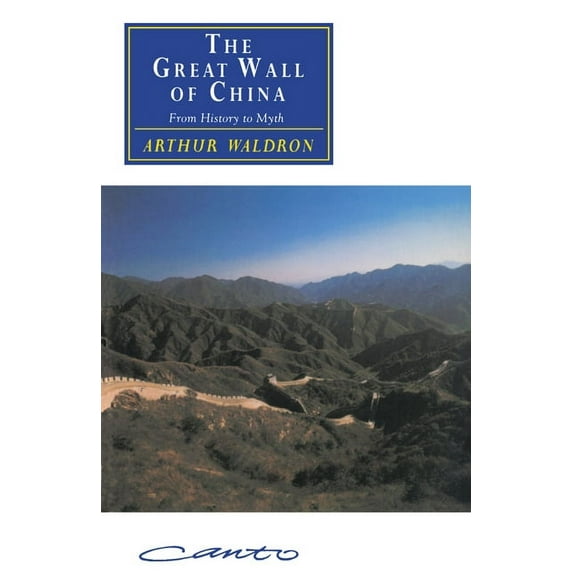
The Great Wall of China is renowned as one of the most impressive and intriguing man-made structures on earth. It is also the subject of an awesome mythology, embedded in both learned and popular imaginations, which has grown up and now obscured the historical record. Even the maps which chart the Wall's position offer erroneous accounts of a phenomenon which has never been accurately surveyed. Arthur Waldron reveals that the notion of an ancient and continuously existing Great Wall, one of modern China's national symbols and a legend in the eyes of the West, is in fact a myth. His fascinating account reveals the strategic and political context for the decision to build walls as fortified defences, and explores its profound implications for nomadic and agricultural life under the Ming dynasty. Taking up the insights offered into more recent Chinese politics, the book concludes with a searching investigation of the Wall's new meanings in the myths - departing from that history - fostered in our own century.
Publishers Weekly,China's modern rulers have nurtured the popular myth that the Great Wall of China is a single, continuous barrier built in the third century B.C. and surviving to the present. Actually, as Princeton historian Waldron demonstrates in a landmark study, most of what we today call the Great Wall was built during the Ming dynasty (1368-1644). Despotic, palace-reared Ming rulers, fearful of a potential invasion by Mongols and other nomads, chose wall-building over trade or diplomatic relations. But the Ming fortifications, like the French Maginot Line, proved ineffective: Manchu warriors entered China in 1644, captured Peking and established the Ch'ing dynasty, a vast multiethnic empire which lasted until 1912. The Great Wall became a symbol of failure and irrelevance. Its recent transformation into China's unofficial national symbol is an enigma deftly unraveled in Waldron's investigation, one of the few books that change our basic assumptions about China. Illustrations. History Book Club selection. (Aug.) (c) Copyright PWxyz, LLC. All rights reserved