

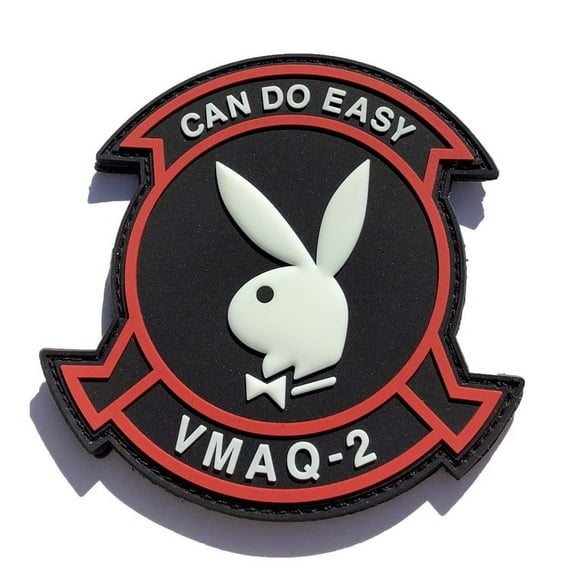
VMAQ-2 PVC Patches -Hook and Loop
(No ratings yet)
Key item features
- Veteran Owned Business
- Wear or Display
- Patch
Specs
- Sewing patch & applique typeSew-On Appliques
- BrandSquadron Nostalgia
Price when purchased online
Not Available
How do you want your item?
Not available
About this item
Product details
VMAQ-2 Playboys PVC Patches This is a 4" VMAQ-2 Playboys PVC patch. PVC Patch US Veteran Owned Business Marine Tactical Electronic Warfare Squadron 2 (VMAQ-2) was a United States Marine Corps electronic warfare squadron in service from 1952 to 2019. It was the last squadron flying the EA-6B Prowler. Mission Its mission was to support the Marine Air-Ground Task Force (MAGTF) commander by conducting airborne electronic warfare, day or night, under all weather conditions during expeditionary, joint, or combined operations. The squadron was based at Marine Corps Air Station Cherry Point, North Carolina and fell under the command of Marine Aircraft Group 14 (MAG-14) and the 2nd Marine Aircraft Wing (2nd MAW). History VMAQ-2's predecessor squadrons flew various electronic warfare aircraft, including the AD-5 Skyraider, the EF-10 Skyknight, and the EA-6A Intruder. VMC-2 was the original composite squadron (combined aerial photographic reconnaissance and electronic warfare capability) in Marine Corps aviation. It was commissioned at Marine Corps Air Station Cherry Point on September 15, 1952 evolving from the former Airborne Early Warning and Electronic Counter Measures section of the Wing Headquarters Squadron. On December 1, 1955, the squadron was redesignated as VMCJ-2 after former Marine Photographic Squadron 2 (VMJ-2) was decommissioned and joined VMC-2, and became VMCJ-2 (Marine Composite Jamming Squadron 1). As 1955 was also the year Playboy magazine was first published, it soon followed that the squadron adopted the Playboy name and logo with their permission. In December 1960, VMCJ-2 provided electronic and photographic intelligence during the Cuban Missile Crisis that enabled President Kennedy to make key decisions that would lead to the removal of Soviet military equipment from Cuba. In 1964 VMCJ-2 participated in Operation Steel Pike, the largest amphibious training exercise in history. The unit sailed from Morehead City, NC to the Naval Base at Rota, Spain and flew both photographic and electronic warfare missions during the exercise. Vietnam War Less than three years after the end of the Cuban Missile Crisis, some of the same VMCJ-2 aircrews deployed with VMCJ-1 to Vietnam and applied their lessons learned against Cuba as the EF-10Bs began to provide ECM support for air strikes against North Vietnamese targets. Beginning in the Spring of 1966 the squadron began sending Marines to join VMCJ-1 in Vietnam for 13-month tours. In late November 1965, VMCJ-2 received the first EA-6A Electric Intruder. With the rapidly escalating North Vietnamese air defenses this new EW aircraft was anxiously awaited by VMCJ-1 still flying the outdated EF-10B Skyknights, However, the initial EW systems delivered with the new aircraft proved unsuitable for the mission without some major modifications. Given the urgency, the decision was made to make the modifications by a contractor team on-site at VMCJ-2. The success of this effort was due to the dedicated support of VMCJ-2 personnel who worked tirelessly to get the aircraft ready for deployment to Vietnam. During this same time period the squadron received the first of its RF-4Bs and for several months the squadron was flying four different aircraft types. In October, 1966 VMCJ-2 sent six EA-6As with full maintenance capability to Danang, Vietnam as a VMCJ-1 replacement cadre. The squadron would continue to provide replacement aircrews and updated aircraft to VMCJ-1 in Vietnam. In 1971 the squadron deployed the first EA-6A detachment aboard USS Forrestal (CV-59) for a Mediterranean cruise that lasted 10 months with cross decking to USS Saratoga (CV-60) and USS America (CV-66). In April 1972 the squadron diverted an EA-6A detachment that was scheduled to deploy on the Saratoga in the Mediterranean to WESTPAC to join VMCJ-1 at NAS Cubi Point. The VMCJ-2 detachment operated in concert with VMCJ-1 to support strikes against North Vietnam under Operation Linebacker that ended with the release of
- Veteran Owned Business
- Wear or Display
- Patch
info:
We aim to show you accurate product information. Manufacturers, suppliers and others provide what you see here, and we have not verified it.
Specifications
Sewing patch & applique type
Sew-On Appliques
Brand
Squadron Nostalgia
Customer ratings & reviews
0 ratings|0 reviews
This item does not have any reviews yet
