

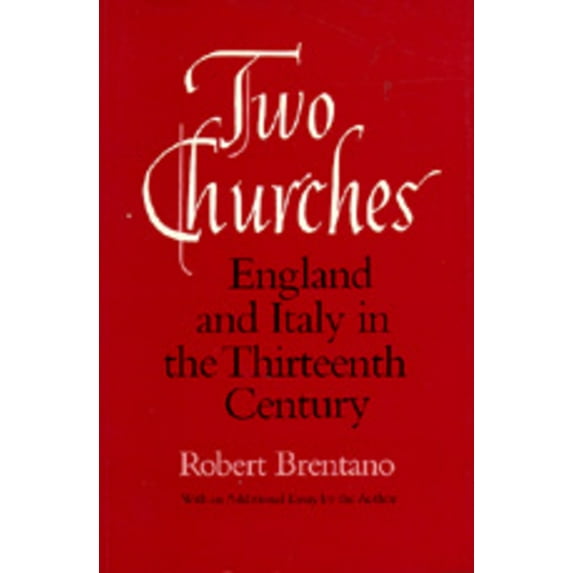
Two Churches : England and Italy in the Thirteenth Century, With an additional essay by the Author. (Edition 1) (Paperback)
(No ratings yet)
Key item features
This book is not meant to be a definitive exploration of the whole of the two churches in any case. The attempt would be absurd. But the book is not meant, either, to be an intense exploration of "certain aspects" of the two churches. It is meant rather to be an extended essay about the connected differences between the two churches, to use "aspects" as touchstones for comparison. It is meant to be a comparison of two total styles. These are not architectural styles, although there is a marked and significant difference between English and Italian ecclesiastical architecture in the thirteenth century. The nonarchitectural style of the thirteenth-century Italian church might in fact be called sustained Romanesque, or perhaps sustained Burgundian.
Comparing England (or Britain) with Italy in order to expose more fully one or both is not a new idea. Historians, like Tacitus and Collingwood, have made the comparison, and so have poets, like Browning and, with superb intellectuality, Clough. This is, at least locally, where angels feared to tread. The famous Venetian Anonymous wrote from the other side in his Relation (of about 1500), and condensed for us his comparison in the observation that unlike the Italians the English felt no real love, only lust. The spring bough and the melon-flower, Collingwood's city and field—the long continuity of the difference is startlingly apparent. Explaining the continuity (and perhaps there is no more difficult sort of historical explanation—its difficulty is painful to the mind) is not the job that this book sets itself. But it would be dull and dishonest to ignore the fact that the continuity exists. All that this book has to say may be no more than that the thirteenthcentury Italian church was in fact, as Browning warned, a melon-flower. The book may be only a gloss on amore. The symbol is more inclusive, more evocative, less guilty of excluding the essential but undefined, than detailed description can be. Melon-flower and amore, however, fortunately for the purpose of this book, say very little about the intricate, connected detail of administrative history. Collingwood's (after Tacitus's) city against field presses less deeply but says more. The general difference between the styles of the English and Italian churches has a great deal to do, and very directly, with the fact that the inhabitants of Italy were continually city-dwellers and the inhabitants of Britain were essentially not.
Although this book is about both England and Italy, it approaches them differently. The thirteenth-century Italian church is, particularly in English and French, practically unknown. Before it can be explained or analyzed, it must be recreated, formed again in detail. The job is in part really archaeological. The outline of past existence must be uncovered. This is not at all true of the thirteenth-century English church. It has been well explored. This disparity in past observation forces my book to talk much more of Italy than of England; but, if it is a book about one church rather than the other, it is a book about England. England is meant to be seen, for a change, against what it was not. In this sort of profile it has a different look. England may no longer seem a country in the frozen North, incapable, in the distance, of responding fully to Lateran enthusiasm. Its full response to ecclesiastical government may seem clearly connected with its, of course relatively, full response to secular government.
Specs
- Book formatPaperback
- Fiction/nonfictionNon-Fiction
- GenreReligion
- Publication dateFebruary, 1988
- Pages432
- SubgenreChristianity
Current price is USD$29.37
Price when purchased online
 Free 90-day returns
How do you want your item?
Try 30 days of Free Shipping with Walmart+! Choose plan at checkout.
Columbus, 43215
Arrives by Sat, Apr 25
.Order within 6 hr 29 min
Sold and shipped by Walmart.com

Free 90-day returns - in store or online

This item is gift eligible
More seller options (3)
Starting from $46.31

Get free delivery, shipping and more*
*Restrictions apply Try Walmart+ now
Similar items you might like
Based on what customers bought
A Medieval Cabinet of Curiosities, (Paperback) $24.45
 $2445current price $24.45
A Medieval Cabinet of Curiosities, (Paperback)
The Debate on the Crusades, 1099-2010 $30.94
 $3094current price $30.94
The Debate on the Crusades, 1099-2010
Crusading in Context Rewriting the First Crusade: Epistolary Culture in the Middle Ages, Book 6, (Paperback) $29.99
 $2999current price $29.99
Crusading in Context Rewriting the First Crusade: Epistolary Culture in the Middle Ages, Book 6, (Paperback)
Manchester Medieval Studies Approaching the Bible in Medieval England, Book 8, (Paperback) $26.95
 $2695current price $26.95
Manchester Medieval Studies Approaching the Bible in Medieval England, Book 8, (Paperback)
The Mind of the Middle Ages: An Historical Survey, (Paperback) $51.32
 $5132current price $51.32
The Mind of the Middle Ages: An Historical Survey, (Paperback)
The Middle Ages (Paperback) $29.95
 $2995current price $29.95
The Middle Ages (Paperback)
Les Bénéfices Et La Vassalité Au Ixme Siècle: Thèse, Paris... (Paperback) $20.95
 $2095current price $20.95
Les Bénéfices Et La Vassalité Au Ixme Siècle: Thèse, Paris... (Paperback)
Ceremonial Culture in Pre-Modern Europe, (Paperback) $24.79
 $2479current price $24.79
Ceremonial Culture in Pre-Modern Europe, (Paperback)
Chronicles of England, Scotland and Ireland, (Paperback) $25.18
 $2518current price $25.18
Chronicles of England, Scotland and Ireland, (Paperback)
Saint Ferdinand III (1198?-1252)., (Paperback) $20.95
 $2095current price $20.95
Saint Ferdinand III (1198?-1252)., (Paperback)
Manchester Medieval Sources: Monasticism in Late Medieval England, C.1300-1535 (Paperback) $28.34
 $2834current price $28.34
Manchester Medieval Sources: Monasticism in Late Medieval England, C.1300-1535 (Paperback)
Medieval and Early Modern Punishments: An Illustrated History, (Paperback) $19.04
 $1904current price $19.04
Medieval and Early Modern Punishments: An Illustrated History, (Paperback)
Chronicles of England, Scotland and Ireland, (Hardcover) $30.95
 $3095current price $30.95
Chronicles of England, Scotland and Ireland, (Hardcover)
Pre-Owned The History of the Medieval World: From the Conversion of Constantine to the First Crusade, 9780393059755, 0393059758, Hardcover, Illustrated edition $22.33
 $2233current price $22.33
Pre-Owned The History of the Medieval World: From the Conversion of Constantine to the First Crusade, 9780393059755, 0393059758, Hardcover, Illustrated edition
I Diplomi Di Berengario I... (Paperback) $18.95
 $1895current price $18.95
I Diplomi Di Berengario I... (Paperback)
Living in Medieval England: The Turbulent Year of 1326, (Paperback) $24.47
 $2447current price $24.47
Living in Medieval England: The Turbulent Year of 1326, (Paperback)
Cistercian Studies Many Mansions: An Introduction to the Development and Diversity of Medieval Theology Volume 146, Book 146, (Paperback) $31.97
 $3197current price $31.97
Cistercian Studies Many Mansions: An Introduction to the Development and Diversity of Medieval Theology Volume 146, Book 146, (Paperback)
Royal Historical Society Studies in Hist Law and Kinship in Thirteenth-Century England, Book 71, (Paperback) $31.57
 $3157current price $31.57
Royal Historical Society Studies in Hist Law and Kinship in Thirteenth-Century England, Book 71, (Paperback)
The Jews of Angevin England (Paperback) $23.38 Was $26.53
 $2338current price $23.38, Was $26.53$26.53
The Jews of Angevin England (Paperback)

About this item
Product details
This book is not meant to be a definitive exploration of the whole of the two churches in any case. The attempt would be absurd. But the book is not meant, either, to be an intense exploration of "certain aspects" of the two churches. It is meant rather to be an extended essay about the connected differences between the two churches, to use "aspects" as touchstones for comparison. It is meant to be a comparison of two total styles. These are not architectural styles, although there is a marked and significant difference between English and Italian ecclesiastical architecture in the thirteenth century. The nonarchitectural style of the thirteenth-century Italian church might in fact be called sustained Romanesque, or perhaps sustained Burgundian. Comparing England (or Britain) with Italy in order to expose more fully one or both is not a new idea. Historians, like Tacitus and Collingwood, have made the comparison, and so have poets, like Browning and, with superb intellectuality, Clough. This is, at least locally, where angels feared to tread. The famous Venetian Anonymous wrote from the other side in his Relation (of about 1500), and condensed for us his comparison in the observation that unlike the Italians the English felt no real love, only lust. The spring bough and the melon-flower, Collingwood's city and field--the long continuity of the difference is startlingly apparent. Explaining the continuity (and perhaps there is no more difficult sort of historical explanation--its difficulty is painful to the mind) is not the job that this book sets itself. But it would be dull and dishonest to ignore the fact that the continuity exists. All that this book has to say may be no more than that the thirteenthcentury Italian church was in fact, as Browning warned, a melon-flower. The book may be only a gloss on amore. The symbol is more inclusive, more evocative, less guilty of excluding the essential but undefined, than detailed description can be. Melon-flower and amore, however, fortunately for the purpose of this book, say very little about the intricate, connected detail of administrative history. Collingwood's (after Tacitus's) city against field presses less deeply but says more. The general difference between the styles of the English and Italian churches has a great deal to do, and very directly, with the fact that the inhabitants of Italy were continually city-dwellers and the inhabitants of Britain were essentially not. Although this book is about both England and Italy, it approaches them differently. The thirteenth-century Italian church is, particularly in English and French, practically unknown. Before it can be explained or analyzed, it must be recreated, formed again in detail. The job is in part really archaeological. The outline of past existence must be uncovered. This is not at all true of the thirteenth-century English church. It has been well explored. This disparity in past observation forces my book to talk much more of Italy than of England; but, if it is a book about one church rather than the other, it is a book about England. England is meant to be seen, for a change, against what it was not. In this sort of profile it has a different look. England may no longer seem a country in the frozen North, incapable, in the distance, of responding fully to Lateran enthusiasm. Its full response to ecclesiastical government may seem clearly connected with its, of course relatively, full response to secular government.
This book is not meant to be a definitive exploration of the whole of the two churches in any case. The attempt would be absurd. But the book is not meant, either, to be an intense exploration of "certain aspects" of the two churches. It is meant rather to be an extended essay about the connected differences between the two churches, to use "aspects" as touchstones for comparison. It is meant to be a comparison of two total styles. These are not architectural styles, although there is a marked and significant difference between English and Italian ecclesiastical architecture in the thirteenth century. The nonarchitectural style of the thirteenth-century Italian church might in fact be called sustained Romanesque, or perhaps sustained Burgundian.
Comparing England (or Britain) with Italy in order to expose more fully one or both is not a new idea. Historians, like Tacitus and Collingwood, have made the comparison, and so have poets, like Browning and, with superb intellectuality, Clough. This is, at least locally, where angels feared to tread. The famous Venetian Anonymous wrote from the other side in his Relation (of about 1500), and condensed for us his comparison in the observation that unlike the Italians the English felt no real love, only lust. The spring bough and the melon-flower, Collingwood's city and field—the long continuity of the difference is startlingly apparent. Explaining the continuity (and perhaps there is no more difficult sort of historical explanation—its difficulty is painful to the mind) is not the job that this book sets itself. But it would be dull and dishonest to ignore the fact that the continuity exists. All that this book has to say may be no more than that the thirteenthcentury Italian church was in fact, as Browning warned, a melon-flower. The book may be only a gloss on amore. The symbol is more inclusive, more evocative, less guilty of excluding the essential but undefined, than detailed description can be. Melon-flower and amore, however, fortunately for the purpose of this book, say very little about the intricate, connected detail of administrative history. Collingwood's (after Tacitus's) city against field presses less deeply but says more. The general difference between the styles of the English and Italian churches has a great deal to do, and very directly, with the fact that the inhabitants of Italy were continually city-dwellers and the inhabitants of Britain were essentially not.
Although this book is about both England and Italy, it approaches them differently. The thirteenth-century Italian church is, particularly in English and French, practically unknown. Before it can be explained or analyzed, it must be recreated, formed again in detail. The job is in part really archaeological. The outline of past existence must be uncovered. This is not at all true of the thirteenth-century English church. It has been well explored. This disparity in past observation forces my book to talk much more of Italy than of England; but, if it is a book about one church rather than the other, it is a book about England. England is meant to be seen, for a change, against what it was not. In this sort of profile it has a different look. England may no longer seem a country in the frozen North, incapable, in the distance, of responding fully to Lateran enthusiasm. Its full response to ecclesiastical government may seem clearly connected with its, of course relatively, full response to secular government.
info:
We aim to show you accurate product information. Manufacturers, suppliers and others provide what you see here, and we have not verified it.
Specifications
Book format
Paperback
Fiction/nonfiction
Non-Fiction
Genre
Religion
Publication date
February, 1988
Warranty
Warranty information
Please be aware that the warranty terms on items offered for sale by third party Marketplace sellers may differ from those displayed in this section (if any). To confirm warranty terms on an item offered for sale by a third party Marketplace seller, please use the 'Contact seller' feature on the third party Marketplace seller's information page and request the item's warranty terms prior to purchase.
Customer ratings & reviews
0 ratings|0 reviews
This item does not have any reviews yet

Related pages
- Greek History Books
- Scandinavian History Books
- Great Britain India Office Library
- Pisa Florence
- Renaissance History Books
- General European History Books
- Greek History
- Greek Historical Sites
- Best Sellers In History Of Medieval Europe
- British Museum Dept Of Greek And Roman
- Russian & Former Soviet Union Art Books
- Ancient & Classical Books