

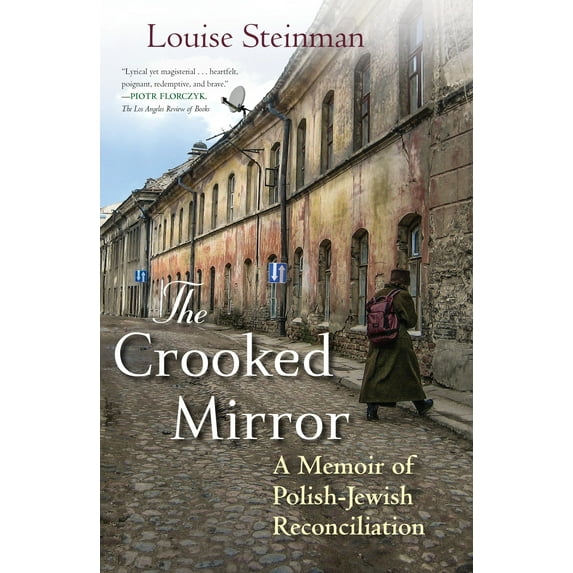
Hero image 0 of The Crooked Mirror : A Memoir of Polish-Jewish Reconciliation (Paperback), 0 of 1
The Crooked Mirror : A Memoir of Polish-Jewish Reconciliation (Paperback)
(No ratings yet)
Key item features
A lyrical literary memoir that explores the exhilarating, discomforting, and ultimately healing process of Polish-Jewish reconciliation taking place in Poland today
“I’d grown up with the phrase ‘Never forget’ imprinted on my psyche. Its corollary was more elusive. Was it possible to remember—at least to recall—a world that existed before the calamity?”
In the winter of 2000, Louise Steinman set out to attend an international Bearing Witness Retreat at Auschwitz-Birkenau at the invitation of her Zen rabbi, who felt the Poles had gotten a “bum rap.” A bum rap? Her own mother could not bear to utter the word “Poland,” a country, Steinman was taught, that allowed and perhaps abetted the genocide that decimated Europe’s Jewish population, including members of her own extended family.
As Steinman learns more about her lost ancestors, though, she finds that the history of Polish-Jewish relations is far more complex. Although German-occupied Poland was the site of horrific Jewish persecution, Poland was for centuries the epicenter of European Jewish life. After the war, Polish-Jewish relations soured. For Poles under Communism, it was taboo to examine or discuss the country’s Jewish past. Among Jews in the Diaspora, there was little acknowledgment of the Poles’ immense suffering during its dual occupation.
Steinman’s research leads her to her grandparents’ town of Radomsko, whose eighteen thousand Jews were deported or shot during the Nazi occupation. As she delves deeper into the town’s and her family’s history, Steinman discovers a prewar past where a lively community of Jews and Catholics lived shoulder to shoulder, where a Polish Catholic painted the blue ceiling of the Radomsko synagogue, and a Jewish tinsmith roofed the spires of the Catholic church. She also uncovers untold stories of Poles who rescued their Jewish neighbors in Radomsko and helps bring these heroes to the light of day.
Returning time and again to Poland over the course of a decade, Steinman finds Poles who are seeking the truth about the past, however painful, and creating their own rituals to teach their towns about the history of their lost Jewish neighbors. This lyrical memoir chronicles her immersion in the exhilarating, discomforting, sometimes surreal, and ultimately healing process of Polish-Jewish reconciliation.
“I’d grown up with the phrase ‘Never forget’ imprinted on my psyche. Its corollary was more elusive. Was it possible to remember—at least to recall—a world that existed before the calamity?”
In the winter of 2000, Louise Steinman set out to attend an international Bearing Witness Retreat at Auschwitz-Birkenau at the invitation of her Zen rabbi, who felt the Poles had gotten a “bum rap.” A bum rap? Her own mother could not bear to utter the word “Poland,” a country, Steinman was taught, that allowed and perhaps abetted the genocide that decimated Europe’s Jewish population, including members of her own extended family.
As Steinman learns more about her lost ancestors, though, she finds that the history of Polish-Jewish relations is far more complex. Although German-occupied Poland was the site of horrific Jewish persecution, Poland was for centuries the epicenter of European Jewish life. After the war, Polish-Jewish relations soured. For Poles under Communism, it was taboo to examine or discuss the country’s Jewish past. Among Jews in the Diaspora, there was little acknowledgment of the Poles’ immense suffering during its dual occupation.
Steinman’s research leads her to her grandparents’ town of Radomsko, whose eighteen thousand Jews were deported or shot during the Nazi occupation. As she delves deeper into the town’s and her family’s history, Steinman discovers a prewar past where a lively community of Jews and Catholics lived shoulder to shoulder, where a Polish Catholic painted the blue ceiling of the Radomsko synagogue, and a Jewish tinsmith roofed the spires of the Catholic church. She also uncovers untold stories of Poles who rescued their Jewish neighbors in Radomsko and helps bring these heroes to the light of day.
Returning time and again to Poland over the course of a decade, Steinman finds Poles who are seeking the truth about the past, however painful, and creating their own rituals to teach their towns about the history of their lost Jewish neighbors. This lyrical memoir chronicles her immersion in the exhilarating, discomforting, sometimes surreal, and ultimately healing process of Polish-Jewish reconciliation.
Specs
- Book formatPaperback
- Fiction/nonfictionNon-Fiction
- GenreHistory, Biography & Memoirs
- Publication dateOctober, 2014
- Pages238
- SubgenreHistory
Current price is USD$19.25
Price when purchased online
- Free shipping
 Free 30-day returns
How do you want your item?
Ships to
Arrives between May 16 - May 19
|
Sold and shipped by Alibris Books
4.569115147177239 stars out of 5, based on 11177 seller reviews(4.6)11177 seller reviews

Free 30-day returns
Other sellers
$16.91
+ $7.98 shippingShipping, arrives by Mon, May 18 to Columbus, 43215
Sold and shipped by Best Prices & Service
Free 30-day returns
About this item
Product details
A lyrical literary memoir that explores the exhilarating, discomforting, and ultimately healing process of Polish-Jewish reconciliation taking place in Poland today "I'd grown up with the phrase 'Never forget' imprinted on my psyche. Its corollary was more elusive. Was it possible to remember--at least to recall--a world that existed before the calamity?"
In the winter of 2000, Louise Steinman set out to attend an international Bearing Witness Retreat at Auschwitz-Birkenau at the invitation of her Zen rabbi, who felt the Poles had gotten a "bum rap." A bum rap? Her own mother could not bear to utter the word "Poland," a country, Steinman was taught, that allowed and perhaps abetted the genocide that decimated Europe's Jewish population, including members of her own extended family. As Steinman learns more about her lost ancestors, though, she finds that the history of Polish-Jewish relations is far more complex. Although German-occupied Poland was the site of horrific Jewish persecution, Poland was for centuries the epicenter of European Jewish life. After the war, Polish-Jewish relations soured. For Poles under Communism, it was taboo to examine or discuss the country's Jewish past. Among Jews in the Diaspora, there was little acknowledgment of the Poles' immense suffering during its dual occupation. Steinman's research leads her to her grandparents' town of Radomsko, whose eighteen thousand Jews were deported or shot during the Nazi occupation. As she delves deeper into the town's and her family's history, Steinman discovers a prewar past where a lively community of Jews and Catholics lived shoulder to shoulder, where a Polish Catholic painted the blue ceiling of the Radomsko synagogue, and a Jewish tinsmith roofed the spires of the Catholic church. She also uncovers untold stories of Poles who rescued their Jewish neighbors in Radomsko and helps bring these heroes to the light of day. Returning time and again to Poland over the course of a decade, Steinman finds Poles who are seeking the truth about the past, however painful, and creating their own rituals to teach their towns about the history of their lost Jewish neighbors. This lyrical memoir chronicles her immersion in the exhilarating, discomforting, sometimes surreal, and ultimately healing process of Polish-Jewish reconciliation.
In the winter of 2000, Louise Steinman set out to attend an international Bearing Witness Retreat at Auschwitz-Birkenau at the invitation of her Zen rabbi, who felt the Poles had gotten a "bum rap." A bum rap? Her own mother could not bear to utter the word "Poland," a country, Steinman was taught, that allowed and perhaps abetted the genocide that decimated Europe's Jewish population, including members of her own extended family. As Steinman learns more about her lost ancestors, though, she finds that the history of Polish-Jewish relations is far more complex. Although German-occupied Poland was the site of horrific Jewish persecution, Poland was for centuries the epicenter of European Jewish life. After the war, Polish-Jewish relations soured. For Poles under Communism, it was taboo to examine or discuss the country's Jewish past. Among Jews in the Diaspora, there was little acknowledgment of the Poles' immense suffering during its dual occupation. Steinman's research leads her to her grandparents' town of Radomsko, whose eighteen thousand Jews were deported or shot during the Nazi occupation. As she delves deeper into the town's and her family's history, Steinman discovers a prewar past where a lively community of Jews and Catholics lived shoulder to shoulder, where a Polish Catholic painted the blue ceiling of the Radomsko synagogue, and a Jewish tinsmith roofed the spires of the Catholic church. She also uncovers untold stories of Poles who rescued their Jewish neighbors in Radomsko and helps bring these heroes to the light of day. Returning time and again to Poland over the course of a decade, Steinman finds Poles who are seeking the truth about the past, however painful, and creating their own rituals to teach their towns about the history of their lost Jewish neighbors. This lyrical memoir chronicles her immersion in the exhilarating, discomforting, sometimes surreal, and ultimately healing process of Polish-Jewish reconciliation.
A lyrical literary memoir that explores the exhilarating, discomforting, and ultimately healing process of Polish-Jewish reconciliation taking place in Poland today
“I’d grown up with the phrase ‘Never forget’ imprinted on my psyche. Its corollary was more elusive. Was it possible to remember—at least to recall—a world that existed before the calamity?”
In the winter of 2000, Louise Steinman set out to attend an international Bearing Witness Retreat at Auschwitz-Birkenau at the invitation of her Zen rabbi, who felt the Poles had gotten a “bum rap.” A bum rap? Her own mother could not bear to utter the word “Poland,” a country, Steinman was taught, that allowed and perhaps abetted the genocide that decimated Europe’s Jewish population, including members of her own extended family.
As Steinman learns more about her lost ancestors, though, she finds that the history of Polish-Jewish relations is far more complex. Although German-occupied Poland was the site of horrific Jewish persecution, Poland was for centuries the epicenter of European Jewish life. After the war, Polish-Jewish relations soured. For Poles under Communism, it was taboo to examine or discuss the country’s Jewish past. Among Jews in the Diaspora, there was little acknowledgment of the Poles’ immense suffering during its dual occupation.
Steinman’s research leads her to her grandparents’ town of Radomsko, whose eighteen thousand Jews were deported or shot during the Nazi occupation. As she delves deeper into the town’s and her family’s history, Steinman discovers a prewar past where a lively community of Jews and Catholics lived shoulder to shoulder, where a Polish Catholic painted the blue ceiling of the Radomsko synagogue, and a Jewish tinsmith roofed the spires of the Catholic church. She also uncovers untold stories of Poles who rescued their Jewish neighbors in Radomsko and helps bring these heroes to the light of day.
Returning time and again to Poland over the course of a decade, Steinman finds Poles who are seeking the truth about the past, however painful, and creating their own rituals to teach their towns about the history of their lost Jewish neighbors. This lyrical memoir chronicles her immersion in the exhilarating, discomforting, sometimes surreal, and ultimately healing process of Polish-Jewish reconciliation.
“I’d grown up with the phrase ‘Never forget’ imprinted on my psyche. Its corollary was more elusive. Was it possible to remember—at least to recall—a world that existed before the calamity?”
In the winter of 2000, Louise Steinman set out to attend an international Bearing Witness Retreat at Auschwitz-Birkenau at the invitation of her Zen rabbi, who felt the Poles had gotten a “bum rap.” A bum rap? Her own mother could not bear to utter the word “Poland,” a country, Steinman was taught, that allowed and perhaps abetted the genocide that decimated Europe’s Jewish population, including members of her own extended family.
As Steinman learns more about her lost ancestors, though, she finds that the history of Polish-Jewish relations is far more complex. Although German-occupied Poland was the site of horrific Jewish persecution, Poland was for centuries the epicenter of European Jewish life. After the war, Polish-Jewish relations soured. For Poles under Communism, it was taboo to examine or discuss the country’s Jewish past. Among Jews in the Diaspora, there was little acknowledgment of the Poles’ immense suffering during its dual occupation.
Steinman’s research leads her to her grandparents’ town of Radomsko, whose eighteen thousand Jews were deported or shot during the Nazi occupation. As she delves deeper into the town’s and her family’s history, Steinman discovers a prewar past where a lively community of Jews and Catholics lived shoulder to shoulder, where a Polish Catholic painted the blue ceiling of the Radomsko synagogue, and a Jewish tinsmith roofed the spires of the Catholic church. She also uncovers untold stories of Poles who rescued their Jewish neighbors in Radomsko and helps bring these heroes to the light of day.
Returning time and again to Poland over the course of a decade, Steinman finds Poles who are seeking the truth about the past, however painful, and creating their own rituals to teach their towns about the history of their lost Jewish neighbors. This lyrical memoir chronicles her immersion in the exhilarating, discomforting, sometimes surreal, and ultimately healing process of Polish-Jewish reconciliation.
info:
We aim to show you accurate product information. Manufacturers, suppliers and others provide what you see here, and we have not verified it.
Specifications
Book format
Paperback
Fiction/nonfiction
Non-Fiction
Genre
History, Biography & Memoirs
Publication date
October, 2014
Warranty
Warranty information
Please be aware that the warranty terms on items offered for sale by third party Marketplace sellers may differ from those displayed in this section (if any). To confirm warranty terms on an item offered for sale by a third party Marketplace seller, please use the 'Contact seller' feature on the third party Marketplace seller's information page and request the item's warranty terms prior to purchase.
Warnings
State Chemical Disclosure
No harmful chemicals
Similar items you might like
Based on what customers bought
Disruption Curio A Polish Girl in Siberia: Surviving and Transcending Exile, (Paperback) $14.96
 $1496current price $14.96
Disruption Curio A Polish Girl in Siberia: Surviving and Transcending Exile, (Paperback)
Between a Rock and a Hard Place: A Chronicle of The Scottish Brown Family, (Paperback) $20.99
 $2099current price $20.99
Between a Rock and a Hard Place: A Chronicle of The Scottish Brown Family, (Paperback)
A Bintel Brief: Sixty Years of Letters from the Lower East Side to the Jewish Daily Forward, (Paperback) $11.62
 $1162current price $11.62
A Bintel Brief: Sixty Years of Letters from the Lower East Side to the Jewish Daily Forward, (Paperback)
If I Am Not for Myself: The Liberal Betrayal of the Jews, (Paperback) $19.99
 $1999current price $19.99
If I Am Not for Myself: The Liberal Betrayal of the Jews, (Paperback)
The Everyday Torah: Weekly Reflections and Inspirations, (Paperback) $18.24
 $1824current price $18.24
The Everyday Torah: Weekly Reflections and Inspirations, (Paperback)
Fighting the Hate: A Handbook for Jews Under Siege, (Paperback) $18.99
 $1899current price $18.99
Fighting the Hate: A Handbook for Jews Under Siege, (Paperback)
Intimate Violence: Anti-Jewish Pogroms on the Eve of the Holocaust, (Paperback) $17.22
 $1722current price $17.22
Intimate Violence: Anti-Jewish Pogroms on the Eve of the Holocaust, (Paperback)
Nobody Lives Here: A Jewish Childhood in the Occupied Netherlands, (Paperback) $17.80
 $1780current price $17.80
Nobody Lives Here: A Jewish Childhood in the Occupied Netherlands, (Paperback)
Eichmann En Jerusalén / Eichmann in Jerusalem: A Report on the Banality of Evil, (Paperback) $13.80 Was $15.90
 $1380current price $13.80, Was $15.90$15.90
Eichmann En Jerusalén / Eichmann in Jerusalem: A Report on the Banality of Evil, (Paperback)
When Light Pierced the Darkness: Christian Rescue of Jews in Nazi-Occupied Poland, (Paperback) $19.17
 $1917current price $19.17
When Light Pierced the Darkness: Christian Rescue of Jews in Nazi-Occupied Poland, (Paperback)
Transforming Coparent Conflict: Through Scripture and Psychology, (Paperback) $17.74
 $1774current price $17.74
Transforming Coparent Conflict: Through Scripture and Psychology, (Paperback)
They Were Good Germans Once: A Memoir: My Jewish Ãmigré Family, (Paperback) $14.55
 $1455current price $14.55
They Were Good Germans Once: A Memoir: My Jewish Ãmigré Family, (Paperback)
Self-Portrait, with Parents and Footnotes: In and Out of a Postwar Jewish Childhood, (Paperback) $20.61
 $2061current price $20.61
Self-Portrait, with Parents and Footnotes: In and Out of a Postwar Jewish Childhood, (Paperback)
Boursicotiérisme Et Lorettisme Ou Flibusterie, Étude de Moeurs Parisiennes, Par Le Juif Errant (Paperback) $17.95
 $1795current price $17.95
Boursicotiérisme Et Lorettisme Ou Flibusterie, Étude de Moeurs Parisiennes, Par Le Juif Errant (Paperback)
Legiony Polskie, 16 Sierpnia 1914-16 Sierpnia 1915; Dokumenty (Paperback) $22.07
 $2207current price $22.07
Legiony Polskie, 16 Sierpnia 1914-16 Sierpnia 1915; Dokumenty (Paperback)
Care and Treatment of the Jewish Blind in the City of New York Paperback 1015148964 9781015148963 Florina Lasker, Etta Lasker, Loula Lasker $17.95
 $1795current price $17.95
Care and Treatment of the Jewish Blind in the City of New York Paperback 1015148964 9781015148963 Florina Lasker, Etta Lasker, Loula Lasker
Jewish Lives Becoming Freud: The Making of a Psychoanalyst, (Paperback) $20.24
 2 optionsAvailable in additional 2 options$2024current price $20.24
Jewish Lives Becoming Freud: The Making of a Psychoanalyst, (Paperback)
Cultural Memory in the Present Nocturnal Seeing: Hopelessness of Hope and Philosophical Gnosis in Susan Taubes, Gillian Rose, and Edith Wyschogrod, (Paperback) $39.72
 $3972current price $39.72
Cultural Memory in the Present Nocturnal Seeing: Hopelessness of Hope and Philosophical Gnosis in Susan Taubes, Gillian Rose, and Edith Wyschogrod, (Paperback)

Customer ratings & reviews
0 ratings|0 reviews
This item does not have any reviews yet
