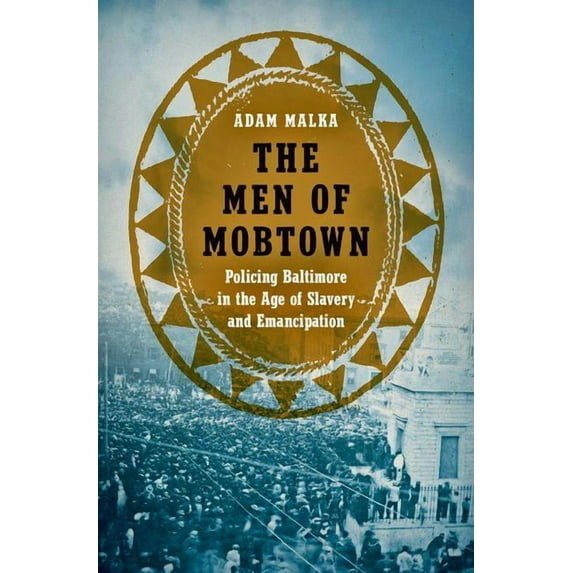
"The customary story of the rise of modern policing in America is rooted in the growth of northern cities. In this telling, professional police forces arose primarily in reaction to growing urban populations of immigrants and the poor. Meanwhile, scholars of the American South often argue that vigilantes and lynch mobs, as opposed to policemen and prisons, policed the region. Yet these two interrelated systems came to coexist in Baltimore. One system relied upon amateur and ordinary people --mostly white men-- to guard the city, enforce its criminal laws, and govern in its name; the other, which emerged in the 1830s and 1840s, employed uniformed policemen to protect property rights and to build disciplinary asylums, reformatories, and prisons for those who infringed upon those rights. Malka shows that for much of the nineteenth century these two systems worked in tandem as complementary state institutions designed to protect white men's property rights and power. He argues that the same assumptions of white male supremacy that sustained slavery also laid the foundations for the development of municipal policing and state punishment, resulting in a state-sanctioned form of brutality that prospered ... under the very conditions of freedom that African Americans fought so determinedly to secure"-- What if racialized mass incarceration is not a perversion of our criminal justice system's liberal ideals, but rather a natural conclusion? Adam Malka raises this disturbing possibility through a gripping look at the origins of modern policing in the influential hub of Baltimore during and after slavery's final decades. He argues that America's new professional police forces and prisons were developed to expand, not curb, the reach of white vigilantes, and are best understood as a uniformed wing of the gangs that controlled free black people by branding them--and treating them--as criminals. The post-Civil War triumph of liberal ideals thus also marked a triumph of an institutionalized belief in black criminality.
Mass incarceration may be a recent phenomenon, but the problems that undergird the new Jim Crow are very, very old. As Malka makes clear, a real reckoning with this national calamity requires not easy reforms but a deeper, more radical effort to overcome the racial legacies encoded into the very DNA of our police institutions.