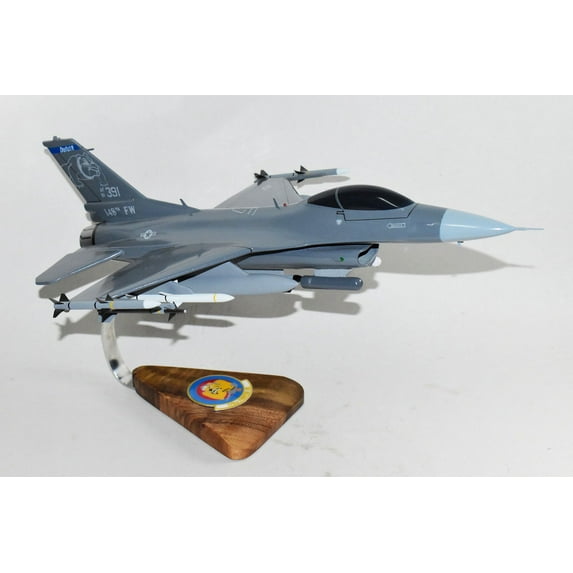
Lockheed Martin® F-16 Fighting Falcon®, 179th Fighter Squadron Fly with the 179th Fighter Squadron in this handcrafted Lockheed Martin F-16 Fighting Falcon Model. Each piece is carved from wood and handpainted to provide a piece you'll love. Length - 18 inches Made from Mahogany US Veteran-Owned Business Officially Licensed by Lockheed Martin The product is not intended to be used by children 12 years and younger. LOCKHEED MARTIN, F-16 Fighting Falcon, associated emblems and logos, and body designs of vehicles are either registered trademarks or trademarks of Lockheed Martin Corporation in the USA and/or other jurisdictions, used under license by Squadron Nostalgia LLC. The 179th Fighter Squadron (179 FS) is a unit of the Minnesota Air National Guard 148th Fighter Wing located at Duluth Air National Guard Base, Minnesota. The 179th Fighter Squadron flys the F-16C Fighting Falcon. History World War II Training in the United States The 179th Fighter Squadron was first organized as the 393d Fighter Squadron at Hamilton Field, California, on 15 July 1943, as one of the original squadrons of the 367th Fighter Group.[2][3] Several members of its initial cadre were former Flying Tigers with prior combat experience. It was not until late August, however, that the group received its first Bell P-39 Airacobra.[4] After building up its strength, the squadron moved in October to Santa Rosa Army Air Field, California.[3] In December group headquarters and the squadron moved to Oakland Municipal Airport,[2] while the other squadrons of the group were at other locations in northern California. The squadron moved temporarily to Tonopah Army Air Field, Nevada, where it performed dive bombing and gunnery training. Training accidents with the Bell P-39 Airacobra cost several pilots their lives. In January 1944, as it prepared for overseas movement, the 393d was beefed up with personnel from the 328th and 368th Fighter Groups.[5] The squadron staged through Camp Shanks, and sailed for England aboard the SS Duchess of Bedford.[6] The "Drunken Duchess"[note 1] docked at Greenock, Scotland on 3 April and the group was transported by train to its airfield at RAF Stoney Cross, England.[5] Having trained on single engine aircraft, the squadrons's pilots were surprised to find Lockheed P-38 Lightnings sitting on Stoney Cross's dispersal pads.[7] Only members of the advance party had any experience flying the Lightning. These pilots had flown combat sorties with the 55th Fighter Group.[8] The change from single engine to twin engine aircraft required considerable retraining for both pilots and ground crew.[7] Although some pilots entered combat with as little as eight hours of flying time on the P-38, in late April the squadron was reinforced by pilots who had trained on the Lightning in the States and were more experienced on the type.[9] However, the lack of instrument training in the P-38 took its toll on the 393d as weather, not enemy action, caused the loss of pilots and airplanes.[10] On 9 May, the 179th Fighter Squadron flew its first combat mission, a fighter sweep over Alençon.[11] For the remainer of the month, the unit flew fighter sweeps, bomber escort and dive bombing, missions and suffered its first combat losses.[12] On D-Day and the next three days the squadron flew missions maintaining air cover over shipping carrying invasion troops.[7] These missions continued for the next three days. The 393d and other P-38 units stationed in England were selected for these missions with the expectation that the distinctive silhouette of the Lightning would prevent potential friendly fire incidents by anti-aircraft gunners mistaking them for enemy fighters.[13] Shortly after the Normandy invasion, on 12 June, the 367th Group was selected to test the ability of the P-38 to carry a 2,000 lb bomb under each wing. The selected target was a railroad yard, and results were mixed.[14] However, on this mission, the squadron scored its first air-to-air vict