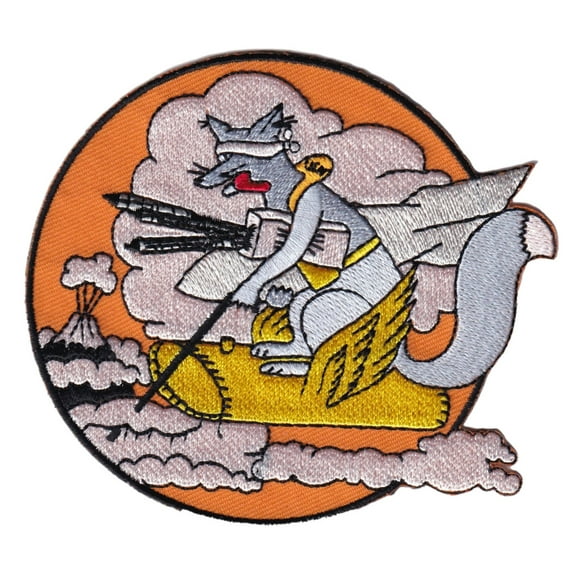
VP-5 Blind Fox 2nd Insignia 1944 Patch
Aviators and Collectors! Enjoy this beautifully embroidered VP-5 Blind Fox 2nd Insignia 1944 Patch. You’ll love the quality of this patch and will be able to display it proudly.
- 4 inch
- Embroidered/ Sew On
- US Naval Aviator Owned Business
- Reproduction
Patrol Squadron FIVE (VP-5) is a long-lived maritime patrol squadron of the United States Navy. It is the second squadron to bear the VP-5 designation. VP-5 is the second oldest patrol squadron, the fourth oldest in the United States Navy, and the 33rd oldest squadron in the United States military. As of 2019, VP-5 is still active and is based at Naval Air Station Jacksonville, Florida.[2]
The squadron was originally established as Patrol Squadron 17-F (VP-17F) on 2 January 1937, redesignated Patrol Squadron 17 (VP-17) on 1 October 1937, redesignated Patrol Squadron 42 (VP-42) on 1 July 1939, redesignated Bombing Squadron 135 (VB-135) on 15 February 1943, redesignated Patrol Bombing Squadron 135 (VPB-135) on 1 October 1944, redesignated Patrol Squadron 135 (VP-135) on 15 May 1946, redesignated Medium Patrol Squadron (Landplane) 5 (VP-ML-5) on 15 November 1946 and redesignated Patrol Squadron 5 (VP-5) on 1 September 1948. It was the second squadron to be designated VP-5, the first VP-5 was redesignated Patrol Squadron 33 (VP-33) on 1 July 1939.[3]
1937–1941
VP-17F was established at FAB Seattle, Washington on 2 January 1937, under the administrative command of PatWing4, Base Force. The squadron’s PM-1 seaplanes were tended by USS Thrush. On 1 October 1937 VP-17F was re-designated VP-17 when all patrol squadrons were removed from the Base Force and placed administratively under Patrol Wings. During March 1938 VP-17 turned in its PM-1s in March for the new PBY-2 Catalina seaplanes. Tender support for the squadron was supplied by USS Teal. The squadron participated in Fleet Problem XIX (Phase II) as part of White Force, along with aircraft of patrol squadrons 7, 9, 11, 12, 16 and 19. Missions included flights extending out to 600 miles (970 km) to locate and successfully attack elements of Black Force. The exercises marked the first use of long-distance radio bearings for aircraft. In November 1938 VP-17 was selected to test new electrically heated flying suits, in the first trials, the suits blew out fuses while at 18,700 feet (5,700 m). The general opinion was that the suits were too bulky and unreliable in the cramped confines of the aircraft. The manufacturer began to incorporate better heating and cabin insulation in later models of the PBY, greatly improving crew comfort on long flights. On 30 January 1941 the squadron began a refit with new aircraft, turning in the older PBY-2 models for PBY-5 aircraft fresh from the factory. On 15 July 1941 VP-42 was deployed to Sitka, Alaska, for advanced base operations and cold weather training. A detachment was maintained at Naval Air Station Kodiak, Alaska. On 2 September 1941, the Kodiak detachment was visited by two aircraft from a Russian seaplane squadron under the command of General Gromof.
World War II
On 7 December 1941 upon receiving word of the Attack on Pearl Harbor, all squadron aircraft were put on alert and prepared for a move to Naval Air Station Tongue Point. The movement of the squadron to the temporary location took place on 8 December 1941, and remained in effect until the next week. On 29 January 1942 VP-42 flew all of its PBY-5s to Naval Air Station San Diego, California, where they were turned in for new PBY-5A amphibious models. Squadron strength was increased to 12 aircraft.
On 1 February 1942 VP-42 relieved VP-41 of patrol duties at Naval Air Station Kodiak. Beginning 1 March 1942, aircraft were sent in elements of two to Naval Air Station Alameda, California, for installation of ASD-1 radar. From 3–15 June 1942 VP-42 participated in the first attack on Japanese vessels and positions while based