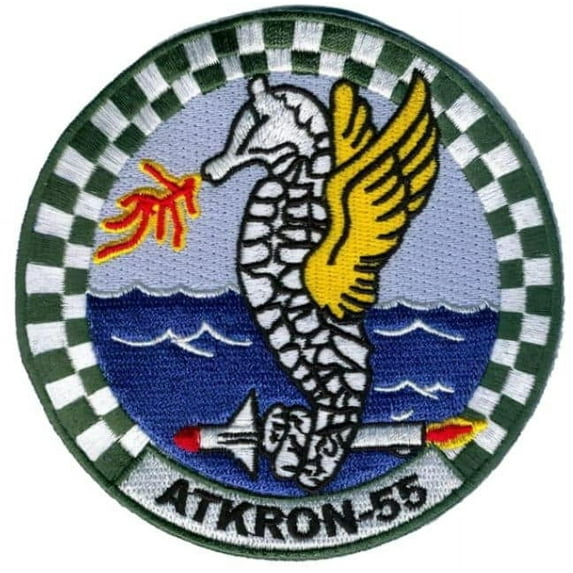
VA-55 Warhorses Squadron Patch Aviators! Are you looking for a high-quality patch you'll proudly wear or display? Look no further than the VA-55 Warhorses Squadron Patch! 4 inch Embroidered US Naval Aviator Owned Business Sew On Plastic Backing increases rigidity, so the patch lasts longer and stays flat Reproduction VA-55 was an Attack Squadron of the U.S. Navy. It was established as Torpedo Squadron VT-5 on 15 February 1943, redesignated VA-6A on 15 November 1946, and finally designated VA-55 on 16 August 1948. The squadron was disestablished on 12 December 1975. It was the first squadron to be designated VA-55, the second VA-55 was established on 7 October 1983 and disestablished on 1 January 1991.[1] The squadron's nickname was the Torpcats from 1943-1955, and the Warhorses from 1955 onward. Its insignia changed several times over its lifetime, ending up as a winged seahorse. They were established in 1943 Operational history World War II 15 February 1943: VGS-30 was disestablished and personnel from the squadron were used to form VT-5 and VF-1. 6–24 July 1943: The squadron departed Norfolk, Virginia embarked on USS Yorktown en route to the Hawaiian Islands via the Panama Canal. 31 August 1943: Embarked on Yorktown, the squadron participated in a raid on Marcus Island. 5–6 October 1943: The squadron participated in a raid on Wake Island. November–December 1943: The squadron supported the Battle of Makin and the Battle of Tarawa, and flew strikes against Kwajalein in the Marshall Islands. January–February 1944: The squadron provided air support for the Gilbert and Marshall Islands campaign. 16–17 February 1944: Squadron aircraft flew strikes against the Japanese stronghold of Truk. 22 February 1944: The squadron participated in a raid on the Marianas, striking targets on Saipan. 30 March–1 April 1944: Squadron aircraft struck ships and facilities at Palau in the Caroline Islands. The strike on 30 March was the first time the squadron’s TBFs were armed with torpedoes in combat. 21–23 April 1944: Strikes were flown against targets on Wake Island and Hollandia in New Guinea. These operations were in support of the landings at Hollandia by General Douglas MacArthur’s forces. 29–30 April 1944: The squadron participated in another strike operation against Truk. 30 April 1944: The squadron’s commanding officer, Lieutenant Commander Dick Upson, failed to return from a search and rescue mission to locate a downed pilot. 14 May 1944: Following a ten-month combat tour beginning in August 1943, Air Group 5 was relieved aboard Yorktown by Air Group 1 and returned to CONUS to reform on 25 June 1944. 7 February 1945: Embarked on USS Franklin, the squadron departed NAS Alameda for Hawaii, arriving there on 13 February. This was the beginning of the squadron’s second major combat tour in the Pacific. 19 March 1945: VT-5 was preparing to launch its aircraft for an attack against the city of Kobe, Japan, when the Franklin was hit by two enemy bombs from a Japanese aircraft. Fires were ignited on the second and third decks from the first bomb and the second triggered munitions on the carrier. All VT-5’s aircraft on the flight and hangar deck were destroyed by the ensuing explosions and fire. The damage was one of the most extensive experienced by an Essex class carrier during World War II. A total of 724 men were killed and 265 wounded. VT-5’s commanding officer, Lieutenant Commander Edmands, was lost in the action. All surviving VT-5 personnel were transferred from Franklin and returned to CONUS. Korean War 3 July 1950: Participated in the first combat strikes by carrier aircraft against the North Koreans. The squadron flew its AD-4 Skyraiders on strikes against airfields, supply lines and transportation facilities in and around Pyongyang, North Korea. This was also the first use of the AD Skyraider in combat. 12 September 1950: Pre-invasion strikes against targets in and around Inchon and Seoul, Korea, began in preparation for the Battle of