

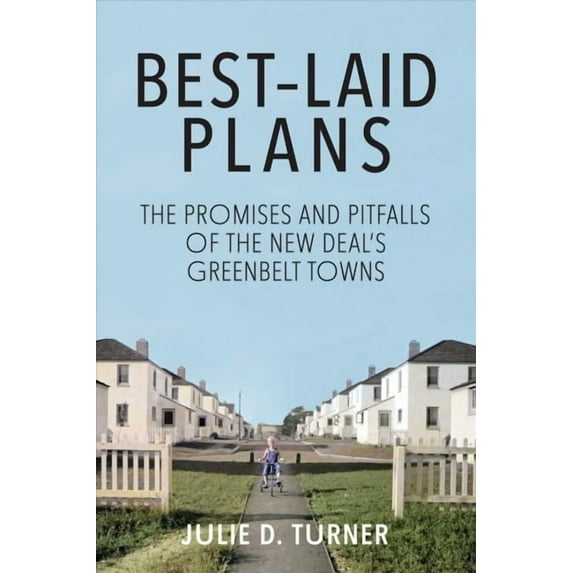
Hero image 0 of Best-Laid Plans : The Promises and Pitfalls of the New Deal Greenbelt Towns (Hardcover), 0 of 1
Best-Laid Plans : The Promises and Pitfalls of the New Deal Greenbelt Towns (Hardcover)
(No ratings yet)
Key item features
A history of the New Deal program intended to improve the living conditions of America’s underclass.
In 1935, under the direction of the Resettlement Administration, the United States government embarked on a New Deal program to construct new suburban towns for the working class. Teams of architects, engineers, and city planners, along with thousands of workers, brought three such communities to life: Greenbelt, Maryland; Greendale, Wisconsin; and Greenhills, Ohio. President Franklin Roosevelt saw this as a way to create jobs. Resettlement Administration head Rexford Tugwell longed to improve the living conditions of the nation’s underclass.
In Best-Laid Plans, Julie Turner identifies where the Greenbelt Towns succeeded and where they failed. The program suffered under the burden of too many competing goals: maximum job creation at minimal cost, exquisite town planning that would provide modest residences for low-income families, progressive innovation that would serve to honor and reinforce traditional American values. Yet the Greenbelt program succeeded in one respect—providing new homes in well-planned communities that continue to welcome residents.
Town planning and suburbanization did not follow the blueprint of the Greenbelt model and instead took a turn toward the suburban sprawl we know today. The Greenbelt towns may represent an unrealistic dream, but they show an imagined way of American life that continues to appeal and hints at what might have been possible.
In 1935, under the direction of the Resettlement Administration, the United States government embarked on a New Deal program to construct new suburban towns for the working class. Teams of architects, engineers, and city planners, along with thousands of workers, brought three such communities to life: Greenbelt, Maryland; Greendale, Wisconsin; and Greenhills, Ohio. President Franklin Roosevelt saw this as a way to create jobs. Resettlement Administration head Rexford Tugwell longed to improve the living conditions of the nation’s underclass.
In Best-Laid Plans, Julie Turner identifies where the Greenbelt Towns succeeded and where they failed. The program suffered under the burden of too many competing goals: maximum job creation at minimal cost, exquisite town planning that would provide modest residences for low-income families, progressive innovation that would serve to honor and reinforce traditional American values. Yet the Greenbelt program succeeded in one respect—providing new homes in well-planned communities that continue to welcome residents.
Town planning and suburbanization did not follow the blueprint of the Greenbelt model and instead took a turn toward the suburban sprawl we know today. The Greenbelt towns may represent an unrealistic dream, but they show an imagined way of American life that continues to appeal and hints at what might have been possible.
Specs
- Book formatHardcover
- Fiction/nonfictionNon-Fiction
- GenreHistory
- Publication dateJanuary, 2023
- Pages330
- EditionStandard Edition
Current price is USD$49.78
Price when purchased online
- Free shipping
 Free 30-day returns
How do you want your item?
Columbus, 43215
Arrives between May 14 - May 20
|
Sold and shipped by newbookdeals
4.5607476635514015 stars out of 5, based on 1926 seller reviews(4.6)1926 seller reviews

Free 30-day returns - in store or online
More seller options (1)
Starting from $67.24
About this item
Product details
A history of the New Deal program intended to improve the living conditions of America's underclass. In 1935, under the direction of the Resettlement Administration, the United States government embarked on a New Deal program to construct new suburban towns for the working class. Teams of architects, engineers, and city planners, along with thousands of workers, brought three such communities to life: Greenbelt, Maryland; Greendale, Wisconsin; and Greenhills, Ohio. President Franklin Roosevelt saw this as a way to create jobs. Resettlement Administration head Rexford Tugwell longed to improve the living conditions of the nation's underclass. In Best-Laid Plans, Julie Turner identifies where the Greenbelt Towns succeeded and where they failed. The program suffered under the burden of too many competing goals: maximum job creation at minimal cost, exquisite town planning that would provide modest residences for low-income families, progressive innovation that would serve to honor and reinforce traditional American values. Yet the Greenbelt program succeeded in one respect--providing new homes in well-planned communities that continue to welcome residents. Town planning and suburbanization did not follow the blueprint of the Greenbelt model and instead took a turn toward the suburban sprawl we know today. The Greenbelt towns may represent an unrealistic dream, but they show an imagined way of American life that continues to appeal and hints at what might have been possible.
A history of the New Deal program intended to improve the living conditions of America’s underclass.
In 1935, under the direction of the Resettlement Administration, the United States government embarked on a New Deal program to construct new suburban towns for the working class. Teams of architects, engineers, and city planners, along with thousands of workers, brought three such communities to life: Greenbelt, Maryland; Greendale, Wisconsin; and Greenhills, Ohio. President Franklin Roosevelt saw this as a way to create jobs. Resettlement Administration head Rexford Tugwell longed to improve the living conditions of the nation’s underclass.
In Best-Laid Plans, Julie Turner identifies where the Greenbelt Towns succeeded and where they failed. The program suffered under the burden of too many competing goals: maximum job creation at minimal cost, exquisite town planning that would provide modest residences for low-income families, progressive innovation that would serve to honor and reinforce traditional American values. Yet the Greenbelt program succeeded in one respect—providing new homes in well-planned communities that continue to welcome residents.
Town planning and suburbanization did not follow the blueprint of the Greenbelt model and instead took a turn toward the suburban sprawl we know today. The Greenbelt towns may represent an unrealistic dream, but they show an imagined way of American life that continues to appeal and hints at what might have been possible.
In 1935, under the direction of the Resettlement Administration, the United States government embarked on a New Deal program to construct new suburban towns for the working class. Teams of architects, engineers, and city planners, along with thousands of workers, brought three such communities to life: Greenbelt, Maryland; Greendale, Wisconsin; and Greenhills, Ohio. President Franklin Roosevelt saw this as a way to create jobs. Resettlement Administration head Rexford Tugwell longed to improve the living conditions of the nation’s underclass.
In Best-Laid Plans, Julie Turner identifies where the Greenbelt Towns succeeded and where they failed. The program suffered under the burden of too many competing goals: maximum job creation at minimal cost, exquisite town planning that would provide modest residences for low-income families, progressive innovation that would serve to honor and reinforce traditional American values. Yet the Greenbelt program succeeded in one respect—providing new homes in well-planned communities that continue to welcome residents.
Town planning and suburbanization did not follow the blueprint of the Greenbelt model and instead took a turn toward the suburban sprawl we know today. The Greenbelt towns may represent an unrealistic dream, but they show an imagined way of American life that continues to appeal and hints at what might have been possible.
info:
We aim to show you accurate product information. Manufacturers, suppliers and others provide what you see here, and we have not verified it.
Specifications
Book format
Hardcover
Fiction/nonfiction
Non-Fiction
Genre
History
Publication date
January, 2023
Warranty
Warranty information
Please be aware that the warranty terms on items offered for sale by third party Marketplace sellers may differ from those displayed in this section (if any). To confirm warranty terms on an item offered for sale by a third party Marketplace seller, please use the 'Contact seller' feature on the third party Marketplace seller's information page and request the item's warranty terms prior to purchase.
Similar items you might like
Based on what customers bought
Lake District Climbs $60.81
 $6081current price $60.81
Lake District Climbs
Welcoming Cities: How Newcomers Shape Urban Policy Making, (Paperback) $42.49
 $4249current price $42.49
Welcoming Cities: How Newcomers Shape Urban Policy Making, (Paperback)
Undammed: Freeing Rivers and Bringing Communities to Life, (Hardcover) $28.99
 $2899current price $28.99
Undammed: Freeing Rivers and Bringing Communities to Life, (Hardcover)
Chasing Permanence: How Businesses on our High Streets Can Adapt and Thrive, (Paperback) $38.39
 $3839current price $38.39
Chasing Permanence: How Businesses on our High Streets Can Adapt and Thrive, (Paperback)
New Urban Management: Attracting Value Flows to Branded Hubs, (Hardcover) $56.14
 $5614current price $56.14
New Urban Management: Attracting Value Flows to Branded Hubs, (Hardcover)
Urban Health Issues: Exploring the Impacts of Big-City Living, (Hardcover) $52.22
 $5222current price $52.22
Urban Health Issues: Exploring the Impacts of Big-City Living, (Hardcover)
BTY Better Than Yesterday: 5 Steps to Greatness, (Hardcover) $51.90
 $5190current price $51.90
BTY Better Than Yesterday: 5 Steps to Greatness, (Hardcover)
Renew Yourself: A Six-Step Plan for More Meaningful Work $52.82
 $5282current price $52.82
Renew Yourself: A Six-Step Plan for More Meaningful Work
Emerald Points Smart Cities: A Panacea for Sustainable Development, (Hardcover) $77.59
 $7759current price $77.59
Emerald Points Smart Cities: A Panacea for Sustainable Development, (Hardcover)
Magnetic Influence: How to Negotiate and Persuade in a Disrupted World, (Hardcover) $34.99
 $3499current price $34.99
Magnetic Influence: How to Negotiate and Persuade in a Disrupted World, (Hardcover)
Care, Protect, Grow: Empower Your Family Through Special Needs Financial Planning, (Hardcover) $27.99
 $2799current price $27.99
Care, Protect, Grow: Empower Your Family Through Special Needs Financial Planning, (Hardcover)
The Women of New York, or, Social Life in the Great City (Hardcover) $44.95
 $4495current price $44.95
The Women of New York, or, Social Life in the Great City (Hardcover)
Urban Development Banking on Cities: Investing in Resilient and Low-Carbon Urbanization, (Paperback) $43.95
 $4395current price $43.95
Urban Development Banking on Cities: Investing in Resilient and Low-Carbon Urbanization, (Paperback)
The Bumpy Road to Better: Unlocking the Hidden Power in Hard Things (Paperback) $12.22 Was $14.33
 $1222current price $12.22, Was $14.33$14.33
The Bumpy Road to Better: Unlocking the Hidden Power in Hard Things (Paperback)
45 out of 5 Stars. 4 reviewsThe City Project You'll Pay for This: How We Can Afford a Great City for Everyone, Forever Volume 1, (Paperback) $15.58
 $1558current price $15.58
The City Project You'll Pay for This: How We Can Afford a Great City for Everyone, Forever Volume 1, (Paperback)
Place Matters: New Directions in Appalac Engaging Appalachia: A Guidebook for Building Capacity and Sustainability, (Hardcover) $40.59
 $4059current price $40.59
Place Matters: New Directions in Appalac Engaging Appalachia: A Guidebook for Building Capacity and Sustainability, (Hardcover)
Mentorship, (Hardcover) $36.06
 $3606current price $36.06
Mentorship, (Hardcover)
Urban Planning Against Poverty, (Paperback) $43.09
 $4309current price $43.09
Urban Planning Against Poverty, (Paperback)
Best Laid Plans: The Tyranny of Unintended Consequences and How to Avoid Them, (Hardcover) $66.76
 $6676current price $66.76
Best Laid Plans: The Tyranny of Unintended Consequences and How to Avoid Them, (Hardcover)
Concise Guides to Planning Planning for an Ageing Society, (Hardcover) $55.35
 $5535current price $55.35
Concise Guides to Planning Planning for an Ageing Society, (Hardcover)
Customer ratings & reviews
0 ratings|0 reviews
This item does not have any reviews yet
