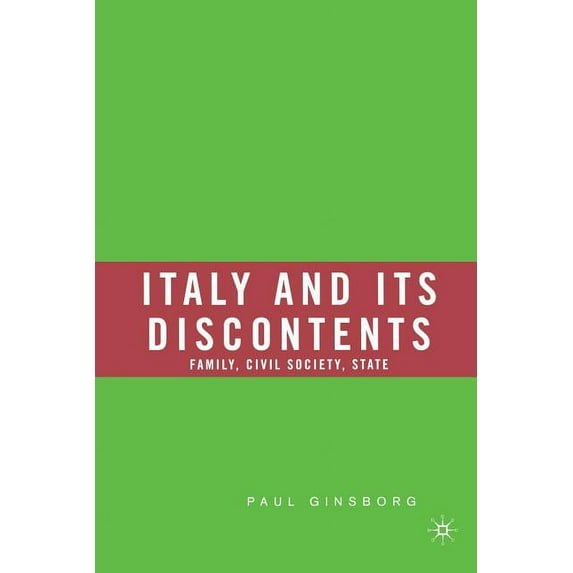
A major bestseller in Italy, Paul Ginsborg's account of this most recent and dynamic period in Italy's history is essential reading for anyone wishing to understand contemoprary Italy. Ginsborg chronicles a period that witnessed a radical transformation in the country's social, economic and political landscape, creating a fascinating and definitve account of how Italy has coped or failed to cope as it moves from one century to the next. With particular emphasis on its role in italian life, work and culture Ginsborg shows how smaller families, longer lives and greater generation crossover have had significant effects on Italian society. Ginsborg looks at the 2000 elections, the influence of the Mafia, the decline of both Communism and Catholicism, and the change in national identity. This is modern history at its best.
Publishers Weekly,In this rich, dense portrait of Italian society, economy and politics during the past 20 years, Ginsborg argues that while Italy has come a long way, it's still got a long way to go. Relying on a wealth of data, Ginsborg (A History of Contemporary Italy) shows how the country has grown wealthier, more democratic and more active in foreign affairs, in large part helped by the growing power of the European community. "Italy constrained by Europe was Italy improved," he writes. He focuses on society both from above (at high politics) and below (family life and class structure) to examine how Italy's jump into postindustrial society has affected Italians in all walks of life. Not surprisingly, many working Italians have been left behind, and a racist backlash-which exists elsewhere in Europe-against a growing immigrant population is widespread. Despite Ginsborg's generally optimistic portrayal, this book is far too complex to offer a Pollyannaish portrayal of Italy. Longstanding threats to Italian democracy remain; divisions between north and south; the power (albeit decreasing) of the Mafia and the Catholic Church. The author also devotes a chapter to the most recent episode in Italian politics-the rise to power of the right-wing businessman Silvio Berlusconi, which he views with some concern because of the antidemocratic tendency represented by having one man with so much economic and political power. Ginsborg has not written an easy book, but it offers a complete portrayal of the textures of Italian society. (Jan.) (c) Copyright PWxyz, LLC. All rights reserved