

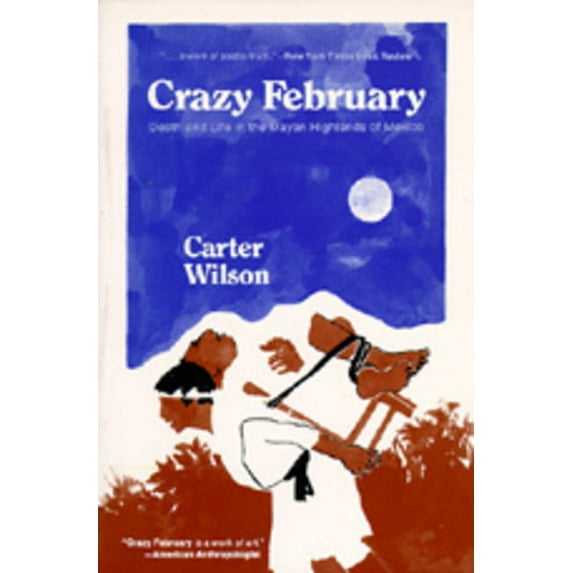
Hero image 0 of Crazy February : Death and Life in the Mayan Highlands of Mexico (Edition 1) (Paperback), 0 of 1
Crazy February : Death and Life in the Mayan Highlands of Mexico (Edition 1) (Paperback)
(No ratings yet)
Key item features
Products of the "imagination," such as novels, can be especially useful tools for understanding how things work in societies far removed from our own experience. Through the telling of a story, a sound ethnographic novel conveys more than information. It involves the reader in the dynamics of life in places where the rules for action are very different from the rules the reader makes his own decisions by.
Some people believe ethnographic novels are comparable to fieldnotes- the data themselves in their original, unanalyzed form. Though I can see the reason for the analogy, the author still disagree with it. Good fieldnotes record raw experience. For the time being, the anthropologist squelches his desire to interpret, and he writes down everything he can see or remember. Good ethnographic fiction also presents experience raw, without generalization. But in building the story, in selecting to tell this because it is important and not to tell that because it seems trivial, the novelist is analyzing his material. Between the raw and the cooked, both ethnographies and ethnographic novels belong in the processed pot.
Anthropologists try to make explicit and public both the method they have used to gather their material and the means for analyzing it. Ordinarily, a novelist obscures his analysis-the grounds for the choices he has made-and depends on the interior logic of the story to make his tale seem "true" or "believable." But Crazy February works with somewhat different principles than the author would normally use in writing "fiction." The book grew directly out of field experience. Wilson felt strongly that it would stand or fall on its ethnographic correctness. And so, faced with choices between what the author would like to see in the story and what he thought would actually happen to an Indian in the mountains of Chiapas, he consistently chose "actuality." In a practical, day-to-day writing sense, reality was the author's rod and my staff. And in the end he was very happy when anthropologists with greater experience in the Mayan area found the book essentially exact and, more important, true to the spirit of the place he had written about.
Specs
- Book formatPaperback
- Fiction/nonfictionNon-Fiction
- Publication dateApril, 1974
- Pages264
- SubgenreSociology
- Series titleNo Series
Current price is USD$24.76
Price when purchased online
 Free 90-day returns
How do you want your item?
Try 30 days of Free Shipping with Walmart+! Choose plan at checkout.
Columbus, 43215
Arrives by Tue, May 5
Sold and shipped by Walmart.com

Free 90-day returns - in store or online

This item is gift eligible
More seller options (3)
Starting from $36.65

Get free delivery, shipping and more*
*Restrictions apply Try Walmart+ now
About this item
Product details
Products of the "imagination," such as novels, can be especially useful tools for understanding how things work in societies far removed from our own experience. Through the telling of a story, a sound ethnographic novel conveys more than information. It involves the reader in the dynamics of life in places where the rules for action are very different from the rules the reader makes his own decisions by. Some people believe ethnographic novels are comparable to fieldnotes- the data themselves in their original, unanalyzed form. Though I can see the reason for the analogy, the author still disagree with it. Good fieldnotes record raw experience. For the time being, the anthropologist squelches his desire to interpret, and he writes down everything he can see or remember. Good ethnographic fiction also presents experience raw, without generalization. But in building the story, in selecting to tell this because it is important and not to tell that because it seems trivial, the novelist is analyzing his material. Between the raw and the cooked, both ethnographies and ethnographic novels belong in the processed pot. Anthropologists try to make explicit and public both the method they have used to gather their material and the means for analyzing it. Ordinarily, a novelist obscures his analysis-the grounds for the choices he has made-and depends on the interior logic of the story to make his tale seem "true" or "believable." But Crazy February works with somewhat different principles than the author would normally use in writing "fiction." The book grew directly out of field experience. Wilson felt strongly that it would stand or fall on its ethnographic correctness. And so, faced with choices between what the author would like to see in the story and what he thought would actually happen to an Indian in the mountains of Chiapas, he consistently chose "actuality." In a practical, day-to-day writing sense, reality was the author's rod and my staff. And in the end he was very happy when anthropologists with greater experience in the Mayan area found the book essentially exact and, more important, true to the spirit of the place he had written about.
Products of the "imagination," such as novels, can be especially useful tools for understanding how things work in societies far removed from our own experience. Through the telling of a story, a sound ethnographic novel conveys more than information. It involves the reader in the dynamics of life in places where the rules for action are very different from the rules the reader makes his own decisions by.
Some people believe ethnographic novels are comparable to fieldnotes- the data themselves in their original, unanalyzed form. Though I can see the reason for the analogy, the author still disagree with it. Good fieldnotes record raw experience. For the time being, the anthropologist squelches his desire to interpret, and he writes down everything he can see or remember. Good ethnographic fiction also presents experience raw, without generalization. But in building the story, in selecting to tell this because it is important and not to tell that because it seems trivial, the novelist is analyzing his material. Between the raw and the cooked, both ethnographies and ethnographic novels belong in the processed pot.
Anthropologists try to make explicit and public both the method they have used to gather their material and the means for analyzing it. Ordinarily, a novelist obscures his analysis-the grounds for the choices he has made-and depends on the interior logic of the story to make his tale seem "true" or "believable." But Crazy February works with somewhat different principles than the author would normally use in writing "fiction." The book grew directly out of field experience. Wilson felt strongly that it would stand or fall on its ethnographic correctness. And so, faced with choices between what the author would like to see in the story and what he thought would actually happen to an Indian in the mountains of Chiapas, he consistently chose "actuality." In a practical, day-to-day writing sense, reality was the author's rod and my staff. And in the end he was very happy when anthropologists with greater experience in the Mayan area found the book essentially exact and, more important, true to the spirit of the place he had written about.
info:
We aim to show you accurate product information. Manufacturers, suppliers and others provide what you see here, and we have not verified it.
Specifications
Book format
Paperback
Fiction/nonfiction
Non-Fiction
Genre
Political & Social Sciences
Publication date
April, 1974
Warranty
Warranty information
Please be aware that the warranty terms on items offered for sale by third party Marketplace sellers may differ from those displayed in this section (if any). To confirm warranty terms on an item offered for sale by a third party Marketplace seller, please use the 'Contact seller' feature on the third party Marketplace seller's information page and request the item's warranty terms prior to purchase.
Similar items you might like
Based on what customers bought
Living in the Sound of the Wind: A Personal Quest for W.H. Hudson, Naturalist and Writer from the River Plate, (Paperback) $25.99
 $2599current price $25.99
Living in the Sound of the Wind: A Personal Quest for W.H. Hudson, Naturalist and Writer from the River Plate, (Paperback)
Eco Revolution: Climate Justice, Community, and the Fight for Our Planet, (Paperback) $19.99
 $1999current price $19.99
Eco Revolution: Climate Justice, Community, and the Fight for Our Planet, (Paperback)
Death Feigning Beetles of the United States and Mexico, (Paperback) $26.78
 $2678current price $26.78
Death Feigning Beetles of the United States and Mexico, (Paperback)
Trail of Tears: The Untold Story of America's Forced Relocation and Survival, (Paperback) $19.99
 $1999current price $19.99
Trail of Tears: The Untold Story of America's Forced Relocation and Survival, (Paperback)
Maya Wisdom and the Survival of Our Planet, (Hardcover) $21.33
 $2133current price $21.33
Maya Wisdom and the Survival of Our Planet, (Hardcover)
Reclaiming the Gods: Magic, Sex, Death and Football, (Paperback) $21.62
 $2162current price $21.62
Reclaiming the Gods: Magic, Sex, Death and Football, (Paperback)
The Dog Who Spoke and More Mayan Folktales: El Perro Que Habló Y Más Cuentos Mayas, (Paperback) $24.95
 $2495current price $24.95
The Dog Who Spoke and More Mayan Folktales: El Perro Que Habló Y Más Cuentos Mayas, (Paperback)
Best seller The Dragon's Prophecy: Israel, the Dark Resurrection, and the End of Days (Hardcover) $4.39 Was $6.91
Best seller $439current price $4.39, Was $6.91$6.91
The Dragon's Prophecy: Israel, the Dark Resurrection, and the End of Days (Hardcover)
1834.9 out of 5 Stars. 183 reviewsPopol Vuh en Escritura Maya, (Paperback) $24.99
 $2499current price $24.99
Popol Vuh en Escritura Maya, (Paperback)
California Series in Public Anthropology: Why Did They Kill? : Cambodia in the Shadow of Genocide (Series #11) (Edition 1) (Paperback) $37.16
 $3716current price $37.16
California Series in Public Anthropology: Why Did They Kill? : Cambodia in the Shadow of Genocide (Series #11) (Edition 1) (Paperback)
Bo Belinsky: The Rise, Fall and Rebound of a Playboy Pitcher, (Paperback) $27.31
 $2731current price $27.31
Bo Belinsky: The Rise, Fall and Rebound of a Playboy Pitcher, (Paperback)
Practical Mayan Astrology, (Paperback) $25.34
 $2534current price $25.34
Practical Mayan Astrology, (Paperback)
Coyote Books El Malpais, Mt. Taylor, and the Zuni Mountains: A Hiking Guide and History, (Paperback) $25.00
 $2500current price $25.00
Coyote Books El Malpais, Mt. Taylor, and the Zuni Mountains: A Hiking Guide and History, (Paperback)
Culture in an Age of Money: The Legacy of the 1980s in America, (Paperback) $19.95
 $1995current price $19.95
Culture in an Age of Money: The Legacy of the 1980s in America, (Paperback)
Egypt (La Mort de Philae) $19.99
 $1999current price $19.99
Egypt (La Mort de Philae)
Texas Pan American God and Production in a Guatemalan Town, (Paperback) $25.91
 $2591current price $25.91
Texas Pan American God and Production in a Guatemalan Town, (Paperback)
A Voyage To South America, With An Account Of A Shipwreck In The River La Plata, In The Year 1817, By The Sole Survivor. (g. Fracker) (Paperback) $17.95
 $1795current price $17.95
A Voyage To South America, With An Account Of A Shipwreck In The River La Plata, In The Year 1817, By The Sole Survivor. (g. Fracker) (Paperback)
Diálogos Death, Dismemberment, and Memory: Body Politics in Latin America, (Paperback) $38.65
 $3865current price $38.65
Diálogos Death, Dismemberment, and Memory: Body Politics in Latin America, (Paperback)
No Magic Bullet: A Social History of Venereal Disease in the United States Since 1880- 35th Anniversary Edition, (Paperback) $37.78
 $3778current price $37.78
No Magic Bullet: A Social History of Venereal Disease in the United States Since 1880- 35th Anniversary Edition, (Paperback)
Customer ratings & reviews
0 ratings|0 reviews
This item does not have any reviews yet

Related pages
- Francisco Moraes
- Saint-denis
- Caribbean & Latin American Poetry Books
- Guatemalan Adventure
- Cuban Poems
- Best Sellers In Biographies Memoirs In Spanish
- Hector Land
- Literary Collections - Caribbean & Latin American
- Hispanic American Poetry Books
- Mexico Historical Teen & Young Adult Books
- Mexico People & Places Teen & Young Adult Books
- Caribbean & Latin America People & Places Teen & Young Adult Books