

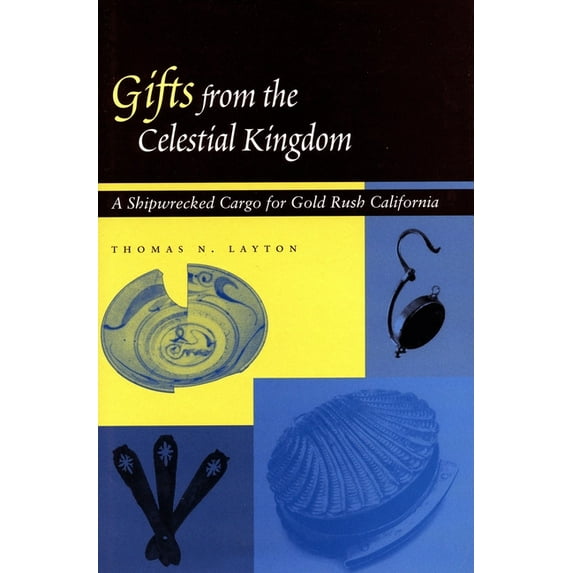
Gifts from the Celestial Kingdom : A Shipwrecked Cargo for Gold Rush California (Paperback)
(No ratings yet)
Key item features
In a prior volume—The Voyage of the "Frolic": New England Merchants and the Opium Trade (Stanford, 1997)—historical archaeologist Thomas N. Laytontold the story of his excavation of an ancient Pomo Indian village site in Northern California, where, to his surprise, he recovered Chinese porcelain potsherds. Tracing those sherds to a beach on the rugged Mendocino coast, he then followed them out to the submerged remains of the Frolic, a sailing vessel wrecked in the summer of 1850 with a rich cargo of Chinese goods bound for Gold Rush San Francisco.
In that volume, Layton used the vessel's earlier role, transporting opium from Bombay to Canton, as a vehicle to tell the story of American participation in the opium trade. Although the Frolic's career as an opium clipper was ended in 1849 by the introduction of steam vessels, the almost simultaneous discovery of gold in California suddenly created enough purchasing power to support direct commerce with China—and thus a new career for the Frolic.
In this sequel volume, Layton has two objectives. First, he employs the Frolic's ill-fated first, and final, cargo to San Francisco to tell the broader story of the beginnings of direct commerce between China and California. Second, he attempts to explore the potential of contextual archaeology—the intellectual process of "transporting" artifacts from their resting places back to the behavioral contexts in which they once functioned.
Layton accomplishes his objectives by describing the full trajectory of the Frolic's final cargo from four different perspectives: from that of John Hurd Everett, the California merchant who assembled the cargo in China; then from the perspectives of the sailors and Pomo Indians who pillaged the cargo immediately after the wreck; then through the eyes of twentieth-century sport divers who plundered it yet again; then, finally, through Layton's scientific perspective as an archaeologist. To augment his quest for context, he employs carefully documented vignettes to fill the interstices between the facts. Throughout, he discusses his research—replete with visits to archives and antique shops—and in so doing introduces readers to the practice of modern historical archaeology.
In that volume, Layton used the vessel's earlier role, transporting opium from Bombay to Canton, as a vehicle to tell the story of American participation in the opium trade. Although the Frolic's career as an opium clipper was ended in 1849 by the introduction of steam vessels, the almost simultaneous discovery of gold in California suddenly created enough purchasing power to support direct commerce with China—and thus a new career for the Frolic.
In this sequel volume, Layton has two objectives. First, he employs the Frolic's ill-fated first, and final, cargo to San Francisco to tell the broader story of the beginnings of direct commerce between China and California. Second, he attempts to explore the potential of contextual archaeology—the intellectual process of "transporting" artifacts from their resting places back to the behavioral contexts in which they once functioned.
Layton accomplishes his objectives by describing the full trajectory of the Frolic's final cargo from four different perspectives: from that of John Hurd Everett, the California merchant who assembled the cargo in China; then from the perspectives of the sailors and Pomo Indians who pillaged the cargo immediately after the wreck; then through the eyes of twentieth-century sport divers who plundered it yet again; then, finally, through Layton's scientific perspective as an archaeologist. To augment his quest for context, he employs carefully documented vignettes to fill the interstices between the facts. Throughout, he discusses his research—replete with visits to archives and antique shops—and in so doing introduces readers to the practice of modern historical archaeology.
Specs
- Book formatPaperback
- Fiction/nonfictionNon-Fiction
- Publication dateApril, 2002
- Pages272
- EditionStandard Edition
- PublisherStanford University Press
Current price is USD$26.63
Price when purchased online
- Free shipping
 Free 30-day returns
How do you want your item?
Ships to
Arrives by Mon, May 18
|
Sold and shipped by Alibris Books
4.569115147177239 stars out of 5, based on 11177 seller reviews(4.6)11177 seller reviews

Free 30-day returns
Other sellers
$30.00
+Free shippingShipping, arrives by Sat, May 16 to Columbus, 43215
Sold and shipped by RAREWAVES-USA
Free 30-day returns
About this item
Product details
In 1850 a sailing vessel was wrecked on the California coast with a rich cargo of Chinese goods bound for the Gold Rush. This book uses the fate of the vessel for a dual purpose: to tell the story of the beginnings of direct commerce between China and California and to explore the potential of contextual archaeology by tracing the cargo back to its origins in China.
In a prior volume—The Voyage of the "Frolic": New England Merchants and the Opium Trade (Stanford, 1997)—historical archaeologist Thomas N. Laytontold the story of his excavation of an ancient Pomo Indian village site in Northern California, where, to his surprise, he recovered Chinese porcelain potsherds. Tracing those sherds to a beach on the rugged Mendocino coast, he then followed them out to the submerged remains of the Frolic, a sailing vessel wrecked in the summer of 1850 with a rich cargo of Chinese goods bound for Gold Rush San Francisco.
In that volume, Layton used the vessel's earlier role, transporting opium from Bombay to Canton, as a vehicle to tell the story of American participation in the opium trade. Although the Frolic's career as an opium clipper was ended in 1849 by the introduction of steam vessels, the almost simultaneous discovery of gold in California suddenly created enough purchasing power to support direct commerce with China—and thus a new career for the Frolic.
In this sequel volume, Layton has two objectives. First, he employs the Frolic's ill-fated first, and final, cargo to San Francisco to tell the broader story of the beginnings of direct commerce between China and California. Second, he attempts to explore the potential of contextual archaeology—the intellectual process of "transporting" artifacts from their resting places back to the behavioral contexts in which they once functioned.
Layton accomplishes his objectives by describing the full trajectory of the Frolic's final cargo from four different perspectives: from that of John Hurd Everett, the California merchant who assembled the cargo in China; then from the perspectives of the sailors and Pomo Indians who pillaged the cargo immediately after the wreck; then through the eyes of twentieth-century sport divers who plundered it yet again; then, finally, through Layton's scientific perspective as an archaeologist. To augment his quest for context, he employs carefully documented vignettes to fill the interstices between the facts. Throughout, he discusses his research—replete with visits to archives and antique shops—and in so doing introduces readers to the practice of modern historical archaeology.
In that volume, Layton used the vessel's earlier role, transporting opium from Bombay to Canton, as a vehicle to tell the story of American participation in the opium trade. Although the Frolic's career as an opium clipper was ended in 1849 by the introduction of steam vessels, the almost simultaneous discovery of gold in California suddenly created enough purchasing power to support direct commerce with China—and thus a new career for the Frolic.
In this sequel volume, Layton has two objectives. First, he employs the Frolic's ill-fated first, and final, cargo to San Francisco to tell the broader story of the beginnings of direct commerce between China and California. Second, he attempts to explore the potential of contextual archaeology—the intellectual process of "transporting" artifacts from their resting places back to the behavioral contexts in which they once functioned.
Layton accomplishes his objectives by describing the full trajectory of the Frolic's final cargo from four different perspectives: from that of John Hurd Everett, the California merchant who assembled the cargo in China; then from the perspectives of the sailors and Pomo Indians who pillaged the cargo immediately after the wreck; then through the eyes of twentieth-century sport divers who plundered it yet again; then, finally, through Layton's scientific perspective as an archaeologist. To augment his quest for context, he employs carefully documented vignettes to fill the interstices between the facts. Throughout, he discusses his research—replete with visits to archives and antique shops—and in so doing introduces readers to the practice of modern historical archaeology.
info:
We aim to show you accurate product information. Manufacturers, suppliers and others provide what you see here, and we have not verified it.
Specifications
Book format
Paperback
Fiction/nonfiction
Non-Fiction
Genre
History, Political & Social Sciences
Publication date
April, 2002
Warranty
Warranty information
Please be aware that the warranty terms on items offered for sale by third party Marketplace sellers may differ from those displayed in this section (if any). To confirm warranty terms on an item offered for sale by a third party Marketplace seller, please use the 'Contact seller' feature on the third party Marketplace seller's information page and request the item's warranty terms prior to purchase.
Similar items you might like
Based on what customers bought
The Land of Ale and Gloom: Discovering the Pacific Northwest, (Paperback) $15.49
 $1549current price $15.49
The Land of Ale and Gloom: Discovering the Pacific Northwest, (Paperback)
The Big Leap: A Barefoot Girl's Journey, (Paperback) $15.99
 $1599current price $15.99
The Big Leap: A Barefoot Girl's Journey, (Paperback)
W. L. Moody JR. Natural History North American Deserts: Ecology of Our Arid Lands, (Paperback) $19.77
 $1977current price $19.77
W. L. Moody JR. Natural History North American Deserts: Ecology of Our Arid Lands, (Paperback)
Best seller The Psychology of Money: Timeless Lessons on Wealth, Greed, and Happiness (Paperback) $7.96 Was $12.64
Best seller $796current price $7.96, Was $12.64$12.64
The Psychology of Money: Timeless Lessons on Wealth, Greed, and Happiness (Paperback)
1434.5 out of 5 Stars. 143 reviewsMaps Of The State Of Maine, (Paperback) $14.97
 $1497current price $14.97
Maps Of The State Of Maine, (Paperback)
Enjoying Maine's Islands, (Paperback) $13.37
 $1337current price $13.37
Enjoying Maine's Islands, (Paperback)
Narrative of a journey down the Ohio and Mississippi in 1789-90, (Paperback) $14.90
 $1490current price $14.90
Narrative of a journey down the Ohio and Mississippi in 1789-90, (Paperback)
Mountain Villages of New Mexico, (Paperback) $15.88
 $1588current price $15.88
Mountain Villages of New Mexico, (Paperback)
Where We Call Home: Lands, Seas, and Skies of the Pacific Northwest, (Paperback) $12.13
 $1213current price $12.13
Where We Call Home: Lands, Seas, and Skies of the Pacific Northwest, (Paperback)
Sailing by Starlight : In Search of Treasure Island (Paperback) $15.12
 $1512current price $15.12
Sailing by Starlight : In Search of Treasure Island (Paperback)
The Last Wild Places of Kansas: Journeys Into Hidden Landscapes, (Paperback) $14.22
 $1422current price $14.22
The Last Wild Places of Kansas: Journeys Into Hidden Landscapes, (Paperback)
15 out of 5 Stars. 1 reviewsA Lowland Lad's Highland Adventure, (Paperback) $14.69
 $1469current price $14.69
A Lowland Lad's Highland Adventure, (Paperback)
Shelter (Large Print) Shelter, Book 1, (Paperback) $14.99
 $1499current price $14.99
Shelter (Large Print) Shelter, Book 1, (Paperback)
15 Short Walks on the Shetland Islands, (Paperback) $16.99
 $1699current price $16.99
15 Short Walks on the Shetland Islands, (Paperback)
Closer To Dirt Than Gold: Discovering Life's Treasures in a California Desert, (Paperback) $18.48
 $1848current price $18.48
Closer To Dirt Than Gold: Discovering Life's Treasures in a California Desert, (Paperback)
Old Settlers of the Grand Traverse Region, (Paperback) $17.95
 $1795current price $17.95
Old Settlers of the Grand Traverse Region, (Paperback)
... A Survey of the Garment Trades in San Francisco (Paperback) $15.95
 $1595current price $15.95
... A Survey of the Garment Trades in San Francisco (Paperback)
Trails of the Feather River Region - Northeastern California's Unspoiled Treasure (Paperback) $14.99
 $1499current price $14.99
Trails of the Feather River Region - Northeastern California's Unspoiled Treasure (Paperback)
The Kings of Slate Creek: Following the Rush for Gold in Alaska, (Hardcover) $25.00
 $2500current price $25.00
The Kings of Slate Creek: Following the Rush for Gold in Alaska, (Hardcover)

Customer ratings & reviews
0 ratings|0 reviews
This item does not have any reviews yet
