

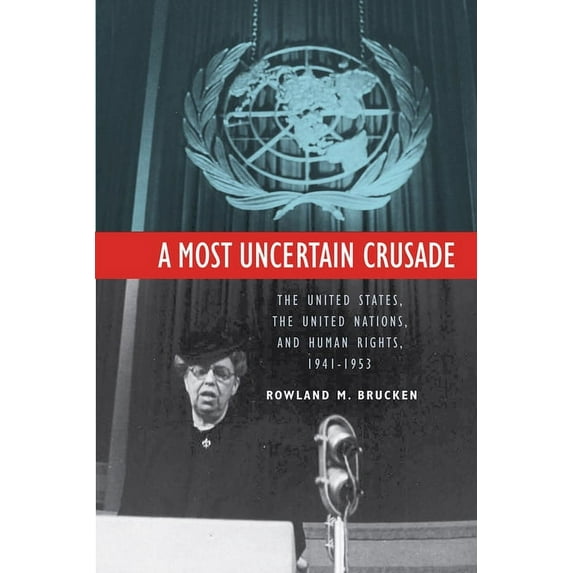
Hero image 0 of A Most Uncertain Crusade : The United States, the United Nations, and Human Rights, 1941-1953 (Hardcover), 0 of 1
A Most Uncertain Crusade : The United States, the United Nations, and Human Rights, 1941-1953 (Hardcover)
(No ratings yet)
Key item features
A Most Uncertain Crusade traces and analyzes the emergence of human rights as both an international concern and as a controversial domestic issue for U.S. policy makers during and after World War II. Historian Brucken focuses on officials in the State Department, at the United Nations, and within certain domestic non-governmental organizations, and explains why, after issuing wartime declarations that called for the definition and enforcement of international human rights standards, the U.S. government refused to ratify the first U.N. treaties that fulfilled those twin purposes. The Truman and Eisenhower administrations worked to weaken the scope and enforcement mechanisms of early human rights agreements, and gradually withdrew support for Senate ratification. A small but influential group of isolationist–oriented senators, led by John Bricker (R-OH), warned that the treaties would bring about socialism, destroy white supremacy, and eviscerate the Bill of Rights. At the U.N., a growing bloc of developing nations demanded the inclusion of economic guarantees, support for decolonization, and strong enforcement measures, all of which Washington opposed.
Prior to World War II, international law considered the protection of individual rights to fall largely under the jurisdiction of national governments. Alarmed by fascist tyranny and guided by a Wilsonian vision of global cooperation in pursuit of human rights, President Roosevelt issued the Four Freedoms and the Atlantic Charter. Behind the scenes, the State Department planners carefully considered how an international organization could best protect those guarantees. Their work paid off at the 1945 San Francisco Conference, which vested the U.N. with an unprecedented opportunity to define and protect the human rights of individuals.
After two years of negotiations, the U.N. General Assembly unanimously approved its first human rights treaty, the Genocide Convention. The U.N. Commission on Human Rights (UNCHR), led by Eleanor Roosevelt, drafted the nonbinding Universal Declaration of Human Rights in 1948. Subsequent efforts to craft an enforceable covenant of individual rights, though, bogged down quickly. A deadlock occurred as western nations, communist states, and developing countries disagreed on the inclusion of economic and social guarantees, the right of self-determination, and plans for implementation.
Meanwhile, a coalition of groups within the United States doubted the wisdom of American accession to any human rights treaties. Led by the American Bar Association and Senator Bricker, opponents proclaimed that ratification would lead to a U.N. led tyrannical world socialistic government. The backlash caused President Eisenhower to withdraw from the covenant drafting process. Brucken shows how the American human rights policy had come full circle: Eisenhower, like Roosevelt, issued statements that merely celebrated western values of freedom and democracy, criticized human rights records of other countries while at the same time postponed efforts to have the U.N. codify and enforce a list of binding rights due in part to America’s own human rights violations.
Prior to World War II, international law considered the protection of individual rights to fall largely under the jurisdiction of national governments. Alarmed by fascist tyranny and guided by a Wilsonian vision of global cooperation in pursuit of human rights, President Roosevelt issued the Four Freedoms and the Atlantic Charter. Behind the scenes, the State Department planners carefully considered how an international organization could best protect those guarantees. Their work paid off at the 1945 San Francisco Conference, which vested the U.N. with an unprecedented opportunity to define and protect the human rights of individuals.
After two years of negotiations, the U.N. General Assembly unanimously approved its first human rights treaty, the Genocide Convention. The U.N. Commission on Human Rights (UNCHR), led by Eleanor Roosevelt, drafted the nonbinding Universal Declaration of Human Rights in 1948. Subsequent efforts to craft an enforceable covenant of individual rights, though, bogged down quickly. A deadlock occurred as western nations, communist states, and developing countries disagreed on the inclusion of economic and social guarantees, the right of self-determination, and plans for implementation.
Meanwhile, a coalition of groups within the United States doubted the wisdom of American accession to any human rights treaties. Led by the American Bar Association and Senator Bricker, opponents proclaimed that ratification would lead to a U.N. led tyrannical world socialistic government. The backlash caused President Eisenhower to withdraw from the covenant drafting process. Brucken shows how the American human rights policy had come full circle: Eisenhower, like Roosevelt, issued statements that merely celebrated western values of freedom and democracy, criticized human rights records of other countries while at the same time postponed efforts to have the U.N. codify and enforce a list of binding rights due in part to America’s own human rights violations.
Specs
- Book formatHardcover
- Fiction/nonfictionNon-Fiction
- GenreTextbooks
- Publication dateDecember, 2013
- Pages450
- EditionStandard
Current price is USD$59.80
Price when purchased online
- Free shipping
 Free 90-day returns
How do you want your item?
Try 30 days of Free Shipping with Walmart+! Choose plan at checkout.
Columbus, 43215
Arrives by Tue, Apr 28
Sold and shipped by Walmart.com

Free 90-day returns

This item is gift eligible
More seller options (1)
Starting from $66.71

Get free delivery, shipping and more*
*Restrictions apply Try Walmart+ now
About this item
Product details
A Most Uncertain Crusade traces and analyzes the emergence of human rights as both an international concern and as a controversial domestic issue for U.S. policy makers during and after World War II. Historian Brucken focuses on officials in the State Department, at the United Nations, and within certain domestic non-governmental organizations, and explains why, after issuing wartime declarations that called for the definition and enforcement of international human rights standards, the U.S. government refused to ratify the first U.N. treaties that fulfilled those twin purposes. The Truman and Eisenhower administrations worked to weaken the scope and enforcement mechanisms of early human rights agreements, and gradually withdrew support for Senate ratification. A small but influential group of isolationist–oriented senators, led by John Bricker (R-OH), warned that the treaties would bring about socialism, destroy white supremacy, and eviscerate the Bill of Rights. At the U.N., a growing bloc of developing nations demanded the inclusion of economic guarantees, support for decolonization, and strong enforcement measures, all of which Washington opposed.
Prior to World War II, international law considered the protection of individual rights to fall largely under the jurisdiction of national governments. Alarmed by fascist tyranny and guided by a Wilsonian vision of global cooperation in pursuit of human rights, President Roosevelt issued the Four Freedoms and the Atlantic Charter. Behind the scenes, the State Department planners carefully considered how an international organization could best protect those guarantees. Their work paid off at the 1945 San Francisco Conference, which vested the U.N. with an unprecedented opportunity to define and protect the human rights of individuals. After two years of negotiations, the U.N. General Assembly unanimously approved its first human rights treaty, the Genocide Convention. The U.N. Commission on Human Rights (UNCHR), led by Eleanor Roosevelt, drafted the nonbinding Universal Declaration of Human Rights in 1948. Subsequent efforts to craft an enforceable covenant of individual rights, though, bogged down quickly. A deadlock occurred as western nations, communist states, and developing countries disagreed on the inclusion of economic and social guarantees, the right of self-determination, and plans for implementation.
Meanwhile, a coalition of groups within the United States doubted the wisdom of American accession to any human rights treaties. Led by the American Bar Association and Senator Bricker, opponents proclaimed that ratification would lead to a U.N. led tyrannical world socialistic government. The backlash caused President Eisenhower to withdraw from the covenant drafting process. Brucken shows how the American human rights policy had come full circle: Eisenhower, like Roosevelt, issued statements that merely celebrated western values of freedom and democracy, criticized human rights records of other countries while at the same time postponed efforts to have the U.N. codify and enforce a list of binding rights due in part to America’s own human rights violations.
Prior to World War II, international law considered the protection of individual rights to fall largely under the jurisdiction of national governments. Alarmed by fascist tyranny and guided by a Wilsonian vision of global cooperation in pursuit of human rights, President Roosevelt issued the Four Freedoms and the Atlantic Charter. Behind the scenes, the State Department planners carefully considered how an international organization could best protect those guarantees. Their work paid off at the 1945 San Francisco Conference, which vested the U.N. with an unprecedented opportunity to define and protect the human rights of individuals. After two years of negotiations, the U.N. General Assembly unanimously approved its first human rights treaty, the Genocide Convention. The U.N. Commission on Human Rights (UNCHR), led by Eleanor Roosevelt, drafted the nonbinding Universal Declaration of Human Rights in 1948. Subsequent efforts to craft an enforceable covenant of individual rights, though, bogged down quickly. A deadlock occurred as western nations, communist states, and developing countries disagreed on the inclusion of economic and social guarantees, the right of self-determination, and plans for implementation.
Meanwhile, a coalition of groups within the United States doubted the wisdom of American accession to any human rights treaties. Led by the American Bar Association and Senator Bricker, opponents proclaimed that ratification would lead to a U.N. led tyrannical world socialistic government. The backlash caused President Eisenhower to withdraw from the covenant drafting process. Brucken shows how the American human rights policy had come full circle: Eisenhower, like Roosevelt, issued statements that merely celebrated western values of freedom and democracy, criticized human rights records of other countries while at the same time postponed efforts to have the U.N. codify and enforce a list of binding rights due in part to America’s own human rights violations.
A Most Uncertain Crusade traces and analyzes the emergence of human rights as both an international concern and as a controversial domestic issue for U.S. policy makers during and after World War II. Historian Brucken focuses on officials in the State Department, at the United Nations, and within certain domestic non-governmental organizations, and explains why, after issuing wartime declarations that called for the definition and enforcement of international human rights standards, the U.S. government refused to ratify the first U.N. treaties that fulfilled those twin purposes. The Truman and Eisenhower administrations worked to weaken the scope and enforcement mechanisms of early human rights agreements, and gradually withdrew support for Senate ratification. A small but influential group of isolationist–oriented senators, led by John Bricker (R-OH), warned that the treaties would bring about socialism, destroy white supremacy, and eviscerate the Bill of Rights. At the U.N., a growing bloc of developing nations demanded the inclusion of economic guarantees, support for decolonization, and strong enforcement measures, all of which Washington opposed.
Prior to World War II, international law considered the protection of individual rights to fall largely under the jurisdiction of national governments. Alarmed by fascist tyranny and guided by a Wilsonian vision of global cooperation in pursuit of human rights, President Roosevelt issued the Four Freedoms and the Atlantic Charter. Behind the scenes, the State Department planners carefully considered how an international organization could best protect those guarantees. Their work paid off at the 1945 San Francisco Conference, which vested the U.N. with an unprecedented opportunity to define and protect the human rights of individuals.
After two years of negotiations, the U.N. General Assembly unanimously approved its first human rights treaty, the Genocide Convention. The U.N. Commission on Human Rights (UNCHR), led by Eleanor Roosevelt, drafted the nonbinding Universal Declaration of Human Rights in 1948. Subsequent efforts to craft an enforceable covenant of individual rights, though, bogged down quickly. A deadlock occurred as western nations, communist states, and developing countries disagreed on the inclusion of economic and social guarantees, the right of self-determination, and plans for implementation.
Meanwhile, a coalition of groups within the United States doubted the wisdom of American accession to any human rights treaties. Led by the American Bar Association and Senator Bricker, opponents proclaimed that ratification would lead to a U.N. led tyrannical world socialistic government. The backlash caused President Eisenhower to withdraw from the covenant drafting process. Brucken shows how the American human rights policy had come full circle: Eisenhower, like Roosevelt, issued statements that merely celebrated western values of freedom and democracy, criticized human rights records of other countries while at the same time postponed efforts to have the U.N. codify and enforce a list of binding rights due in part to America’s own human rights violations.
Prior to World War II, international law considered the protection of individual rights to fall largely under the jurisdiction of national governments. Alarmed by fascist tyranny and guided by a Wilsonian vision of global cooperation in pursuit of human rights, President Roosevelt issued the Four Freedoms and the Atlantic Charter. Behind the scenes, the State Department planners carefully considered how an international organization could best protect those guarantees. Their work paid off at the 1945 San Francisco Conference, which vested the U.N. with an unprecedented opportunity to define and protect the human rights of individuals.
After two years of negotiations, the U.N. General Assembly unanimously approved its first human rights treaty, the Genocide Convention. The U.N. Commission on Human Rights (UNCHR), led by Eleanor Roosevelt, drafted the nonbinding Universal Declaration of Human Rights in 1948. Subsequent efforts to craft an enforceable covenant of individual rights, though, bogged down quickly. A deadlock occurred as western nations, communist states, and developing countries disagreed on the inclusion of economic and social guarantees, the right of self-determination, and plans for implementation.
Meanwhile, a coalition of groups within the United States doubted the wisdom of American accession to any human rights treaties. Led by the American Bar Association and Senator Bricker, opponents proclaimed that ratification would lead to a U.N. led tyrannical world socialistic government. The backlash caused President Eisenhower to withdraw from the covenant drafting process. Brucken shows how the American human rights policy had come full circle: Eisenhower, like Roosevelt, issued statements that merely celebrated western values of freedom and democracy, criticized human rights records of other countries while at the same time postponed efforts to have the U.N. codify and enforce a list of binding rights due in part to America’s own human rights violations.
info:
We aim to show you accurate product information. Manufacturers, suppliers and others provide what you see here, and we have not verified it.
Specifications
Book format
Hardcover
Fiction/nonfiction
Non-Fiction
Genre
Textbooks
Publication date
December, 2013
Warranty
Warranty information
Please be aware that the warranty terms on items offered for sale by third party Marketplace sellers may differ from those displayed in this section (if any). To confirm warranty terms on an item offered for sale by a third party Marketplace seller, please use the 'Contact seller' feature on the third party Marketplace seller's information page and request the item's warranty terms prior to purchase.
Warnings
State Chemical Disclosure
No harmful chemicals
Similar items you might like
Based on what customers bought
Revisiting Human Rights in Canadian History, (Hardcover) $70.00
 $7000current price $70.00
Revisiting Human Rights in Canadian History, (Hardcover)
Non-Governmental Human Rights Organizations in International Relations, (Hardcover) $56.14
 $5614current price $56.14
Non-Governmental Human Rights Organizations in International Relations, (Hardcover)
Best seller Nobody's Girl: A Memoir of Surviving Abuse and Fighting for Justice (Hardcover) $16.10
Best seller $1610current price $16.10
Nobody's Girl: A Memoir of Surviving Abuse and Fighting for Justice (Hardcover)
2124.7 out of 5 Stars. 212 reviewsClass Conflict, Slavery, and the United States Constitution, (Hardcover) $96.66
 $9666current price $96.66
Class Conflict, Slavery, and the United States Constitution, (Hardcover)
Policing in Africa, (Hardcover) $56.14
 $5614current price $56.14
Policing in Africa, (Hardcover)
America's Perceptions of Europe, (Hardcover) $56.14
 $5614current price $56.14
America's Perceptions of Europe, (Hardcover)
Human Rights, Migration, and Social Conflict: Towards a Decolonized Global Justice, (Hardcover) $56.14
 $5614current price $56.14
Human Rights, Migration, and Social Conflict: Towards a Decolonized Global Justice, (Hardcover)
The European Convention on Human Rights: A Threat to United States-European Security Relations and the United States Mil, (Paperback) $57.95
 $5795current price $57.95
The European Convention on Human Rights: A Threat to United States-European Security Relations and the United States Mil, (Paperback)
The Moral Epistemology of Intuitionism: Neuroethics and Seeming States, (Hardcover) $110.82
 $11082current price $110.82
The Moral Epistemology of Intuitionism: Neuroethics and Seeming States, (Hardcover)
Gobbledygook Has Gotta Go (Hardcover) $33.79
 $3379current price $33.79
Gobbledygook Has Gotta Go (Hardcover)
A Hygienic City-Nation, (Hardcover) $101.22
 $10122current price $101.22
A Hygienic City-Nation, (Hardcover)
The Colonialism of Human Rights (Hardcover) $61.38
 $6138current price $61.38
The Colonialism of Human Rights (Hardcover)
The American Government (Hardcover) $39.95
 $3995current price $39.95
The American Government (Hardcover)
American Power After 9/11, (Hardcover) $63.94
 $6394current price $63.94
American Power After 9/11, (Hardcover)
The Constitution of the United States (Hardcover) $44.99
 $4499current price $44.99
The Constitution of the United States (Hardcover)
America's Viceroys: The Military and U.S. Foreign Policy, (Hardcover) $60.29
 $6029current price $60.29
America's Viceroys: The Military and U.S. Foreign Policy, (Hardcover)
Indonesia: Towards Democracy (Hardcover) $57.49
 $5749current price $57.49
Indonesia: Towards Democracy (Hardcover)
NATO Renewed: The Power and Purpose of Transatlantic Cooperation, (Hardcover) $56.14
 $5614current price $56.14
NATO Renewed: The Power and Purpose of Transatlantic Cooperation, (Hardcover)
Digital Leadership: Führung in Zeiten Des Digitalen Wandels, (Hardcover) $62.05
 $6205current price $62.05
Digital Leadership: Führung in Zeiten Des Digitalen Wandels, (Hardcover)
The American Federationist, (Hardcover) $39.95
 $3995current price $39.95
The American Federationist, (Hardcover)
Customer ratings & reviews
0 ratings|0 reviews
This item does not have any reviews yet
