

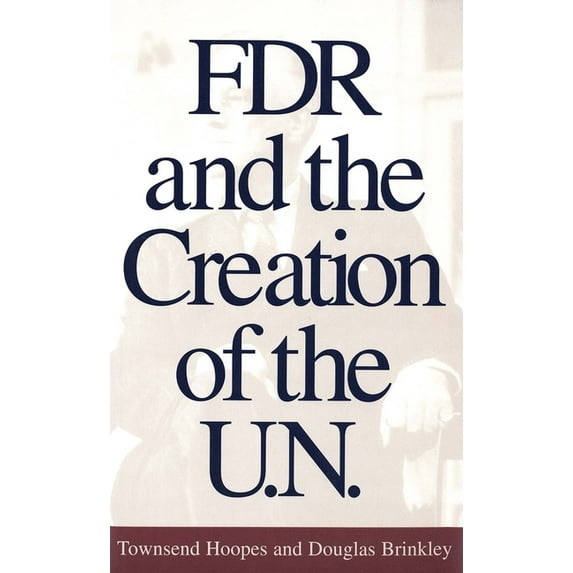
FDR and the Creation of the U.N. (Paperback)
(No ratings yet)
Key item features
In recent years the United Nations has become more active in—and more generally respected for—its peacekeeping efforts than at any other period in its fifty-year history. During the same period, the United States has been engaged in a debate about the place of the U.N. in the conduct of its foreign policy. This book, the first account of the American role in creating the United Nations, tells an engrossing story and also provides a useful historical perspective on the controversy.
Prize-winning historians Townsend Hoopes and Douglas Brinkley explain how the idea of the United Nations was conceived, debated, and revised, first within the U.S. government and then by negotiation with its major allies in World War II. The experience of the war generated increasing support for the new organization throughout American society, and the U.N. Charter was finally endorsed by the community of nations in 1945. The story largely belongs to President Franklin Roosevelt, who was determined to form an organization that would break the vicious cycle of ever more destructive wars (in contrast to the failed League of Nations), and who therefore assigned collective responsibility for keeping the peace to the five leading U.N. powers—the major wartime Allies. Hoopes and Brinkley focus on Roosevelt but also present vivid portraits of others who played significant roles in bringing the U.N. into being: these include Cordell Hull, Sumner Welles, Dean Acheson, Harry Hopkins, Wendell Willkie, Edward Stettinius, Arthur Vandenberg, Thomas Dewey, William Fulbright, and Walter Lippmann. In an epilogue, the authors discuss the checkered history of the United Nations and consider its future prospects.
Prize-winning historians Townsend Hoopes and Douglas Brinkley explain how the idea of the United Nations was conceived, debated, and revised, first within the U.S. government and then by negotiation with its major allies in World War II. The experience of the war generated increasing support for the new organization throughout American society, and the U.N. Charter was finally endorsed by the community of nations in 1945. The story largely belongs to President Franklin Roosevelt, who was determined to form an organization that would break the vicious cycle of ever more destructive wars (in contrast to the failed League of Nations), and who therefore assigned collective responsibility for keeping the peace to the five leading U.N. powers—the major wartime Allies. Hoopes and Brinkley focus on Roosevelt but also present vivid portraits of others who played significant roles in bringing the U.N. into being: these include Cordell Hull, Sumner Welles, Dean Acheson, Harry Hopkins, Wendell Willkie, Edward Stettinius, Arthur Vandenberg, Thomas Dewey, William Fulbright, and Walter Lippmann. In an epilogue, the authors discuss the checkered history of the United Nations and consider its future prospects.
Specs
- Book formatPaperback
- Fiction/nonfictionNon-Fiction
- Publication dateJuly, 2000
- Pages300
- EditionRevised Edition
- PublisherYale University Press
Current price is USD$25.76
Price when purchased online
 Free 90-day returns
How do you want your item?
Try 30 days for just $1! Choose a plan at checkout.
Ships to
Arrives by Thu, May 14
Sold and shipped by Walmart.com

Free 90-day returns

This item is gift eligible
More seller options (1)
Starting from $51.43

Try 30 days of Walmart+ for just $1!
T&C apply. Claim offer now
About this item
Product details
In recent years the United Nations has become more active in-and more generally respected for-its peacekeeping efforts than at any other period in its fifty-year history. During the same period, the United States has been engaged in a debate about the place of the U.N. in the conduct of its foreign policy. This book, the first account of the American role in creating the United Nations, tells an engrossing story and also provides a useful historical perspective on the controversy. Prize-winning historians Townsend Hoopes and Douglas Brinkley explain how the idea of the United Nations was conceived, debated, and revised, first within the U.S. government and then by negotiation with its major allies in World War II. The experience of the war generated increasing support for the new organization throughout American society, and the U.N. Charter was finally endorsed by the community of nations in 1945. The story largely belongs to President Franklin Roosevelt, who was determined to form an organization that would break the vicious cycle of ever more destructive wars (in contrast to the failed League of Nations), and who therefore assigned collective responsibility for keeping the peace to the five leading U.N. powers-the major wartime Allies. Hoopes and Brinkley focus on Roosevelt but also present vivid portraits of others who played significant roles in bringing the U.N. into being: these include Cordell Hull, Sumner Welles, Dean Acheson, Harry Hopkins, Wendell Willkie, Edward Stettinius, Arthur Vandenberg, Thomas Dewey, William Fulbright, and Walter Lippmann. In an epilogue, the authors discuss the checkered history of the United Nations and consider its future prospects.
In recent years the United Nations has become more active in—and more generally respected for—its peacekeeping efforts than at any other period in its fifty-year history. During the same period, the United States has been engaged in a debate about the place of the U.N. in the conduct of its foreign policy. This book, the first account of the American role in creating the United Nations, tells an engrossing story and also provides a useful historical perspective on the controversy.
Prize-winning historians Townsend Hoopes and Douglas Brinkley explain how the idea of the United Nations was conceived, debated, and revised, first within the U.S. government and then by negotiation with its major allies in World War II. The experience of the war generated increasing support for the new organization throughout American society, and the U.N. Charter was finally endorsed by the community of nations in 1945. The story largely belongs to President Franklin Roosevelt, who was determined to form an organization that would break the vicious cycle of ever more destructive wars (in contrast to the failed League of Nations), and who therefore assigned collective responsibility for keeping the peace to the five leading U.N. powers—the major wartime Allies. Hoopes and Brinkley focus on Roosevelt but also present vivid portraits of others who played significant roles in bringing the U.N. into being: these include Cordell Hull, Sumner Welles, Dean Acheson, Harry Hopkins, Wendell Willkie, Edward Stettinius, Arthur Vandenberg, Thomas Dewey, William Fulbright, and Walter Lippmann. In an epilogue, the authors discuss the checkered history of the United Nations and consider its future prospects.
Prize-winning historians Townsend Hoopes and Douglas Brinkley explain how the idea of the United Nations was conceived, debated, and revised, first within the U.S. government and then by negotiation with its major allies in World War II. The experience of the war generated increasing support for the new organization throughout American society, and the U.N. Charter was finally endorsed by the community of nations in 1945. The story largely belongs to President Franklin Roosevelt, who was determined to form an organization that would break the vicious cycle of ever more destructive wars (in contrast to the failed League of Nations), and who therefore assigned collective responsibility for keeping the peace to the five leading U.N. powers—the major wartime Allies. Hoopes and Brinkley focus on Roosevelt but also present vivid portraits of others who played significant roles in bringing the U.N. into being: these include Cordell Hull, Sumner Welles, Dean Acheson, Harry Hopkins, Wendell Willkie, Edward Stettinius, Arthur Vandenberg, Thomas Dewey, William Fulbright, and Walter Lippmann. In an epilogue, the authors discuss the checkered history of the United Nations and consider its future prospects.
info:
We aim to show you accurate product information. Manufacturers, suppliers and others provide what you see here, and we have not verified it.
Specifications
Book format
Paperback
Fiction/nonfiction
Non-Fiction
Genre
Political & Social Sciences
Publication date
July, 2000
Warranty
Warranty information
Please be aware that the warranty terms on items offered for sale by third party Marketplace sellers may differ from those displayed in this section (if any). To confirm warranty terms on an item offered for sale by a third party Marketplace seller, please use the 'Contact seller' feature on the third party Marketplace seller's information page and request the item's warranty terms prior to purchase.
Warnings
State Chemical Disclosure
None
Similar items you might like
Based on what customers bought
Betriebswirtschaftliche Formelsammlung: Kommentierte Kennzahlen, (Paperback) $22.62 Was $28.00
 $2262current price $22.62, Was $28.00$28.00
Betriebswirtschaftliche Formelsammlung: Kommentierte Kennzahlen, (Paperback)
A History of Early Glenside, (Paperback) $23.47
 $2347current price $23.47
A History of Early Glenside, (Paperback)
American History, Book 1 (Paperback) $25.01
 $2501current price $25.01
American History, Book 1 (Paperback)
Biology As Ideology, (Paperback) $9.69
 $969current price $9.69
Biology As Ideology, (Paperback)
Best seller A People's History of the United States (Paperback) $17.68
Best seller $1768current price $17.68
A People's History of the United States (Paperback)
634.7 out of 5 Stars. 63 reviewsThe Great Disruption (Paperback) $28.63
 $2863current price $28.63
The Great Disruption (Paperback)
The Walam Olum, (Paperback) $21.92
 $2192current price $21.92
The Walam Olum, (Paperback)
I Am Who I Say I Am: Get to Know You for You (Paperback) $10.99
 $1099current price $10.99
I Am Who I Say I Am: Get to Know You for You (Paperback)
The Huxleys: An Intimate History of Evolution, (Paperback) $22.24
 $2224current price $22.24
The Huxleys: An Intimate History of Evolution, (Paperback)
The American Government (Paperback) $26.95
 $2695current price $26.95
The American Government (Paperback)
Human Nature, (Paperback) $21.62
 $2162current price $21.62
Human Nature, (Paperback)
Sententiae (Paperback) $19.91
 $1991current price $19.91
Sententiae (Paperback)
Another Generation Cometh, (Paperback) $26.95
 $2695current price $26.95
Another Generation Cometh, (Paperback)
How to Become an Alpinist, (Paperback) $23.95
 $2395current price $23.95
How to Become an Alpinist, (Paperback)
L'Évolution Créatrice (Paperback) $25.95
 $2595current price $25.95
L'Évolution Créatrice (Paperback)
Aesthetics, (Paperback) $25.09
 $2509current price $25.09
Aesthetics, (Paperback)
The Anatomy of God, (Paperback) $13.82
 $1382current price $13.82
The Anatomy of God, (Paperback)
While You Were Asleep, (Paperback) $18.02
 $1802current price $18.02
While You Were Asleep, (Paperback)
Caesarfabeln des Mittelalters, (Paperback) $18.50
 $1850current price $18.50
Caesarfabeln des Mittelalters, (Paperback)
Metaphysic in Three Books (Paperback) $25.37
 $2537current price $25.37
Metaphysic in Three Books (Paperback)
Customer ratings & reviews
0 ratings|0 reviews
This item does not have any reviews yet

Related pages
- Allied Logistics
- Transatlantic Intelligence Consortium
- Iran Nuclear Weapons
- Code Deploy
- International Military Tribunal
- Navy Intelligence
- Biological & Chemical Warfare Military History Books
- Intelligence & Espionage Political Books
- Wars & Conflicts Military History Books
- Civilization History Books
- Ancient Military History Books
- War & Military Teen & Young Adult Books