

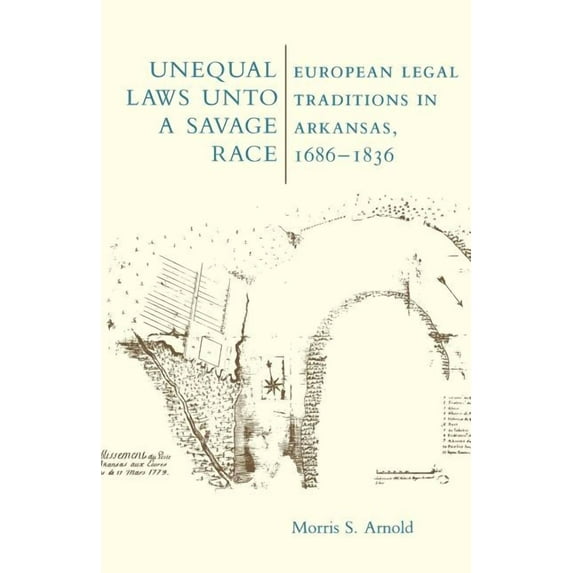
Unequal Laws Unto a Savage Race : European Legal Traditions in Arkansas, 1686-1836 (Paperback)
Key item features
Partly because its colonial settlements were tiny, remote, and inconsequential, the early history of Arkansas has been almost entirely neglected. Even Arkansas Post, the principal eighteenth-century settlement, served mainly as a temporary place of residence for trappers and voyageurs. It was also an entrepot for travelers on the Mississippi—a place to be while on the way elsewhere. Only a very few inhabitants, true agricultural settlers, ever established themselves a or around the Post.
For most of the eighteenth century, Arkansas’s non-Indian population was less than one hundred, and never much exceeded five or six hundred. Its European residents of that era, mostly French, have left virtually no physical trace: the oldest buildings and the oldest marked graves in the state date from the 1820s. Drawing on original French and Spanish archival sources, Morris Arnold chronicles for the first time the legal institutions of colonial Arkansas, the attitude of its population towards European legal ideas as were current in Arkansas when Louisiana was transferred to the United States in 1803. Because he views the clash of legal traditions in the upper reaches of the Jefferson’s Louisiana as part of a more general cultural conflict, Arnold closely examines the social and economic characteristics of Arkansas’s early residents in order to explain why, following the American takeover, the common law was introduced into Arkansas with such relative ease.
Specs
- Book formatPaperback
- Fiction/nonfictionNon-Fiction
- GenreHistory
- Pub date1985-06-01
- Pages266
- Reading levelProfessional and Scholarly
 Free 90-day returns
How do you want your item?


More seller options (2)

Get free delivery, shipping and more*
About this item
Product details
Partly because its colonial settlements were tiny, remote, and inconsequential, the early history of Arkansas has been almost entirely neglected. Even Arkansas Post, the principal eighteenth-century settlement, served mainly as a temporary place of residence for trappers and voyageurs. It was also an entrepot for travelers on the Mississippi--a place to be while on the way elsewhere. Only a very few inhabitants, true agricultural settlers, ever established themselves a or around the Post.
For most of the eighteenth century, Arkansas's non-Indian population was less than one hundred, and never much exceeded five or six hundred. Its European residents of that era, mostly French, have left virtually no physical trace: the oldest buildings and the oldest marked graves in the state date from the 1820s. Drawing on original French and Spanish archival sources, Morris Arnold chronicles for the first time the legal institutions of colonial Arkansas, the attitude of its population towards European legal ideas as were current in Arkansas when Louisiana was transferred to the United States in 1803. Because he views the clash of legal traditions in the upper reaches of the Jefferson's Louisiana as part of a more general cultural conflict, Arnold closely examines the social and economic characteristics of Arkansas's early residents in order to explain why, following the American takeover, the common law was introduced into Arkansas with such relative ease.
Partly because its colonial settlements were tiny, remote, and inconsequential, the early history of Arkansas has been almost entirely neglected. Even Arkansas Post, the principal eighteenth-century settlement, served mainly as a temporary place of residence for trappers and voyageurs. It was also an entrepot for travelers on the Mississippi—a place to be while on the way elsewhere. Only a very few inhabitants, true agricultural settlers, ever established themselves a or around the Post.
For most of the eighteenth century, Arkansas’s non-Indian population was less than one hundred, and never much exceeded five or six hundred. Its European residents of that era, mostly French, have left virtually no physical trace: the oldest buildings and the oldest marked graves in the state date from the 1820s. Drawing on original French and Spanish archival sources, Morris Arnold chronicles for the first time the legal institutions of colonial Arkansas, the attitude of its population towards European legal ideas as were current in Arkansas when Louisiana was transferred to the United States in 1803. Because he views the clash of legal traditions in the upper reaches of the Jefferson’s Louisiana as part of a more general cultural conflict, Arnold closely examines the social and economic characteristics of Arkansas’s early residents in order to explain why, following the American takeover, the common law was introduced into Arkansas with such relative ease.
Specifications
Book format
Fiction/nonfiction
Genre
Pub date
Warranty
Warranty information
Similar items you might like
Based on what customers bought
Studies in Critical Social Sciences Criminalization: Politics and Policies, (Paperback) $24.39
 $2439current price $24.39
Studies in Critical Social Sciences Criminalization: Politics and Policies, (Paperback)
The Real Charlie Kirk, (Paperback) $13.77 Was $16.19
 $1377current price $13.77, Was $16.19$16.19
The Real Charlie Kirk, (Paperback)
15 out of 5 Stars. 1 reviewsAn Indigenous Voice to Parliament: Considering a Constitutional Bridge - Third Edition, (Paperback) $19.99
 $1999current price $19.99
An Indigenous Voice to Parliament: Considering a Constitutional Bridge - Third Edition, (Paperback)
New Destination Dreaming: Immigration, Race, and Legal Status in the Rural American South, (Paperback) $18.00
 $1800current price $18.00
New Destination Dreaming: Immigration, Race, and Legal Status in the Rural American South, (Paperback)
An Account of the Present Deplorable State of the Ecclesiastical Courts of Record; With Proposals Fo (Paperback) $17.75
 $1775current price $17.75
An Account of the Present Deplorable State of the Ecclesiastical Courts of Record; With Proposals Fo (Paperback)
Compilation of the Laws of Louisiana Now in Force for the Organization and Support of a System of Public Education: Vol., (Paperback) $18.90
 $1890current price $18.90
Compilation of the Laws of Louisiana Now in Force for the Organization and Support of a System of Public Education: Vol., (Paperback)
The Great Vanishing ACT: Blood Quantum and the Future of Native Nations, (Paperback) $20.69
 $2069current price $20.69
The Great Vanishing ACT: Blood Quantum and the Future of Native Nations, (Paperback)
Hybrid Constitutions: Challenging Legacies of Law, Privilege, and Culture in Colonial America, (Paperback) $18.71
 $1871current price $18.71
Hybrid Constitutions: Challenging Legacies of Law, Privilege, and Culture in Colonial America, (Paperback)
Beiträge zum preußischen Rechte für Studierende und Referendare (Paperback) $23.29
 $2329current price $23.29
Beiträge zum preußischen Rechte für Studierende und Referendare (Paperback)
de l'Élevage Du Cheval, Des Courses Et de l'Amélioration Des Races Chevalines En France (Paperback) $17.81
 $1781current price $17.81
de l'Élevage Du Cheval, Des Courses Et de l'Amélioration Des Races Chevalines En France (Paperback)
Documents of Freedom Boxed Set (Books of American Wisdom), (Paperback) $11.99
 $1199current price $11.99
Documents of Freedom Boxed Set (Books of American Wisdom), (Paperback)
Opposing the Crusader State: Alternatives to Global Interventionism, (Paperback) $15.65
 $1565current price $15.65
Opposing the Crusader State: Alternatives to Global Interventionism, (Paperback)
Sociology of Race and Ethnicity The Bricks Before Brown: The Chinese American, Native American, and Mexican Americans' Struggle for Educational Equ, (Paperback) $20.30
 $2030current price $20.30
Sociology of Race and Ethnicity The Bricks Before Brown: The Chinese American, Native American, and Mexican Americans' Struggle for Educational Equ, (Paperback)
The Horrors Of The Negro Slavery Existing In Our West Indian Islands,, (Paperback) $13.95
 $1395current price $13.95
The Horrors Of The Negro Slavery Existing In Our West Indian Islands,, (Paperback)
Argument on Behalf of the American Tract Society in the Matter of the Legacies Fo Luman Pease and Elnathan Jones (Paperback) $19.75
 $1975current price $19.75
Argument on Behalf of the American Tract Society in the Matter of the Legacies Fo Luman Pease and Elnathan Jones (Paperback)
The American Churches the Bulwarks of American Slavery: Third American Edition, (Paperback) $16.90
 $1690current price $16.90
The American Churches the Bulwarks of American Slavery: Third American Edition, (Paperback)
Indigenous Education American Indians, the Irish, and Government Schooling: A Comparative Study, (Paperback) $16.80
 $1680current price $16.80
Indigenous Education American Indians, the Irish, and Government Schooling: A Comparative Study, (Paperback)
Political Sociology: The Human Rights Enterprise (Paperback) $18.94
 $1894current price $18.94
Political Sociology: The Human Rights Enterprise (Paperback)


Customer ratings & reviews

Related pages
- Governors Indiana
- Ohio Politicians
- Tn) Lee University (cleveland
- Georgia Revolution
- Pennsylvania State Agent
- History Detroit
- Presidents & Heads of State Biographies & Memoirs
- Western State & Local United States History Books
- Southern State & Local United States History Books
- Presidents & First Families Teen & Young Adult Books
- Southwest State & Local United States History Books
- Midwest State & Local United States History Books